
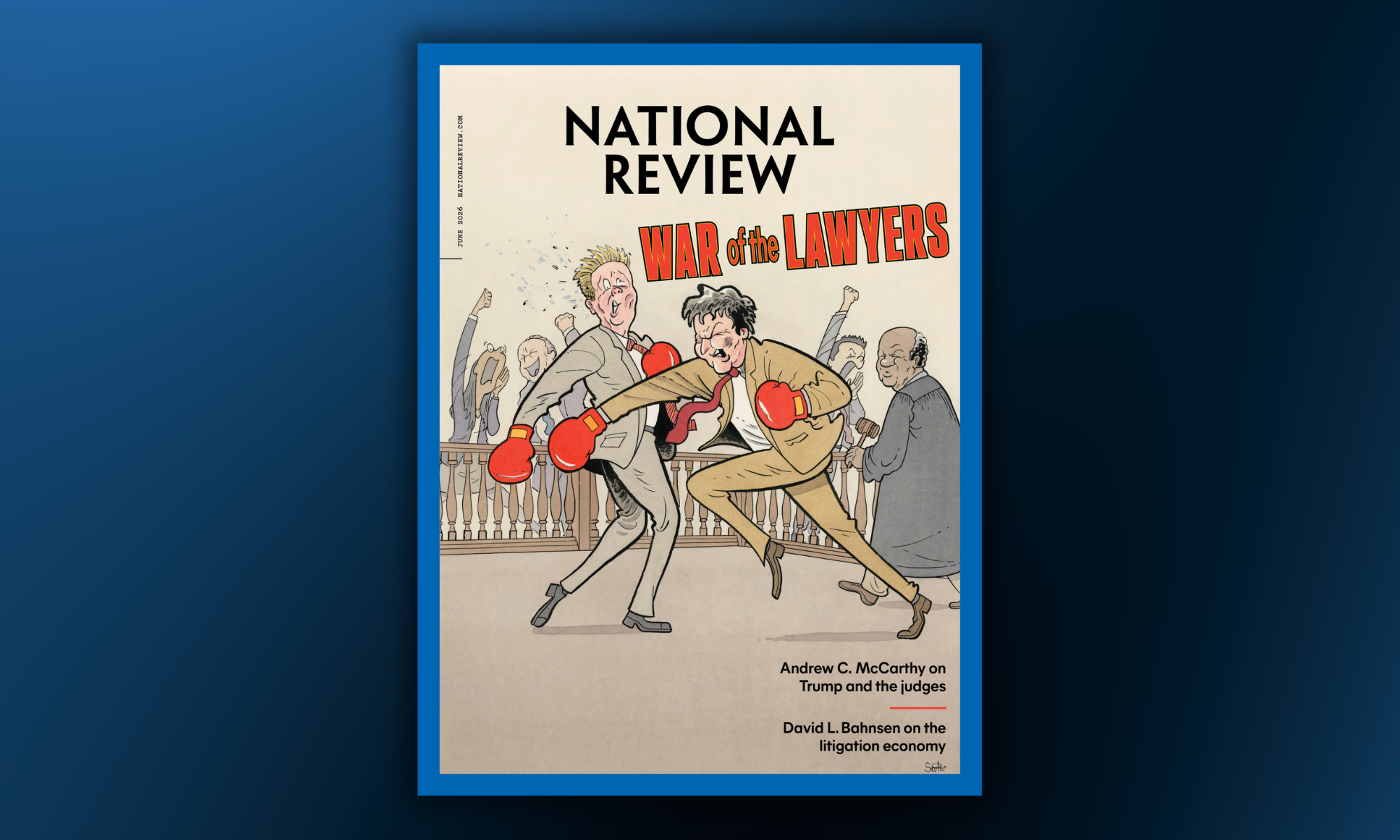
Hamlet, the depressed prince, is in the graveyard, looking at a dug-up skull: “Why may not that be the skull of a lawyer? Where be his quiddities now, his quillities, his cases, his tenures, and his tricks?”
In the new issue of National Review, we turn our attention to living lawyers and two vital matters concerning the law. Andrew McCarthy assesses the battle between the Trump administration and the courts: is the ongoing courtroom drama evidence of “judicial insurrection,” executive overreach, or both?
In “Trump’s Messy Courtroom Drama,” Andy writes:
Because Congress is indolent as well as paralyzed, it is increasingly left to the courts to rein in an overbearing executive. The president lashes out at the judiciary, but it is a form of transference. The rudimentary problem is that he isn’t popular, he lacks bipartisan congressional support, and, as a result, he can’t get his agenda enacted in a constitutional manner that would immunize it from much judicial interference.
And David Bahnsen, in “The Next Supply-Side Battle,” looks at the litigation economy, arguing that legal reform is necessary to ensure the nation’s economic well-being:
Today, the greatest threat to economic productivity is America’s noxious legal environment. Excessive legal costs, the prevalence of frivolous lawsuits, and the fear of legal action all massively impede pro-growth decision-making. Legal reform must become the next cause of the supply-side movement. Our economic well-being depends on it.
Elsewhere in the issue, James Kirchick, in “Blaming the Jews, Again,” writes about the continuities — and discontinuities — between Pat Buchanan’s dual-loyalty charges and those of Joe Kent, who recently left the administration to launch a similarly ugly campaign. The striking difference? “When Buchanan made his accusations, . . . he found very few allies on the left. Today, many prominent progressives have been receptive to Kent’s message, which they point to as yet further confirmation of Israel’s pernicious hold on the United States.”
In the latest installment of Our Spacious Skies, the magazine’s monthly love letter to America, Andrew Stuttaford motors west on Route 66. Yes, he gets his kicks, and you will too, vicariously; if we dare declare OSS a genre unto itself, then this piece is a classic of it.
There’s much more:
- Brian Stewart on the future of Lebanon
- Audrey Fahlberg on the filibuster’s future
- Two views on one year of Trump’s tariffs, from Matthew Lynn (pro) and Alfredo Carrillo Obregon (con)
- Daniel Buck on what happens when conservatives win school boards
- Patrick Brown on what can be done about falling birth rates
- John Puri on all the president’s mergers
In Books, Arts & Manners, we’re immensely excited to present an excerpt from acclaimed author Mark Helprin’s new novel, Elegy in Blue. A taste: “I know one is not supposed to speak ill of the dead, especially when one is the one who has killed him. But wait.”
Also in BAM, the legal theme returns in a trio of book reviews: Eric Tung on the second volume of James Rosen’s Scalia biography; Andy McCarthy on Randy Barnett’s memoir; and Michael M. Rosen on Sarah Isgur’s Supreme Court portrait. In his movie review, Ross Douthat sees one big problem with the big (and long) hit movie Project Hail Mary. Yours truly rounds out the issue with a somewhat un-Happy Warrior about trees loved, lopped, and lost.
If you aren’t already a subscriber, your next move should be obvious.






Comments