
The Export-Import Bank isn’t allowed to lend money to customers in certain countries, such as North Korea, Libya, and Iran. Russia, recently praised by Hilary Clinton for its “long history” of working with the Export-Import Bank, got the axe last year and is now cut off from buying discounted Boeing jets.
But in order to know whether the bank is actually complying with these restrictions and limitations, we need to be able to check its data, right? Unfortunately, as I have mentioned before, the bank’s data, when available, is a mess. So much of it is labeled “unknown” and “various countries” that it’s hard to use for proper oversight.
The following chart displays the top foreign buyers of exports financed by Ex-Im from 2007 to 2013. (We had to use the old dataset that used to be on Data.Gov but then was one day mysteriously removed and later replaced with an abridged dataset that didn’t list critical fields such as the “Primary Buyer.”)
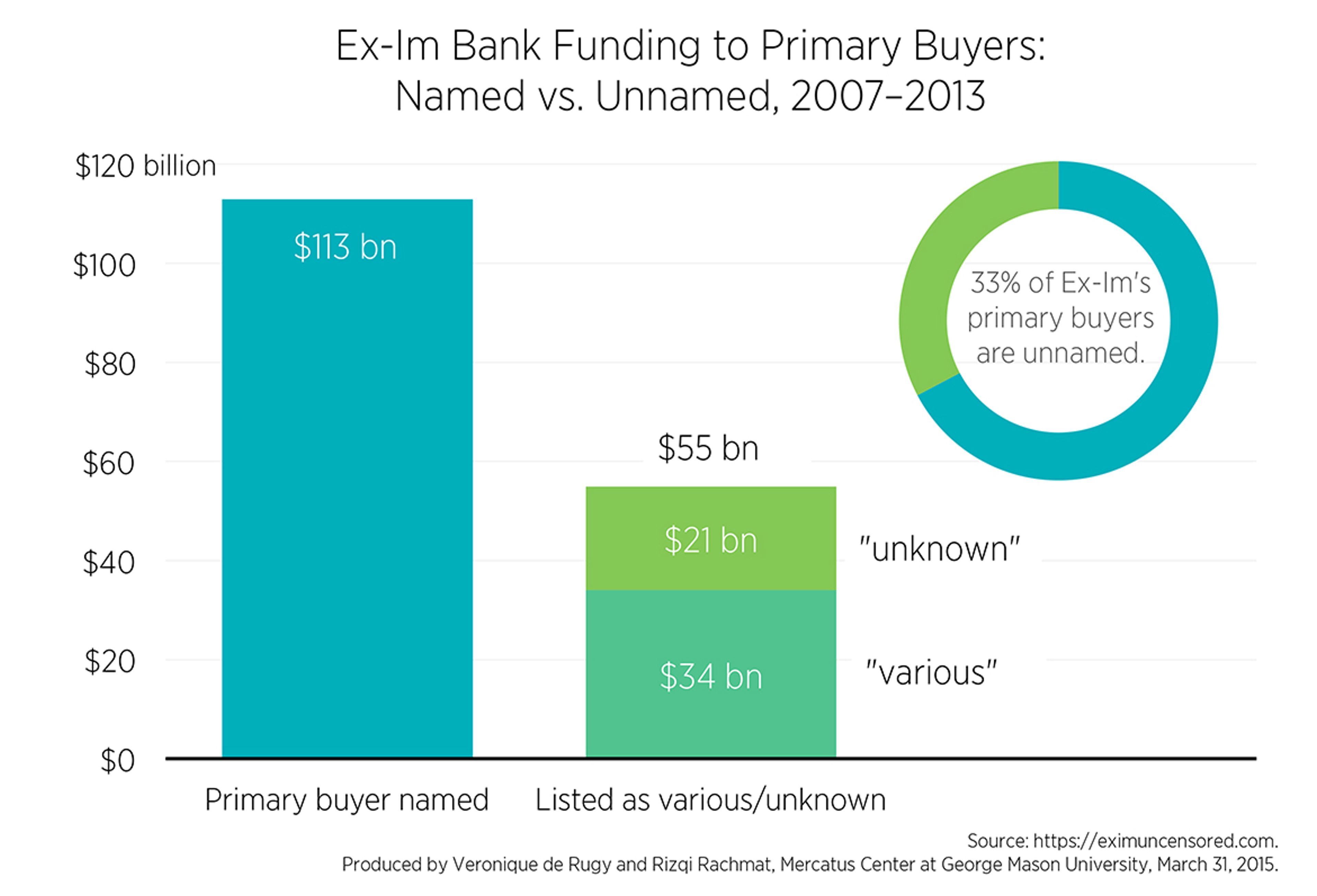
This chart shows the total dollar amount of deals financed by Ex-Im in which the Primary Buyer is marked as “unknown” or “various” in data made available to the public — 33 percent of buyers by dollar value aren’t named.
How do we know that some Ex-Im loans didn’t go to companies in restricted countries if we don’t know which companies are getting loans? In most cases, the dataset shows the name of a country associated with the unknown deal. But how can we be sure that it is actually accurate without the name of the company? I would like to trust the bank, but it’s hard to in light of how it’s intentionally mislabeled its data to make it look as if more lending was going to benefit small businesses than was, has employees being investigated for taking bribes in exchange for loans, and indulged in cronyist collusion with top corporate executives ( by sking for input on policies bank policies that could benefit their firms. Even without Ex-Im’s past missteps, it’s hard to see why we should trust them when they won’t just release accurate data.






Comments