
The Heritage Foundation’s Diane Katz and I have a new paper looking at an overlooked aspect of the Export-Import Bank activities: Who are the foreign buyers that are getting the subsidized loans?
In the paper we find that the bank’s top foreign buyers, who are getting an advantage over unsubsidized American businesses, are large, often state-owned, corporations. The bank’s overwhelming focus on very large corporations belies its claim that small businesses are at the “core” of its business model. (We already knew that from looking at the top beneficiaries on the U.S. side, of course.)
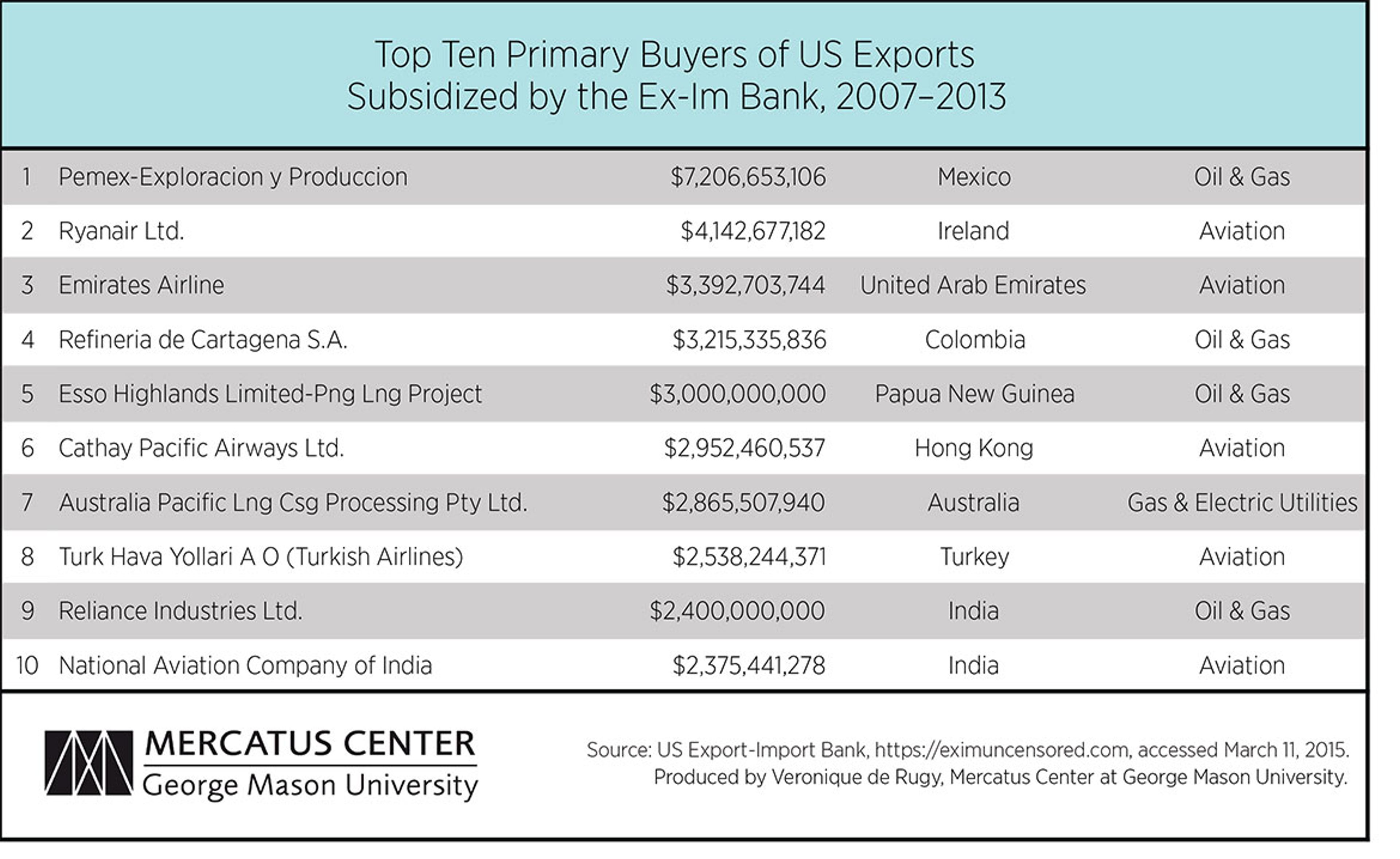
Here is a table with the top ten foreign beneficiaries:
In our paper we note highlight the following points:
- Among the top-ten Ex-Im financed buyers, five are state-controlled companies, such as Mexico’s Pemex. They’re getting millions in subsidies from their own government over and above what they get from Ex-Im, providing a large competitive advantage over unsubsidized American firms.
- Five of the top ten are involved in oil-and-gas development — a business that’s already subsidized the world over (although here in the U.S., the federal government also piles regulations on it).
- The other five are airlines that collectively have received more than $15 billion in subsidies over the last seven years solely to purchase products from Boeing.
- The amount of Ex-Im subsidies going to foreign airlines has tripled since 2008, damaging low-cost American carriers in the process.
Pemex, the biggest Ex-Im beneficiary on this list, has a market cap of $416 billion but somehow really needs more than $7 billion in U.S.-taxpayer-backed financing to facilitate deals with American exporters.How do President Obama and Democratsdefend doing this while they vilify the oil-and-gas industry at home and spend billions of dollars promoting green energy? Who knows.
A number of these subsidized foreign companies end up competing with American businesses: Emirates Airline and other airlines get cheap loans to buy Boeings while domestic airlines such as Delta have to pay full price.
The House Oversight Committee held a hearing this Wednesday about Ex-Im, have to admit that it was actually quite amusing to watch Fred Hochberg, the president of the Ex-Im Bank, do his very best to defend this bizarre situation (you can watch the whole thing here). He tried to defend Ex-Im by saying it’s that the banks are lending the actual money, as if that changes the fact that it’s Ex-Im’s involvement that allows the loans to be made at such favorable interest rates.
Hochberg also tried to fall back on the tired argument that without Ex-Im exporters would lack for financing. That’s hard to believe in light of these facts:
- Over 98 percent of U.S. exports take place without any Ex-Im backing.
- Many of Ex-Im’s airline customers buy other planes without loans, which shows that they can get access to capital, too, without Ex-Im backing.
- Today, only 10 percent of Boeing planes are purchased with an Ex-Im guarantee. S&P issued a report last summer finding that the capital market would be able to provide sufficient financing for customers that want Boeings.
- Only 16 percent of Ex-Im activities even bother to claim that they’re necessary because of a lack of capital.
- The fact that the capital market doesn’t extend a loan to everyone who wants it is a feature of the capital market, not a bug. Not every project is worth the risk.
Ex-Im Exposed has more on separating fact from fiction in Hochberg’s testimony, and our paper is here.






Comments