
Last week, I mentioned a German study that found that exporters who received export-credit guarantees had higher exports, sales, and employment than similar industries and firms who didn’t. Nothing surprising there, since the point of export support is for the government to choose a few winners and prop up their business. But the study seemed to conclude that based on this result export subsidies were a net positive — a dubious suggestion, since it didn’t take into account any of the costs.
Well, over at the Wall Street Journal’s Think Tank blog, economist Salim Furth of the Heritage Foundation digs into the studies’ methodology and concludes that the approach used by the German researchers suffers from one major flaw: “It cannot say anything about whether the subsidies should exist; merely that if they do exist, it is better to receive them.” He explains:
Extensive academic literature shows that the case for export subsidies breaks down once complexity is accounted for. One important insight of that literature is that, like many government programs, Ex-Im has concentrated benefits and diffuse costs.
Imagine a mandatory lottery that took $1 from 300 million Americans, spent $50 million on administrative costs, and split the rest between 10 lucky winners. If you measure the wealth of the winners against a control group of other citizens, the program looks like a big success. But we know that it didn’t raise national income.
It’s not too hard to see who the winners are in the U.S., since they have a big incentive to invest money in defending the program. But it’s harder to identify the losers, who may not even know they’re losers. That’s the case with most redistributive government programs.
Furth adds:
In the case of Ex-Im, the costs are much more than the collateral taxpayers put up to fund subsidies. Most of the cost is realized through distortion, lower productivity, monopolies, and trade disadvantages. For Americans, that means fewer jobs and lower wages. But here, too, the control group is not outside the experiment.
There are perhaps some lessons to be drawn from the German experience: Firms that received subsidies were smaller and less efficient; subsidies aimed at middle-income countries were most effective; and large losses are possible, as Germany discovered in the 1980s and 1990s.
Indeed, Ex-Im creates a lot of distortions into the capital market. Lenders are likely to shift resources toward subsidized projects and away from non-subsidized ones, independently on the merits of the projects, and the subsidy may artificially boost the demand for particular good above ordinary market levels.
As Furth concludes that, to his knowledge,
No one has made an intellectually serious case for renewing the charter of the Export-Import Bank. Most arguments in favor rely on stating the benefits without acknowledging the costs. Most economists who have studied both the costs and the benefits concluded that the costs are larger than the benefits. Renewing Ex-Im will prevent job creation and hold down wage growth.
But, while it’s hard to determine the losers, it’s not impossible.
Dan Ikenson of the Cato Institute has done a good job trying to point to some of them in a new study and to highlight the direct costs to these firm or industries. His findings obviously under-estimate the actual cost of Ex-Im, since they ignore other costs that flow from distortions in investment and other choices as a consequence of Ex-Im’s actions, but it’s very useful nonetheless. Here is a chart that summarizes his findings:
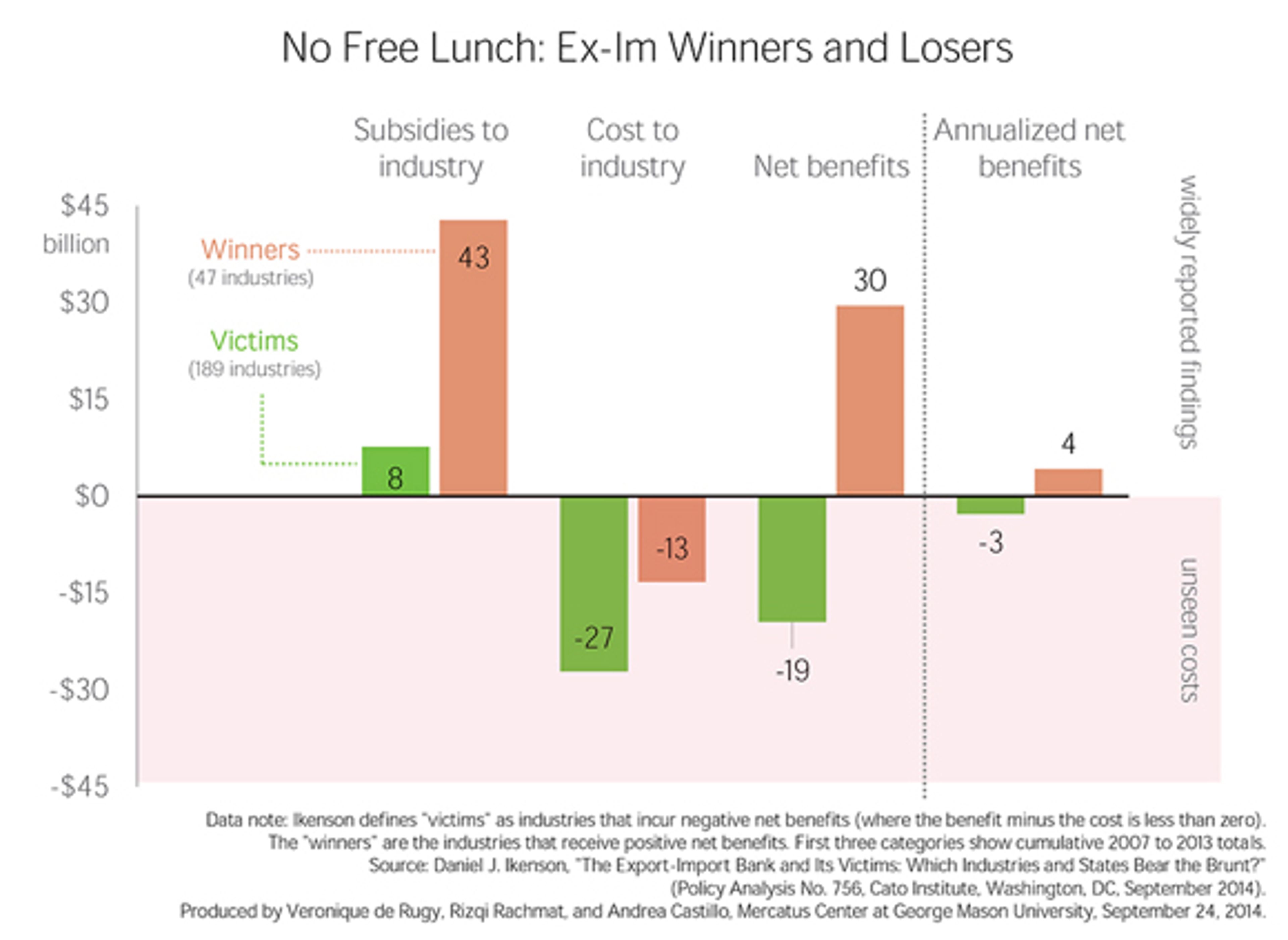
The results of Ikenson’s analysis: Ex-Im imposes net downstream costs on far more industries than it benefits. Each year, the 189 victim industries of Ex-Im incur costs of roughly $2.8 billion because of distorting industry subsidies. The 47 winner industries, on the other hand, enjoy net benefits of roughly $4.2 billion each year.
The chart and study show that Ex-Im is far from a free lunch. Its subsidies impose billions in downstream costs on hundreds of industries each year, even before we start looking at the other effects. The study did not consider the costs imposed on domestic manufacturers who compete with Ex-Im–subsidized domestic exporters, nor does it consider what alternative opportunities might have been otherwise viable in the absence of subsidies. If these indirect costs are factored in, the total true costs of Ex-Im subsidies would be even greater, and likely outweigh its benefits.
Proper debate on trade policy will consider the benefits and the costs of Ex-Im before attempting to claim that it’s a good deal for all Americans. This chart shows that the costs of Ex-Im are substantial, a point that has not been fully acknowledged throughout the debate.




Comments