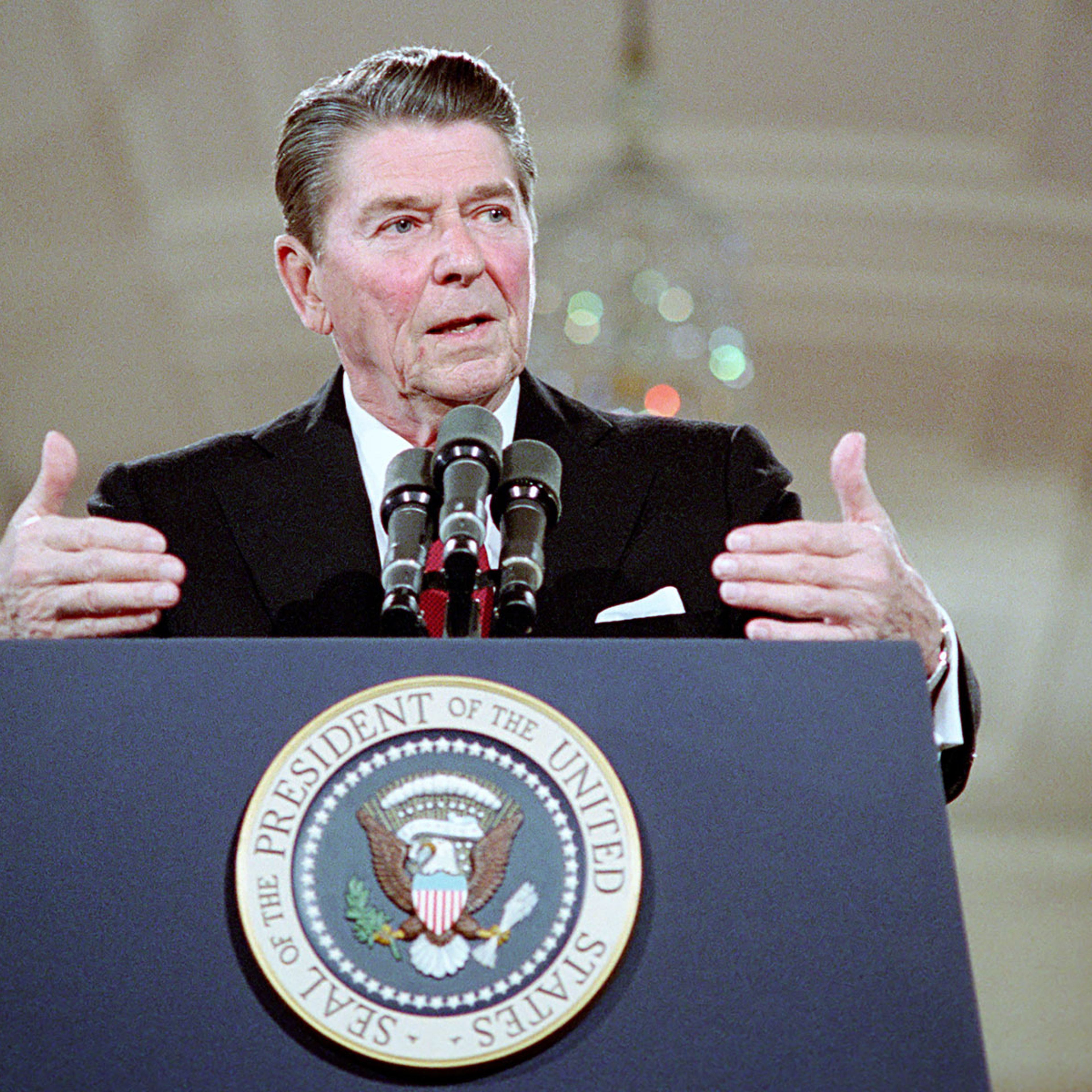
Report card: Stuart Eizenstat, Jimmy Carter’s domestic-policy advisor, says “Reagan’s tenure has strengthened the prestige of the office [of President].” . . . Carter biographer Betty Glad believes Reagan “will be seen as a remarkable President. He showed that the Presidency could be used to shape the national agenda.” . . . Historian James MacGregor Burns: “Reagan will be remembered for making the Republican Party into a coherent, pragmatic, ideologically conservative party.” . . . Historian Arthur Schlesinger Jr., a JFK White House aide, says Reagan’s successes “have restored a certain amount of confidence to the Presidency.” . . . Scholar emeritus James Sundquist of Brookings: “We were headed in the direction of the welfare state, and all Republicans could do before was to slow the trend. Reagan halted it.” . . . Washington Post columnist David Broder faults Reagan for his civil-rights record (“He was deaf to calls for justice”), but praises him for shifting the initiative and responsibility for domestic programs out of Washington and back to the states and cities. . . . Mary McGrory’s knife remained unsheathed to the end: “In his eight years of office, he has taken actions that suggest that if he is not a bigot, he might as well have been one as far as blacks were concerned.” . . . Former UN Ambassador Jeane Kirkpatrick put her finger on reason for media hostility to Reagan: “Most commentators resent Reagan’s unflappable calm, unshakable optimism, irrepressible good humor, and his stubborn failure to understand that he was never up to the job.”
In 1981, when Reagan took office, a Gallup satisfied/dissatisfied poll indicated 78 per cent of Americans dissatisfied with the way things were going; Reagan leaves office with a 58 per cent satisfied count. . . . New York Times poll Inauguration week gives Reagan a 68 per cent favorable exit rating, the highest for any President since FDR, who died in office. . . . Incidental intelligence: Reagan contributed only 78 of the 2,408 vetoes run up by the first forty U.S. Presidents. FDR was all-time veto king with 635, followed by Grover Cleveland with 414. George Washington vetoed only two measures, and his two immediate successors, John Adams and Thomas Jefferson, vetoed none. More recent presidential veto counts: JFK 21; LBJ 30; Nixon 43; Ford 66 (in three years); Carter thirty-one.



Comments