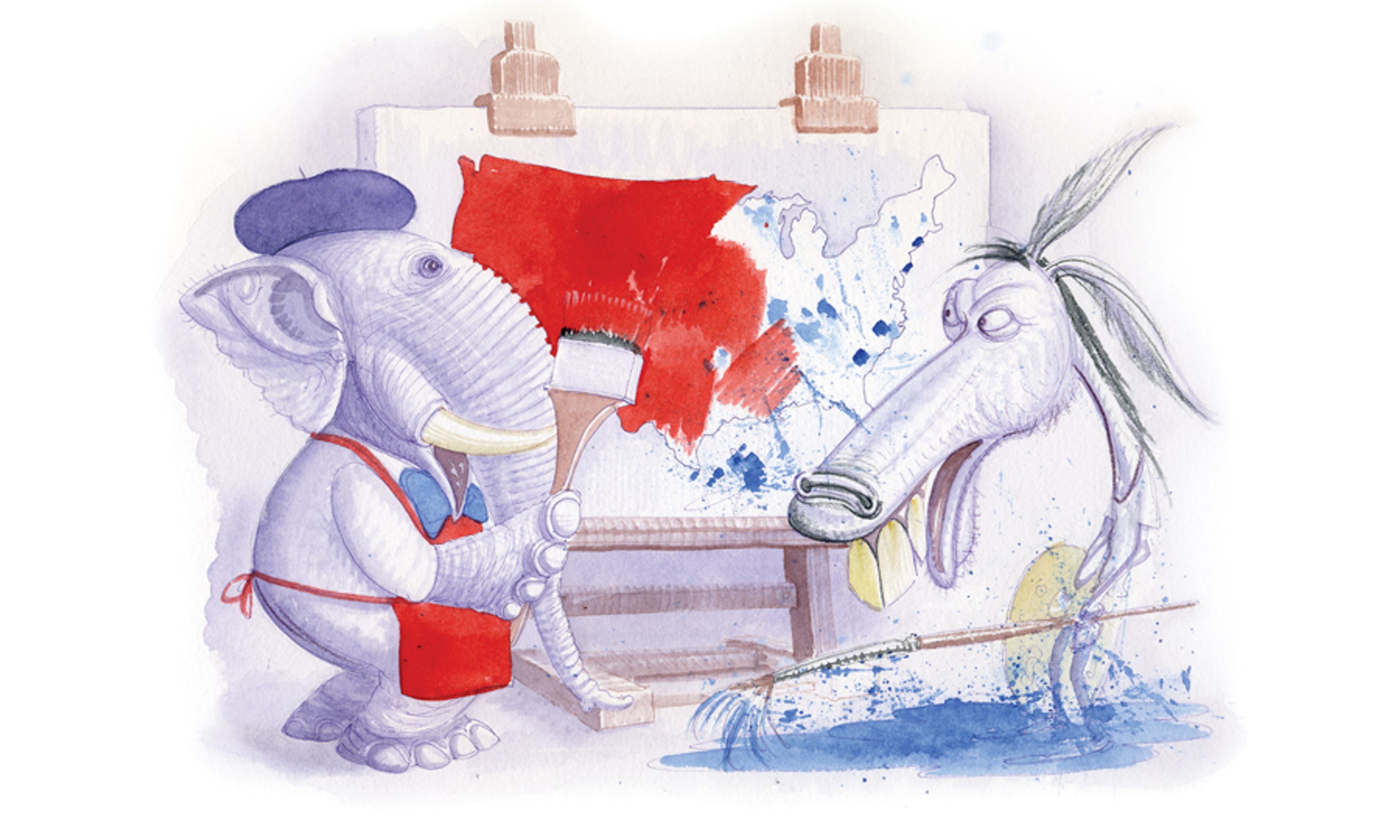
Many Democrats and liberal-progressive pundits are obsessed these days with the idea that they are being robbed of victories by the structure of the American electoral process. One element of this complaint is the charge that the Republican dominance of the House of Representatives is due to partisan gerrymandering. Former attorney general Eric Holder has pledged to dedicate himself to attacking gerrymandering, and former president Barack Obama has likewise indicated that he will make it a major cause of his post-presidency, the most directly partisan focus of any former president in living memory. A November court decision striking down Wisconsin’s state-assembly districts, solely on grounds that they unduly favor Republicans, represents a renewed legal assault on the practice, despite the Supreme Court’s skepticism over the past 30 years that the courts have any principled and workable way to referee purely partisan district-drawing fights.
Gerrymandering is no novelty; it’s as old as American democracy itself. The practice is named for Elbridge Gerry, who signed the Declaration of Independence, was a delegate to the Constitutional Convention, served in the first Congress, helped write the Bill of Rights, and was our fifth vice president (under James Madison). To anyone over the age of 40 (including Obama and Holder), a sudden Democratic enthusiasm for stopping gerrymanders reeks of hypocrisy and partisan opportunism. Democrats dominated the House of Representatives for four uninterrupted decades from 1954 to 1994, and they did so with the considerable help of partisan gerrymanders, abetted by entrenched Democratic control of many state legislatures. A number of states in the South, in particular, had continuously Democratic-run state legislatures from the end of Reconstruction into the 21st century. One of the first big gerrymandering controversies of the current era was a 2003 effort by Texas Republicans, after capturing control of the state legislature for the first time in 130 years, to replace a lopsided 1991 Democratic gerrymander. Democratic legislators fled the state in an effort to prevent its legislature from revising the 1991 map.











Comments