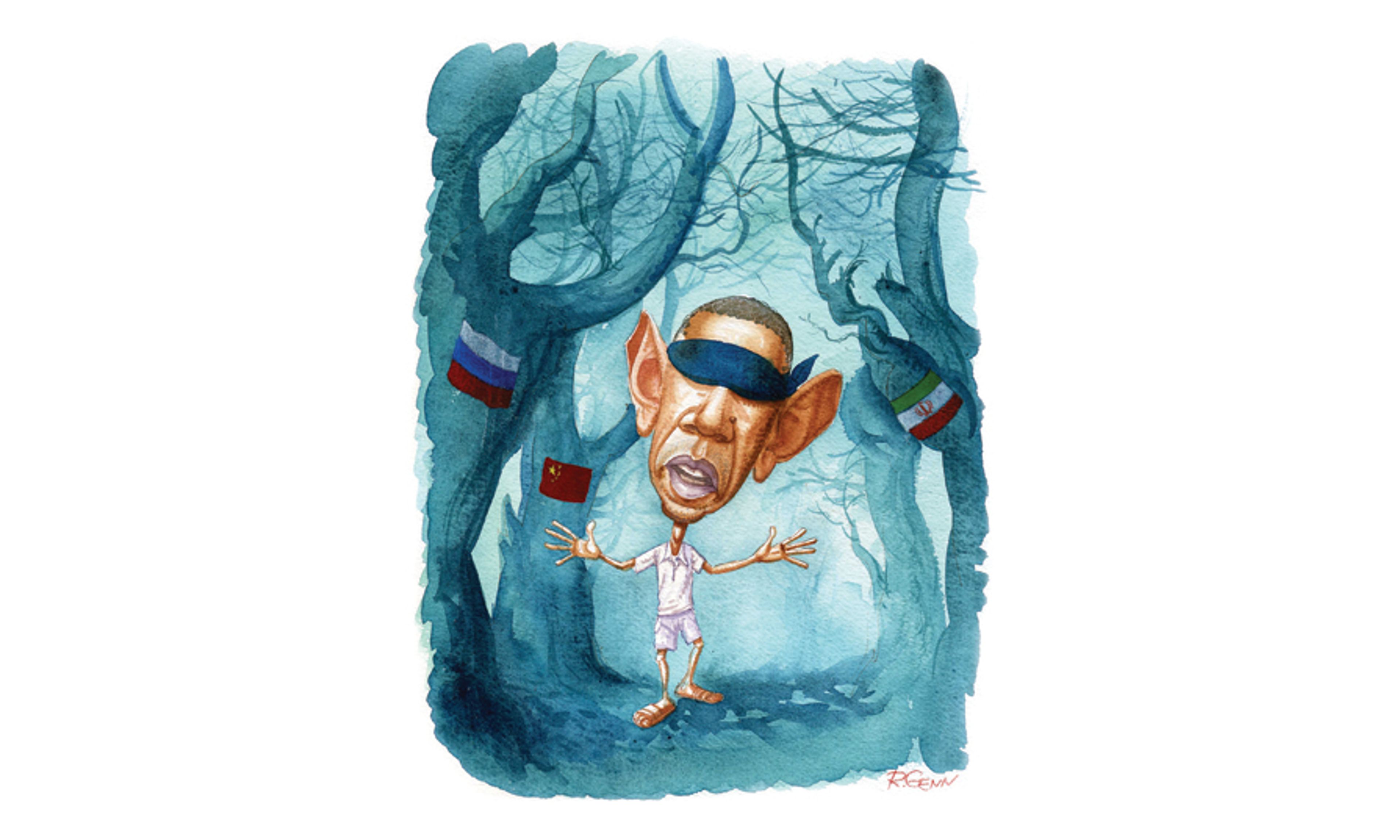
American foreign policy today is in disarray. Faced with three major challenges to Western democracy — a restive Russia, an economically ascendant China, and Islamic extremism emanating from a strife-torn Middle East — President Obama has struggled to formulate a coherent strategy. His September 28 address to the United Nations General Assembly summed up the conceptual confusion that has bedeviled his presidency. He spent most of his speech scolding Iran, Russia, and China for their various transgressions. But he concluded by saying he was “prepared to work with any nation, including Russia and Iran, to resolve the conflict” in Syria.
Obama admitted that he had left “a vacuum” in Libya by ensuring the fall of Moammar Qaddafi. But the president’s ideal outcome in Syria remains “a managed transition away from Assad.” In his U.N. speech, Obama alluded disdainfully to the “rule that applied for most of human history . . . that strong states must impose their will on weaker ones.” But his Russian counterpart, Vladimir Putin, is showing him that weak states can sometimes impose their will on stronger ones if they know the rudiments of strategy.










Comments