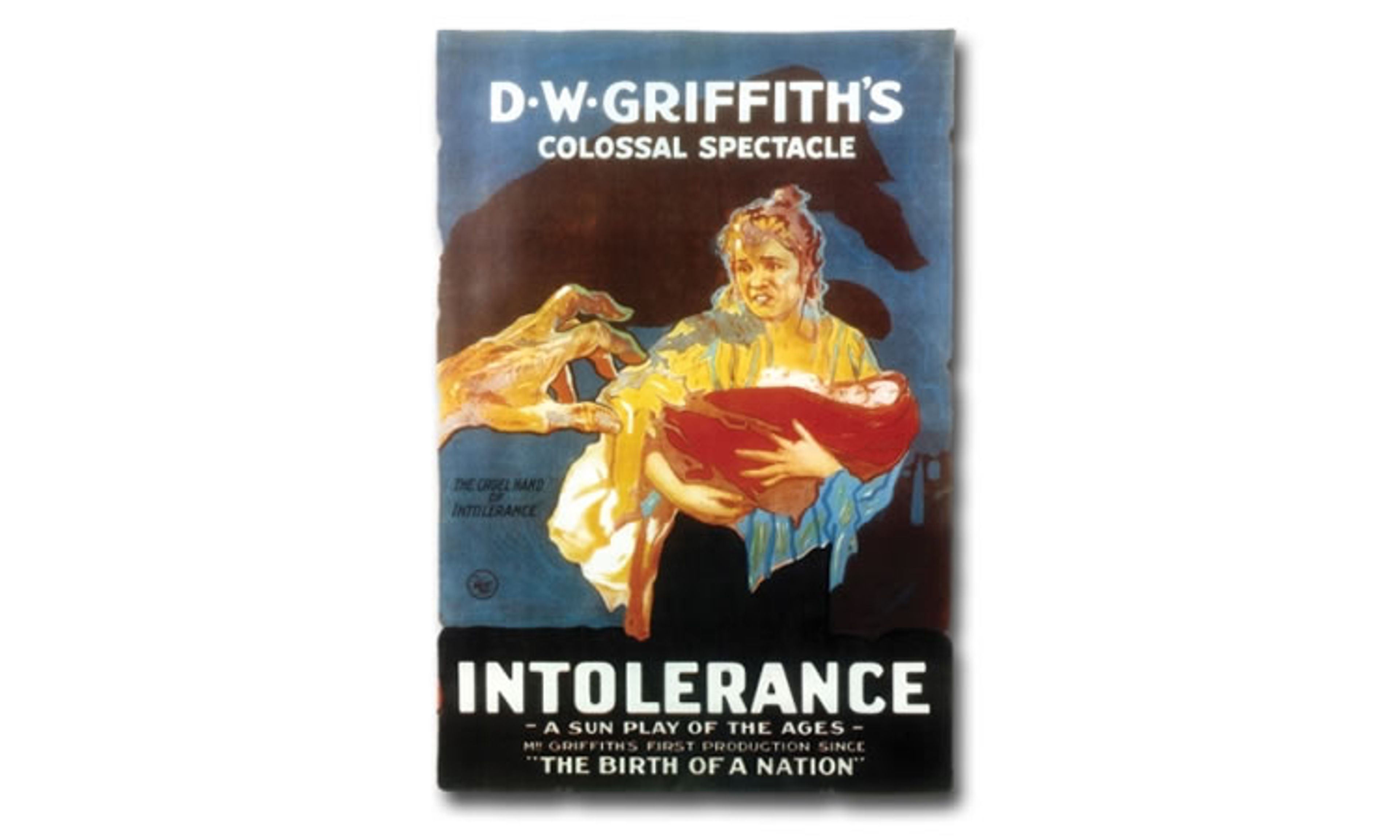
For many critics and scholars — myself among them — D. W. Griffith’s Intolerance is the greatest film ever made. A century later we are as close to its subject as we are distant from its art. Political specifics, moral arguments, and movie styles may look different today, yet the only real difference is Griffith’s still-daring ingenuity, which calls for a more open-minded reception than in our simplistic habits we are accustomed to: It calls for an optimistic, united popular audience, which Griffith took for granted.
When Intolerance premiered on September 5, 1916, its opening intertitles introduced silent-movie viewers to an extraordinary narrative device: “Our play is made up of four separate stories, laid in different periods of history, each with its own set of characters.” Employing a prologue and two acts, Griffith called it “a sun-play,” marked by florid melodramatics developed from Emersonian Transcendentalism, which film scholar Bill R. Scalia has described as “calling for an original American literature,” for “poets with the ability to ‘see’ past the material, apparent world to the world of eternal forms, which shaped nature in accordance with a divine moral imperative. Through this connection, man-as-poet would discover God in himself.”










Comments