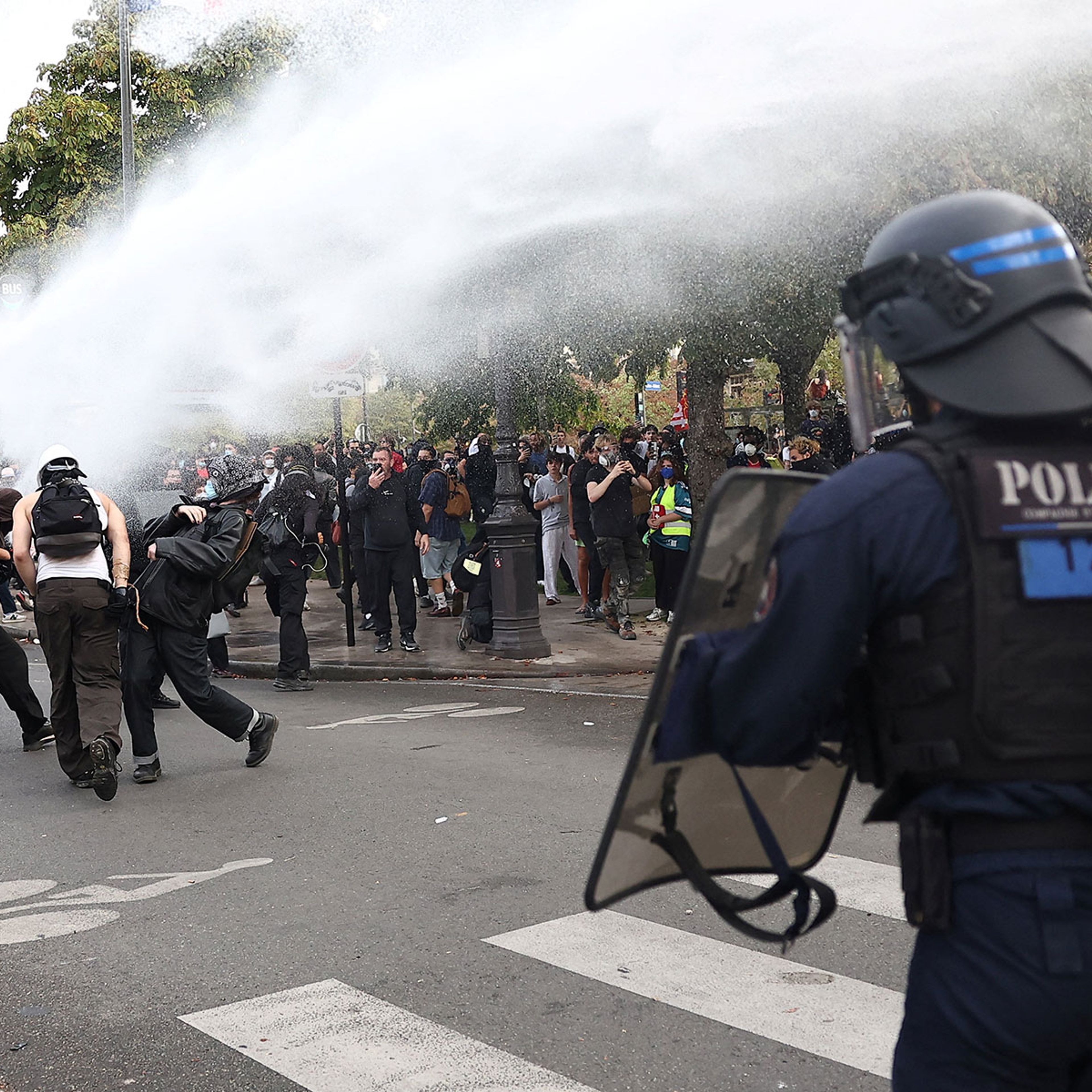
Los Angeles police stand accused of using excessive force to break up a May 1st immigration protest. Among those injured by the police were a number of journalists. LA Times:
One day after several reporters and camera operators were injured while covering an altercation at an immigrant rights rally in MacArthur Park, news organizations condemned the Los Angeles Police Department for its use of batons and riot guns against members of the media, and some said they were considering legal options.
“We are sorry for what happened to our employees and find it unacceptable that they would be abused in that way when they were doing their job,” said Alfredo Richard, spokesman for the Spanish-language network Telemundo, of the anchor and the reporter who were hurt during the evening rally.
Other members of the media who were injured included four employees of KVEA-TV Channel 52, a KTTV-TV Channel 11 news reporter who suffered a minor shoulder injury, a camerawoman who has a broken wrist and a reporter for KPCC-FM (89.3) who was bruised by a police baton.
“I was dumbfounded,” said the KPCC reporter, Patricia Nazario. “I’ve covered riots. I’ve covered chaos. I was never hit or struck or humiliated the way the LAPD violated me yesterday.”
However, after reading this eyewitness account of the protest, written by an LA Times reporter, I wonder if the police might have had trouble distinguishing who was an official journalist and who was a protester/citizen journalist. LA Times:
Most of the protesters and press stayed ahead of the advancing line by walking rapidly. One elderly homeless woman in red, who appeared distraught, was having a difficult time and protesters helped her. The officers moved forward in intervals of 40 feet or so, then stopped, then started forward again.
They repeated this pattern of walking and stopping several times, moving north, then west across the soccer field. On the north side of Wilshire, some people lingered right in front of the line, facing the officers at distances of between six and 20 feet, and letting officers close the distance between them.
The lingerers were a mix of protesters and reporters. Some were reporters from established news organizations watching or recording what police were doing, and some were self-styled grassroots reporters — protesters with cameras — some of whom were both filming officers closely and yelling challenges at them. At least three men in this mixed group lingered long enough to be caught by the advancing line of officers and they were batoned. They received one or two baton strokes each.
The arguments continued as police advanced. The challengers were resistant, but appeared nonviolent. They were mostly people who quarreled with individual officers while backing away from the advancing line. One man briefly laid down on his back in front of the police. The people throwing things, among them the plastic bottle lobber, appeared to be farther back in the retreating crowd.
As the chief spoke, with Assistant Chief Earl Paysinger at his side, at least 40 people surrounded him, with six or seven squatting on the ground in front to hear better. About half of the group appeared not to be official members of the press corps, but rather, protesters and self-appointed journalists affiliated with the protesters. When it came time to call out questions — often a competitive moment among reporters from competing news agencies — the protesters held their own.
And here’s coverage of the incident from the Oakland Tribune. This section stood out:
The department fielded 600 officers at the scene including 100 from its elite Metropolitan Division, considered to be among its most highly trained, who cleared the park. Bratton was sharply questioned by reporters on why top-trained officers wouldn’t know reporters had a right to be there. Andre Birotte, the department’s inspector general, said his office was trying to determine what exactly officers said to disperse the crowd and whether the order was in Spanish — the native language of most protesters. Several people, including about a dozen officers, were hurt in the clashes. About 10 people were taken to hospitals for treatment of injuries including cuts, authorities said. The injuries were not believed to be serious.
As we see from the eyewittness account, the people pretending to be reporters were the issue. As an example, take the case of Patricia Nazario, mentioned above. She’s a reporter for a FM radio station out in California. I would highly doubt she was walking around with a camera crew and unfortunately, to an police officer, she probably didn’t look any different than one of the protester/citizen journalists who were, by at least the eyewitness account, casuing trouble.
And I think the most enlightening aspect of all this is that Chief Bratton and MSM reporters, who are now accusing officers of using excessive force, lost their tempers at the protester/citizen journalists. From the LA Times eyewitness account:
As questioners peppered Bratton with demands for answers, some seemed more intent on expressing their own views than hearing Bratton’s and there was confusion about whether those speaking were paid by an established news organization or were self-appointed.
A large man in front of the chief to his right, who had been heckling with words of skepticism throughout the event, repeatedly asked in a loud voice whether the chief planned to appoint a civilian panel to investigate the incident. He interrupted reporters. Tempers flared. Dave Clark, a well-known broadcast journalist with KCAL 9 and CBS 2, admonished him to be quiet. “We are trying to work here!” Clark said.
At one point, Bratton also asked this man to be quiet. The press conference was being held for the benefit of the official media, he said. The man responded by insisting he was a “citizen journalist,” but then backed down, professing his respect for the chief.
More fallout surely to come from all of this.




Comments