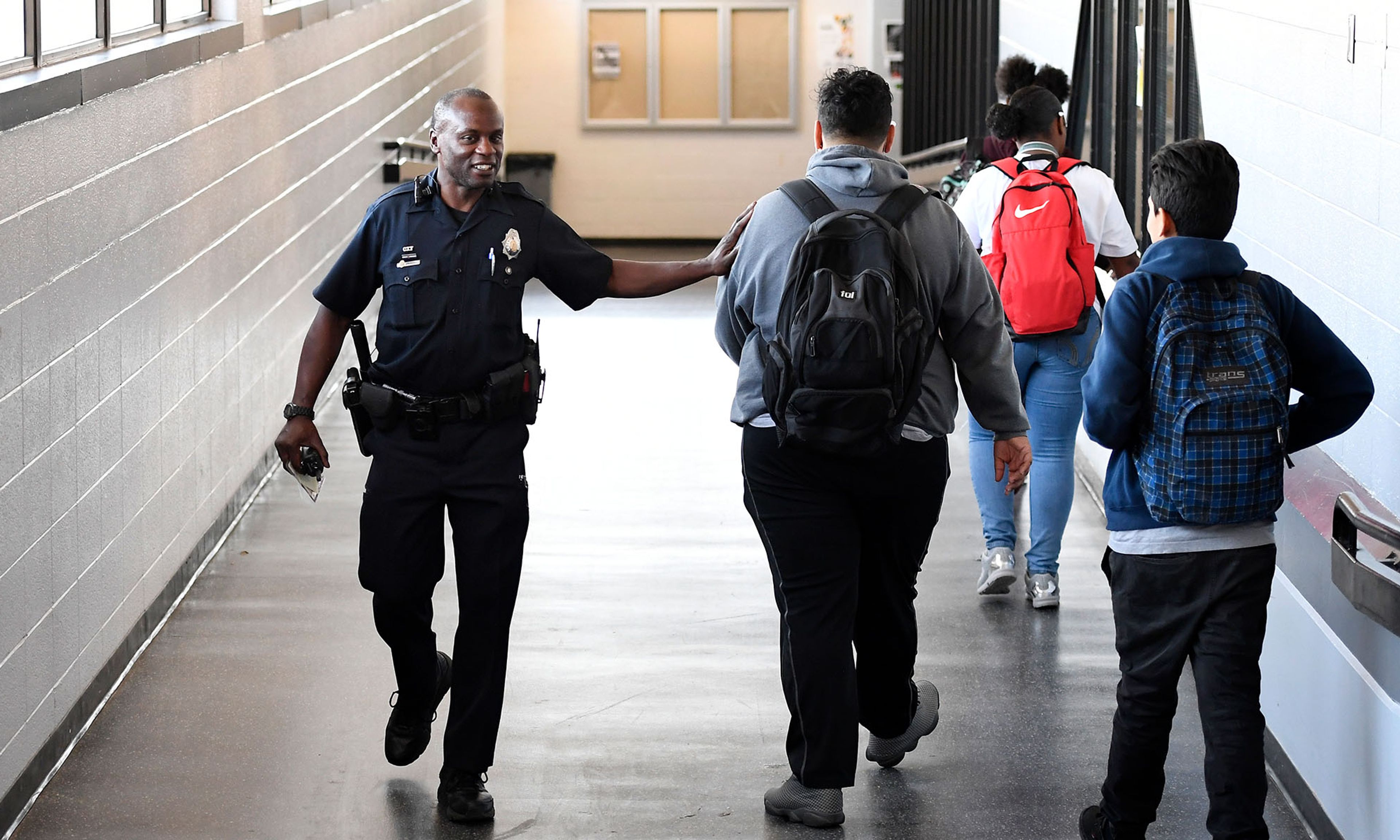
It was in the name of racial equity that the Denver school board voted unanimously in the summer of 2020 to remove police officers from the city’s public high schools.
Minority kids, board members argued, were disproportionally ticketed and arrested by the armed officers, who had worked in the local high schools for more than two decades.
Board member Auon’tai Anderson wrote that the move was about ending the “school to prison pipeline” and “dismantling a system that has held children of color down for far too long.”
Supporters said that seeing armed officers in school every day “messes with your psyche,” and that it is hard to develop a relationship with someone wearing a bulletproof vest.
Denver’s majority-minority school district was among a series of districts nationwide that cut ties with their local police in wake of the racial-justice riots that erupted after George Floyd’s killing in Minneapolis in 2020. There were better ways, they insisted, to make their schools safe.
But there were warnings in Denver that the plan to short-circuit racism in the schools by removing the police presence would not go as smoothly as supporters suggested.
Many school leaders were adamantly against the idea. Their concerns were ignored. “The public does not realize how many knives and guns and drugs [Denver police] and my department have recovered in the past several years,” one district safety officer warned, according to the Denverite news website.
Three years later, amid deteriorating safety conditions, district leaders are pushing to reintegrate police back into Denver schools. They’re following the lead of school district in places such as Phoenix, Ariz., and Alexandria, Va., which have already reinstated school-resource officers amid rising crime. Last month, Washington, D.C., leaders quietly backtracked on a plan to phase police officers out of all city schools by 2025.
But the debate in Denver has been particularly intense — opponents of reintegrating police into schools have suggested that it is dangerous, traumatic, and a form of white supremacy. The effort comes after a series of high-profile shootings and killings at or around local high schools.
Just this school year, there have been at least three shooting incidents at or around East High, one of the city’s oldest schools.
In September, two people were shot outside the school at a nearby rec center, including 14-year-old RJ Harding, who was shot in the mouth and survived. In February, 16-year-old soccer player Luis Garcia was shot in his car outside of the school. He later died. And in March, 17-year-old Austin Lyle shot two school administrators who were tasked with patting him down before he entered the school. The administrators survived. Lyle fled, and killed himself.
Lyle had previously been arrested and charged with illegally possessing an AR-15. He was one of at least 40 Denver high-school students who required a daily pat down to enter school, according to records gathered by local parent groups.
“I think the dangers have definitely increased,” Melissa Craven, a longtime Denver Public Schools safety leader and the mother of a high-school student, told National Review.
She supports reinstating school-resource officers, but believes the district’s biggest problem is its so-called discipline matrix, a document that directs how students are to be disciplined for a variety of offenses, including bringing weapons and drugs to school.
The board updated the matrix is October 2021, making it harder to expel students and placing new limits on when police can be called. It was also done to “disrupt bias, fight disproportionality,” and to “end the school-to-prison pipeline,” according to a board document.
Per the updated matrix, a student who brings a gun to school no longer faces automatic expulsion, but must instead attend an expulsion hearing. Staff aren’t allowed to notify law enforcement about students caught destroying school property, stealing, or bullying others.
Critics say the matrix, along with the district’s overall social-justice mission, has led to violent and potentially dangerous kids like Lyle being placed in the general student population.
Earlier this year, a middle-school principal in Denver requested that one of his students be expelled or required to take classes online after the student was arrested and charged with attempted first-degree murder. His requests were denied.
“As there is no evidence that [the student] was in possession of a firearm on his school grounds or at any other DPS school, the request for an extended suspension and expulsion hearing is denied. Please return the student to school,” the district’s student discipline program matter wrote to the principal, according to a report by a Denver NBC affiliate.
The district also didn’t expel a student who wrote in a text, “About to shoot up the school and go for the principal only.” District leaders told the principal that if she received a restraining order, she would be the one kept from coming to school, not the student.
“I remain concerned for my personal safety and that of my school,” the principal wrote to the judge in the case, according to a local news report.
Craven has objected to the discipline matrix as offender-centered rather than safety-centered.
“The rights of the innocent and their protection and their safety are being overlooked so that we protect the students that have acted out violently,” she said.
Racial-justice advocates behind the effort have touted a significant drop in law-enforcement referrals as evidence that the less-stringent discipline matrix and the removal of school-resource officers have been successful.
“They’re correct, we are not putting students into the criminal-justice system. But that doesn’t mean the behaviors have stopped,” Craven said. “We’re not referring kids. We’re just continuing to let them be violent in schools without any consequences.”
Craven said the school district’s small safety division does not have the resources to respond to all of the calls for service from the schools. The school-resource officers helped carry the load.
The day after Lyle shot the two East High administrators, Superintendent Alex Marrero went against the board’s policy and ordered police back into local high schools. “I can no longer stand on the sidelines,” he wrote in a letter to board members. “I am willing to accept the consequences of my actions.”
The board backed him, voting to return police to the schools for the rest of the school year. But for now, the policy officially prohibiting school-resource officers remains and will be in effect again at the end of June.
Marrero and Denver Police Chief Ron Thomas have urged the board to permanently reinstate the officers, with additional training requirements. As “men of color,” Marrero said at a recent board meeting, he and Thomas “know first-hand how detrimental the over-criminalization is of our students and our young folks.” He vowed that wouldn’t happen if police are reinstated.
Board member Scott Baldermann, who previously voted to remove officers from local high schools, has proposed reinstating them.
Polling from local high schools has found that over 80 percent of staff, students, and parents support returning the officers. It was at 100 percent at some schools, according to the district.
But a board meeting on Monday to discuss the proposal went off the rails when two members opposed to bringing police back to the schools lashed out.
Board secretary Michelle Quattlebaum said it would be better to have officers in elementary schools, and she lectured her colleagues and the police chief that acting with urgency is a “character trait of white supremacy.” When told by the Hispanic board president that she was speaking out of turn, Quattlebaum said the request that she respect procedure is also a trait of white supremacy.
Auon’tai Anderson, a Democratic socialist and now the board’s vice president, ordered the board president not to cut Quattlebaum’s microphone. “That is oppressive,” he said.
Anderson also refused to abide by the board’s rules of order, speaking out of turn with his microphone cut off. “Arrest me if you want to,” he said at one point.
“If we’re going to be about making sure we have safe communities, let’s make sure all of us feel safe,” he said. “Because as a black man in America, I don’t even feel safe on this board.”
Quattlebaum questioned the accuracy of the district’s polling, alleging that the district’s black students “do not feel safe speaking their truth.” They “suffer in silence,” she said.
“Our kids are telling us, you put [police officers] back in the schools, you’re triggering my trauma,” she said. “Do those kids not matter? Are they not valued?”
Denver’s chapter of the Democratic Socialists of America has been particularly outspoken against reinstating police officers in schools, claiming that they perpetuate violence against “Black, Brown, Indigenous, disabled, queer, and trans young people, as well as students who experience poverty, abuse, and neglect.”
“No guns in schools, no violence in schools and no cops in schools,” the organization wrote in response to the March shooting.
Far-left activists flooded the board meeting on Monday, acting out and cheering on Anderson. At one point, Alvertis Simmons, a local civil rights activist who supports reinstating officers in schools, said the meeting had devolved into a “clown show.”
“All this bickering back and forth, people don’t want to respect authority,” he said. “That’s why the kids don’t respect, because y’all don’t.”
Rather than bringing officers back into schools, Anderson, Quattlebaum, and board member Scott Esserman have proposed working with the police department to have community resource officers patrolling near local schools so they can respond when needed.
Steve Katsaros, a parent of a student at East High, said the opponents of the school-resource officers have read the tea leaves and realized that doing nothing is a “nonstarter.”
“So they came up with this creative next option,” said Katsaros, who co-founded the Parents-Safety Advocacy Group, or P-SAG, focused on school safety districtwide.
“I personally am all-in for an SRO return,” Katsaros said, adding that last fall East High was hit with a so-called “swatting” incident — a phony report of a shooting leading to police storming the school. He also alleged that high-school bathrooms have turned into “drug dens.”
“All of that goes away if there’s just some sense of accountability to a police officer,” he said.
Kirsten Benefiel, a member of another new parent group, Resign DPS, told National Review that she, too, would welcome school-resource officers back in the schools, though it’s not an official position of her organization. Resign DPS is calling for the entire school board to resign.
“They’re not just there to police the kids,” she said of the officers. “They’re there to be a resource, and most kids see them as that resource.”
She also believes that the district’s lax discipline matrix is the bigger problem.
“Principals were raising red flags” about violent students, she said. “They were ignored.”
She and others believe that students with violent backgrounds and histories of weapons charges should be funneled into alternative school settings rather than being kept in traditional — or comprehensive — high schools. Denver’s Justice High School, which is designed for students involved in the criminal justice system, is at its lowest enrollment in four years, according to a report in the Denver Post.
“If you have a weapons charge, and you have known issues with weapons, you should go to a school that has the resources to handle that situation,” Benefiel said. “I feel like the board is so focused on what they consider to be equitable that they are missing the boat and putting kids in unsafe situations for themselves and also endangering other kids.”
Craven, the former safety leader agreed that every student has a right to an education, but not necessarily in a traditional setting.
“I don’t agree with the fact that every student has a right to be educated in a school with 1,000 other students,” she said. “Attempted murder is a pretty significant crime.”






Comments