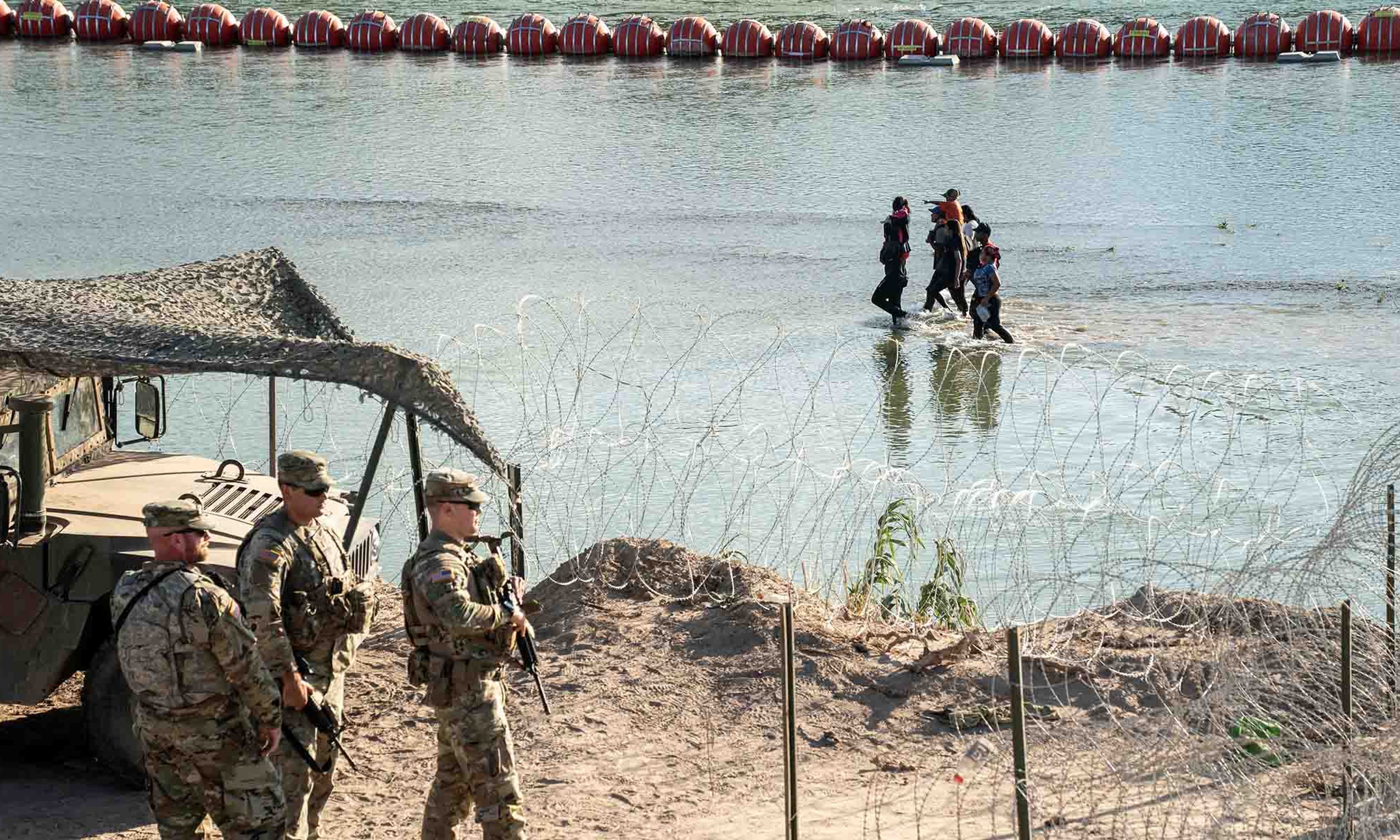
Shortly after a federal judge ordered Texas to remove its floating buoy barrier along a section of the Rio Grande River on Wednesday, Governor Greg Abbott announced his intentions to appeal the ruling.
“Today’s court decision merely prolongs President Biden’s willful refusal to acknowledge that Texas is rightfully stepping up to do the job that he should have been doing all along,” Abbott said in a statement, calling the ruling “incorrect.”
Federal district judge David Ezra decided to issue a preliminary injunction in favor of the U.S. Justice Department in its lawsuit against the Texas governor, less than two months after the suit was filed. In the order, Ezra wrote Abbott “was not ‘asking for permission’ for Operation Lone Star,” the border-security program that allowed construction of the buoy barrier.
“Unfortunately for Texas, permission is exactly what federal law requires before installing obstructions in the nation’s navigable waters,” the judge wrote.
The barrier in question is a 1,000-foot-long line of orange buoys, which are tied together with metal cables and anchored to the bottom of the river with concrete blocks, according to the legal document. Located near Eagle Pass, Texas, the structure also has a two-foot underwater net that deters illegal immigrants from easily diving below the surface.
In response to the order, Abbott promised he will “take this fight all the way to the U.S. Supreme Court” on the behalf of Texas. He added the state will continue to do what it can to “secure the border” considering President Joe Biden won’t.
“We will continue to utilize every strategy to secure the border, including deploying Texas National Guard soldiers and Department of Public Safety troopers and installing strategic barriers,” said Abbott. “Our battle to defend Texas’ sovereign authority to protect lives from the chaos caused by President Biden’s open border policies has only begun.”
On July 24, the Justice Department sued Abbott for refusing to remove the buoys, asserting Texas didn’t seek the required federal authorization for the immigration measure. By obstructing navigation on the Rio Grande, the man-made barrier poses a risk to the “public safety” of migrants wishing to enter the U.S. and the “environment,” per the federal filing.
The barrier was installed over the summer to divert migrants to official ports of entry. Despite that argument, many immigration advocates have condemned the border structure.
In the order, Ezra wrote the Justice Department’s lawsuit “will likely succeed” on the basis that the barriers were constructed on navigable waters. Such an action requires a permit from the U.S. Army Corps of Engineers.
Texas has until September 15 to remove the floating barrier, or else, face more legal action.






Comments