
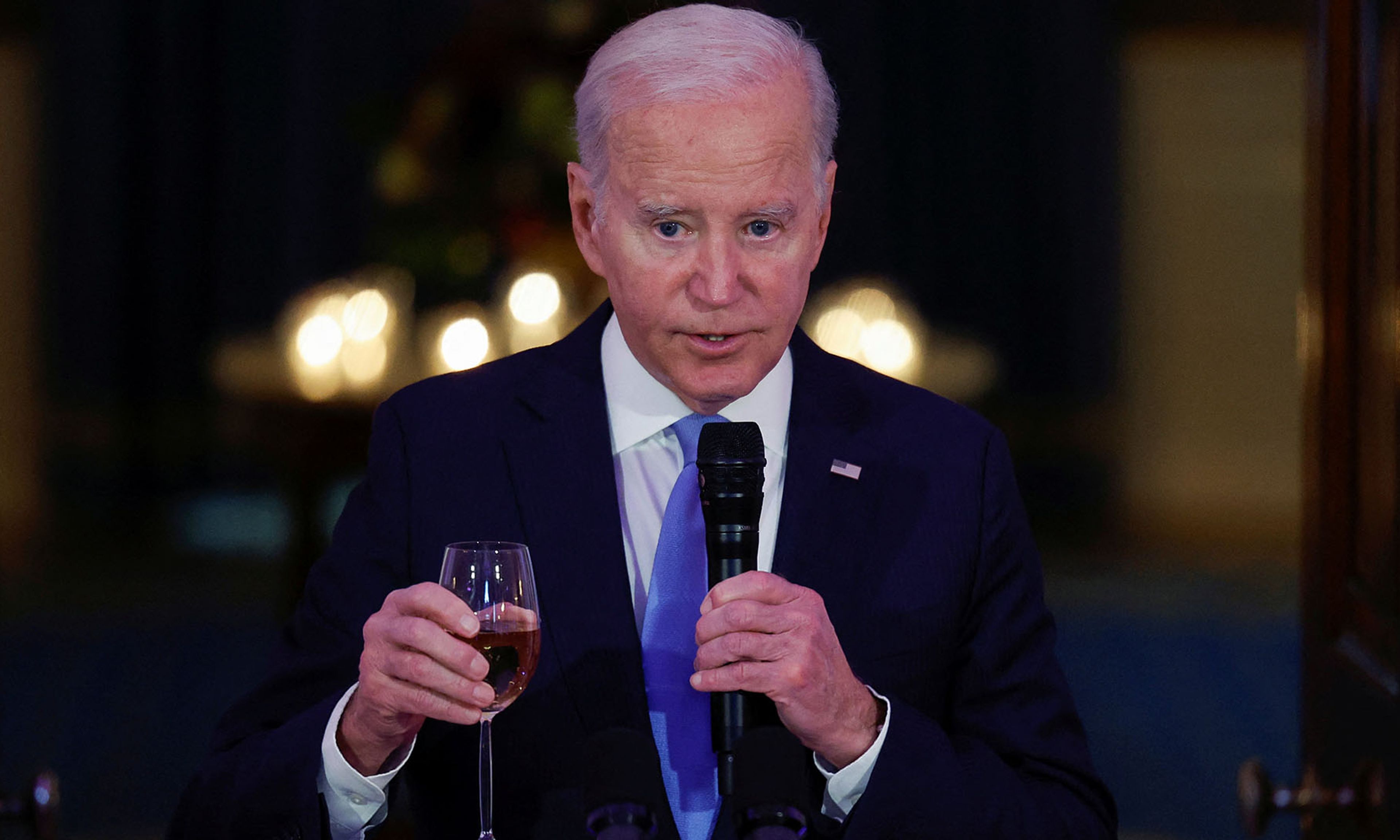
On the menu today: The ongoing debt-ceiling fight is the odd kind of political news story that is consequential but not that interesting to people, even political junkies. A large part of that is because most of us have lived through similar fights before, and we’ve all seen the same pattern of increasingly panicked coverage followed by a last-minute deal. The coverage of the fight contends that this year’s battle is different because the worldview and incentives for House Republicans are different than in the past. Perhaps, but I’d argue there’s a much more consequential difference on the other side: When it comes to making a political argument and persuading the public, Joe Biden is not Bill Clinton or Barack Obama.
Fine, Let’s Talk about the Debt Ceiling!
I haven’t written much about this year’s ongoing debt-ceiling fight. Part of this is because there are a lot of other fascinating and consequential things going on, such as the widespread exploitation of migrant teenagers, the sudden changes at Fox News, President Biden’s relying on a cheat sheet at a press conference, and stuff blowing up over the Kremlin. And part of it is because I have more economics–minded colleagues who know this stuff better than I do.
But mostly I haven’t written a great deal about the debt-ceiling fight because these big budgetary fights tend to follow the same predictable pattern: Both sides insist they’ve made their best offer, the deadline gets closer, the news reports get more and more ominous, and then as the clock ticks down toward the last minute, there’s a bit of movement, and then suddenly a deal is reached. Each side insists that it got what it wanted and maintains that the other side made the most consequential concessions, and everybody goes home and stops thinking about the debt ceiling until the next time we get within a couple hundred billion or so of hitting it.
I know, I know, this year, a lot of columnists have written versions of, “This time, it’s different.” Reuters ran that headline. Megan Greene of the Financial Times warned, “Forget Groundhog Day vibes on debt ceiling — this time it’s different.” And the other Charlie Cook explained, “Why Debt-Ceiling Brinkmanship Feels Different This Time.”
The gist is often that today’s Republicans are more reckless and don’t understand or care about the consequences of the federal government defaulting on its debts — and those columnists point out, accurately, that working out a deal is tougher when the party controlling the House has such a narrow majority.
“Democrats hold a narrow Senate majority, as they did in 2011, and Republican leader Mitch McConnell is again in a position to help shape the outcome. Any agreement that emerges from that chamber will need bipartisan support, which could prove difficult for a Republican House majority to accept,” warned Andy Sullivan of Reuters.
Greene cautioned, “Default is now a much greater possibility. A small group of Republican hardliners have decided that the size of the national debt matters more than the full faith and credit of the government. The House of Representatives is so divided they may indeed take the country hostage.”
And Cook gravely observed that any possible agreement was threatened by “the increasing share of Republicans on Capitol Hill, particularly in the House, who seem to look more to the twice-nominated and once-elected former President Trump for cues and inspiration on policy, priorities, and style than to those who are their official leaders, such as House Speaker Kevin McCarthy and Senate Minority Leader Mitch McConnell.”
Except, a funny thing happened on the way to economic Armageddon: Those allegedly hopelessly divided House Republicans came together with just enough votes to pass their preferred spending proposal.
Their bill would raise the debt ceiling for one year or until the debt hits $32.9 trillion, whichever happens first, in exchange for capping spending at fiscal year 2022 levels. As the Editors noted, “In Washington-speak, this will be decried as a draconian cut, because holding spending steady means it won’t go up as planned. Keeping spending the same as it was last year is hardly a radical move, and pales in comparison to the initial idea to balance the budget in ten years.”
The House GOP proposal also repeals most of the $80 billion windfall for the IRS and the illegal and unconstitutional student-loan “forgiveness” plan, takes back some of Democrats’ green-energy subsidies, and reforms the permitting process to make it easier to build new energy infrastructure. It puts new work requirements on able-bodied adults who have no dependents and receive Medicaid or SNAP benefits, and claws back unspent funds from pandemic-relief programs.
As Yuval Levin observes, so far, McCarthy is a much shrewder speaker than anyone expected, in part because he’s brought more of the House hardliners inside the tent, facing out, instead of outside the tent, facing in, to clean up Lyndon Johnson’s comment about J. Edgar Hoover. There’s a long way to go, but the House GOP, so far, is holding together and increasing its leverage.
Over in the Senate, Democrats still have a narrow majority, but that doesn’t mean all 51 senators have a strong appetite for brinksmanship; Politico notes that Joe Manchin and Kyrsten Sinema are “not only pushing for a bipartisan deal but positioning themselves as potential players in any future Senate talks on a way out of the crisis.” And the publication reported earlier this week that a handful of politically vulnerable House Democrats could end up signing on to a negotiated deal, agreeing to energy permitting, work requirements for food-assistance programs, a spending cut here or there, and some changes to the student-loan-forgiveness plan.
Democrats are touting the idea of getting enough House Republicans to sign on to a “discharge petition” to force a floor vote on a bill that would raise the debt ceiling, no strings attached. If 218 House members sign a petition to vote on a particular bill, it has to be brought to the floor; that means five House Republicans would have to join all 213 House Democrats who want to raise the debt limit with no policy changes. So far, there aren’t any Republicans signaling they’ll sign on to a clean increase.
Ironically, I do see a big difference from past fights, but that doesn’t seem to be a major focus in those “this time it’s different” columns above.
The largest debt-ceiling fights occurred in 1995, 2011, and 2013. We’ve had government shutdowns — similar big partisan showdowns over government spending — once in 1995–96, once in 2013, and twice in 2018 (one at the beginning of the year, and and one at the end of the year that stretched into 2019).
Most, but not all those times, the Democratic side of the argument was represented by the president at the time, Bill Clinton or Barack Obama. As far as political communicators and orators go, Clinton and Obama rank among the very best the Democratic Party has ever had. You don’t have to like or agree with these guys to recognize the skill they brought to the effort of maximizing the pressure on the political opposition. And when you’re trying to persuade Americans that you and your allies are being reasonable and the other party is full of intransigent extremists, it helps to have a leader with a golden tongue.
When it comes to making a political argument and persuading the public, Joe Biden is not Bill Clinton or Barack Obama. I won’t rehash all the recent observations about how the 80-year-old Biden is a part-time president — the limited work schedule between 10 a.m. and 4 p.m., the lack of appearances on weekends, needing several days to recover from overseas trips, avoiding press conferences and sit-down interviews. Just recognize that Americans aren’t all that enamored with Biden right now. Biden’s job-approval rating is around 42 percent. He hit an all-time low of 37 percent in the last Gallup poll. In the most recent NBC News poll, 70 percent of Americans said Biden shouldn’t run for another term.
The Biden strategy so far has been to paint vivid portraits of just how bad breaching the debt ceiling would be, and to contend that because that scenario is so bad, Republicans should just agree to raise the debt ceiling without any policy concessions. “The most important thing we have to do in that regard is to make sure the threat by the Speaker of the House to default on the national debt is off the table,” Biden said Monday. “We pay our bills, and we should do so without reckless hostage-taking from some of the MAGA Republicans in Congress.”
Perhaps the greatest danger is that Biden goes into these negotiations with a wildly unrealistic sense of his own leverage, and keeps turning down GOP offers, convinced that Republicans will blink at the last minute and give him a “clean” increase in the debt limit, with no concessions. That’s the one way a default could plausibly arrive: As the clock ticks down, Biden sits there waiting for a GOP surrender that is never going to arrive.
Sure, the economic fallout from a debt default would probably ensure the GOP House majority is short-lived. But it would also be catastrophic for Biden’s reelection chances. If, as the White House warns, a debt default would lead to the stock market plummeting 45 percent, U.S. gross domestic product falling by 6.1 percent, and the unemployment rising five percentage points, the American electorate is not going to look at Biden and say, “Great job, Grandpa. Give me another four years of this.”
Sometimes, you need the pressure of an impending deadline to get the parties to agree to the deal. To use an example from my non-political interests, the New York Jets and the Green Bay Packers had the basic outlines of a deal to trade Aaron Rodgers in place in March, but it took 40 days to work out the details. The two teams worked out the details right before this year’s draft, in part because the Packers wanted to start using those compensatory draft picks this year and next year, instead of next year and in 2025.
As for the idea that Biden will suddenly reverse himself and make concessions . . . recall that Biden abandoned his past statements supporting “home rule” and stood with Republicans, opposing a District of Columbia criminal-code overhaul that would have reduced sentences for carjackers. Then, Biden opened the door to reviving the practice of detaining migrant families who cross the border illegally. He and his administration also gave formal approval for a huge oil-drilling project in Alaska known as Willow, enraging environmentalists.
You really think White House Chief of Staff Jeff Zients won’t make some concessions to avoid a default?
ADDENDA: A few stray thoughts to close out this Thursday edition . . .
Our Christian Schneider: “With the growth of wannabe-influencer candidates, it is now harder to get tickets to a Taylor Swift concert than it is to enter the presidential race.”
Yikes: “The average monthly mortgage payment for a typical U.S. home has grown by 50 percent since Jan. 31, 2022.” Never mind “are you better off now than you were four years ago?” Are you better off now than you were 18 months ago?
A much-touted House Democratic super PAC ad campaign hitting McCarthy and “MAGA Republicans” turned out to be much, much less than what was promised: “It ran just twice on daytime MSNBC programs last Wednesday before the House voted to approve McCarthy’s plan.” Well, I’m sure that ad persuaded all of those Republican-leaning viewers who were watching Ana Cabrera’s show and Andrea Mitchell’s program.





Comments