
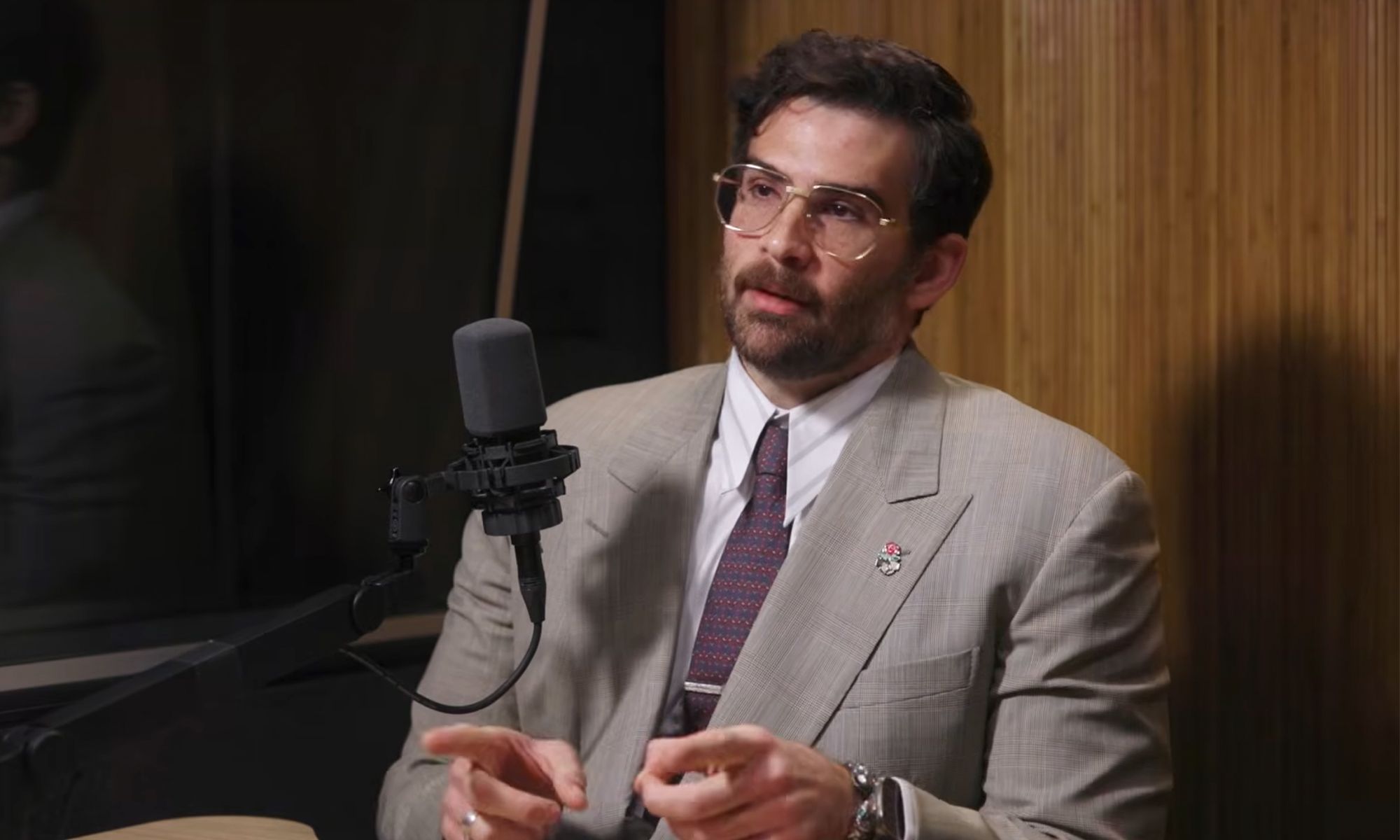
On the menu today: Hasan Piker exposes himself — or, more specifically, he exposes his own jaw-dropping ignorance about one of his signature causes. Elsewhere, Vice President JD Vance contemplates his future options, the editors of National Review draw a conclusion about the “Trump establishment” in Washington, and a Texas U.S. attorney uses some colorful metaphors in his warning letter to Massachusetts Senator Elizabeth Warren. Read on.
Hasan’s Medicare Muddle
Ezra Klein of the New York Times interviewed It Boy of the Left Hasan Piker, and Piker, a relentless advocate for Medicare for All, was forced to admit he hadn’t heard about the time Democrats unsuccessfully tried to enact a single-payer health-care system in Vermont, an effort that spanned 2011 to 2014.
(For those wondering about the terms, Medicare for All is a form of a single-payer health-care system.)
Shortly after Piker argued, “If we are going to have to face this inevitable resistance from moneyed interests, we might as well go all the way,” Klein brought up Vermont’s experience.
Klein: Have you looked much at what happened when they tried to do single-payer in Vermont?
Piker: No, I’m not familiar with what the single-payer initiative was in Vermont. But I will say this ——
Klein: It’s useful to chat about Vermont for a minute, because I think it gets to where maybe I think this is going to end up.
So, they tried to do this a couple years ago. Bernie Sanders, obviously being a senator from Vermont, they had full Democratic trifecta control. It fell apart. And there are different reasons it fell apart. My colleague Sarah Kliff — now at the Times, then at Vox — did a lot of great reporting on this. But one of the things that happens when you try to ingest the entire health care system into a single-payer system is that all of these costs that are hidden right now become visible all at once to the electorate.
In theory, the people you would think would want Medicare for all are employers. A huge amount of my health care spend is covered by an employer — I don’t see it. That’s true for most Americans who are not in Medicare and Medicaid itself.
And so everything that the employer is paying becomes a tax, and everything that is hidden in tax deductions becomes a tax. And so the price tag doesn’t look smaller to people, even though it might be less on the national budget, because a lot of the costs right now are hidden. So, you have that problem.And the other problem — I don’t know if you saw this, it was a poll by Mehdi Hasan’s group and Searchlight, so you had a left and centrist poll. And people want Medicare for all, but then you ask: Do you want your private insurance taken away? They say no. Do you trust the government more than your private insurer? They say no.
And so it has seemed to me that even if you want to get to single-payer, you have to be in a trust-building period where you take it in pieces. When I had Abdul El-Sayed on the show, he talked about how this is like climbing Mount Everest. You’ve got to get to base camp and then a piece and then a piece.
So first, I’m curious which part of that political analysis you disagree with. And if you don’t, what would be a progression toward what you want, as opposed to biting it all at once?
Piker was left saying, essentially, “nuh-uh,” and contending that Americans can’t wait to get rid of their existing health-care insurance and put the federal government in charge of it all:
Piker: Yeah. I don’t think that biting it all at once is something that is feasible or possible right now. But I think there’s value in advancing that as our legislative North Star.
The reason there is this distinction, and people get frustrated, or are more negative about Medicare for all when you tell them that they might lose their private health care, is because there’s not a lot of confidence in good governance right now. And that has been, I would say, the defining feature of the post-Reagan neoliberal era.
I think there are some real changes coming right now. But it requires great communicators to diligently talk to people — not treat them as stupid, but to explain to them the situation ahead.
The reason Medicare for all has become much more popular over the years is because health care premiums are unbelievably costly. People hate health care. People hate their private insurance companies.
Thanks to the new and much better search engine, I can tell you that we at National Review have written dozens of times about Vermont’s ill-fated effort to enact single-payer. Many aspects of Vermont’s experience are illuminating, among them that there were no Republicans around for Democrats to blame. All the usual villains in the progressive narrative — “greedy corporations,” “lobbyists,” “special interests” — were either nonfactors or minimal factors.
Nope, it all came down to the “math not mathing,” as the kids say. Vermont Governor Peter Shumlin and his team ran the numbers repeatedly and kept coming up with the same result: Paying for the system they wanted to build meant they needed about $2.5 billion in additional revenue in the first year. The state’s total tax revenue at that time was . . . $2.7 billion.
Go to any government, at any level, and say, “To make my program work, we need to almost double our tax revenue within one year,” and you’re going to get laughed out of the room. Back in 2018, Democrats in the state of Maryland proposed a similar plan, and Maryland’s Department of Legislative Services calculated that the state would have to levy a 10 percent payroll tax against every business and charge a $2,800 fee for every man, woman, and child in the state. How many Maryland families of four do you think have an extra $11,200 lying around to pay for their health care?
One of the biggest obstacles to Medicare for All is people who understand math and who recognize that you need enough money coming in to cover the costs of all that health care going out, and you cannot generate enough by just taxing “billionaires” or “big corporations” or any other bogeymen of the left. The only way to bring in enough money to pay for it is to enact considerably large middle-class tax hikes, and for obvious reasons, the middle class does not want to pay more in taxes.
A curious progressive might start to wonder, if the benefits of single payer were so obvious, why no blue state has enacted that program yet. The U.S. has no shortage of Democrat-dominated blue states; since 2019, Democrats have had as few as 14 trifectas — control of the governorship, a state senate, and a state house — and as many as 17. Quite a few states have expanded Medicaid eligibility, but none have instituted Medicare for All or single-payer. Why? Because to do it would require tax increases on a scale too large for even the most heavily Democratic state electorate to tolerate.
Hasan Piker has become a well-known and apparently influential voice in progressive circles, and a leading advocate for Medicare for All or single payer, without ever having heard of Vermont’s experience (nor, I suspect, Maryland’s either).
I was reminded of the April 10, 2025, episode of Joe Rogan’s podcast, featuring the illustrious and well-traveled journalist Douglas Murray and Dave Smith, a comedian who apparently never tells jokes, arguing about Israel and Gaza, and this exchange:
Murray: Have you been to the crossing points?
Smith: No.
Murray: When were you last there at all?
Smith: I’ve never been.
Murray: You’ve never been?
Smith: Well, I’m not — am I not allowed to talk about it now? I’ve never been to — Have you ever been to Nazi Germany? Are you allowed to havefeelings about them?
Murray: You can’t time travel, but you can travel.
Smith: Okay, but so what? So, what’s the point? Lots of people have been there and agree with me and lots of people have been there and agree with you.
Murray: If you’re going to spend a year and a half talking about a place, you should at least do the courtesy of visiting it.
Smith: All right. I just think this is a non-argument.
Murray: You don’t think–
Smith: I think it’s a non-argument.
Rogan: Well, you have to go and touch the ground?
Murray: No, I think you have to see– I think it’s a good idea to see stuff, particularly if you spend a career talking about something. Yes. I have a journalistic rule of trying never to talk about a country even in passing, unless I’ve at least been there. It’s . . . a normal thing to do. You’re talking about — hang on — talking about crossing points and not only have you never been to a crossing point in either Egypt or in Israel, but you’ve never even been to the region.
Think of any place you’ve been, where your best friend hasn’t been to that place. Which one of you understands that place better? Probably nine times out of ten, it’s going to be you.
The fact that Murray has been to Israel and Gaza many times, and Smith has never visited, doesn’t mean that Murray is automatically right about everything he says about the topic, and that Smith is automatically wrong. But it does suggest that Murray is more likely to have a better-informed and more accurate perspective; he’s seen the situation with his own eyes, spoken to the people there directly. You don’t have to have been to a place to have an opinion or to make a good point. But it helps.
Similarly, if you want to persuade the public to scrap its existing system of providing health care and try out a new one, it helps if you understand why previous efforts to institute your preferred system failed.
Apparently, Hasan Piker can’t be bothered to do this. He streams for seven hours a day, including playing video games. That’s not time spent reading, and apparently there is no video game called Grand Theft Auto: State Medicare Reform. Piker has ascended to a position of influence in progressive circles, without knowing much of anything about the topics on which he opines. He’s ill-informed when he’s not uninformed, excitable, temperamental, and prone to unforgivable outbursts like “America deserved 9/11” or “let the streets soak in the red, capitalist blood!”
Sure, Democrats are riding high right now. But if I were a member of that party, I would be nervous about my party’s grassroots taking their cues from a guy who doesn’t know much of anything about what are supposed to be the issues he cares most about.
Other highlights from that interview:
Piker: “Look, I’m Turkish. I grew up in Turkey. I know President Recep Tayyip Erdoğan is very corrupt, and so is Vladimir Putin in Russia, for example, but at least they hide it. And Trump was so in our faces with his corruption and with his lack of interest in the overall economy.”
You can oppose Trump without arguing that Putin is superior to Trump in any way.
At another point, Piker contends, “We need law and order. I’m a law-and-order Democrat,” which does not really align with calling for the blood of capitalists to run in the streets.
One last interesting wrinkle in that conversation between Klein and Piker, discussing male athletes in women’s sports:
And it wasn’t even that effective of a distraction, considering that I would routinely point to that to say to a lot of young men coming into my audience: Are you feeling better? Is your rent more affordable? Are groceries cheaper now that Trump did this? And if not, why do you think he was doing this? Why do you think he was focusing so much on this particular issue?
Something shifted in the last decade or so, where Republicans started winning the culture war battles. And I don’t think we need to participate in those battles at all.
“I don’t think we need to participate in those battles at all” sounds an awful lot like surrender.
ADDENDA: In case you missed it Friday, CNN reports that people close to Vice President JD Vance say he “has given serious consideration to not running for president in 2028.” To me, that’s just being wise and taking the opportunity and risks seriously. A presidential campaign is a huge, life-altering endeavor, and he and Usha have kids aged nine, six, four, and a few months old.
. . . The Editors look at the modern GOP and conclude: “Every party elite reaches its point of exhaustion, and that’s where the Trump establishment is now.”
. . . Over in the magazine, I looked at the likelihood of a Democratic Congress and foresaw (at least) two years of trench warfare. Already, U.S. attorney for the Southern District of Texas Aaron Reitz is warning Massachusetts Senator Elizabeth Warren that her investigations must have “a legitimate legislative purpose” and accusing her of being “eager to wield your future gavel like a tomahawk, hunting for the scalps of President Trump’s private associates.”





Comments