
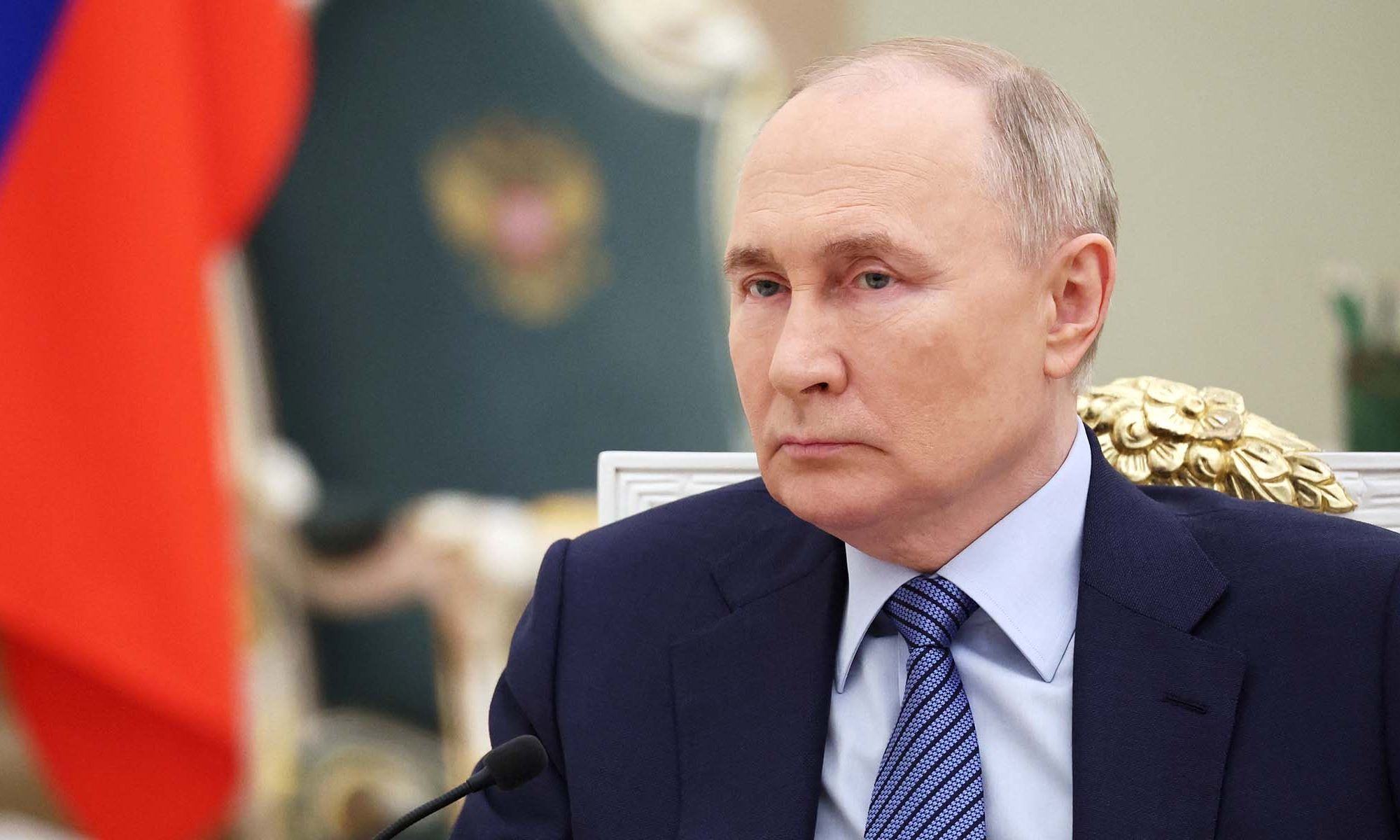
On the menu today: It’s a heck of a time to be in Europe. Vladmir Putin declares that now that Ukraine is running low on ammunition and supplies, he has no interest in peace talks — demonstrating that the contention that cutting off U.S. aid to Ukraine would force both parties to the negotiating table was an erroneous assumption. Meanwhile, Polish prime minister Donald Tusk spits hot fire about the U.S. Congress’s inability to pass a Ukraine aid package, and German chancellor Olaf Scholz blurts out that French and British military personnel are helping the Ukrainians target Russians with long-range missiles. Oh, and a little-noticed note about why President Biden might particularly appreciate Prime Minister Tusk criticizing House Speaker Mike Johnson.
Putin: It Would Be ‘Ridiculous’ to Talk Peace with Ukraine When They’re Low on Ammo
Krakow, Poland — A few weeks ago, this newsletter looked at Vladimir Putin’s idea of a fair deal to end the Russian invasion of Ukraine — a post-war Ukraine without anything resembling an effective or modern army and no defenses against any future Russian military aggression. I asked, if Ukraine were forced, at gunpoint, to sign a deal like this, who among us would be willing to say, “Well, Putin would never start an unprovoked war of territorial aggression against Ukraine for a fourth time”?
This week, Putin made it clear that he will not agree to anything that could seriously be considered a peace deal:
Vladimir Putin has ruled out opening peace talks with Ukraine just because Kyiv’s forces are running out of ammunition.
In a growing sign of confidence in the country’s war effort, the Russian president insisted negotiations would have to focus on Moscow’s priorities and not simply allow for a pause in hostilities for Ukraine to rearm its battle-stricken military.
“It would be ridiculous for us to start negotiating with Ukraine just because it’s running out of ammunition,” Putin said, adding: “Possible negotiations are not a pause for rearming Kyiv, but a serious conversation with security guarantees for Moscow.”
Certain American commentators have contended that Ukraine is somehow the unreasonable party in this war, that the Ukrainians need to be persuaded to stand down, and that cutting off U.S. aid will force the Ukrainians to the negotiating table.
But what we see now demonstrates that this argument was always backward. Instead of forcing the Ukrainians to the negotiating table, Russian success on the battlefield is making Putin confident that he doesn’t need to preserve what he already has through a peace deal. He wants to take a much bigger bite.
There is no peace deal to be had with Putin — at least, nothing resembling real peace; only the “peace” of conquest and subjugation, and the potential threat of additional military aggression in the not-so-distant future. Negotiating with Putin is probably not all that different from negotiating with Hamas — what’s his is his, and what’s yours is negotiable.
Suddenly, Poland Is the Pivotal Voice on the World Stage
While I’m in Poland, the Polish prime minister, Donald Tusk, is in Washington, with about as harsh a message for an American congressional leader as I can recall:
“This is not some political skirmish that only matters on the American political scene,” Tusk told reporters in Washington on Tuesday.
He added: “Mr. Johnson’s failure to make a positive decision will cost thousands of lives. He takes personal responsibility for that. . . .”
“He must be aware . . . that the fate of millions of people depends on his individual decisions, and thousands of lives in Ukraine today and tomorrow depend on his decisions,” Tusk said of Johnson.
The U.S. did manage to scrape together a couple hundred million dollars’ worth of military aid, announced at the Pentagon by press secretary and Air Force major general Pat Ryder:
This package is the 55th tranche of assistance and is valued at up to $300 million and includes capabilities to support Ukraine’s immediate air defense, artillery, and anti-tank requirements. The capabilities in this announcement include Stinger anti-aircraft missiles, additional ammunition for HIMARS, 155 millimeter artillery rounds, including high-explosive and dual-purpose improved cluster munition rounds, 105 millimeter artillery rounds, AT4 anti-armor systems, additional rounds of small arms ammunition, demolitions munitions for obstacle clearing, spare parts, maintenance, and other ancillary equipment.
Now, to be clear, we were able to provide this PDA due to negotiated savings on contracts to replace equipment from previous drawdowns for Ukraine. As a result of these cost savings, we were able to authorize a new PDA package for Ukraine today without additional significant impacts to U.S. military readiness.
But this does not change the fact that we urgently need Congress to pass DOD’s supplemental request. Today’s PDA package, while providing urgent capabilities to Ukraine’s forces, is nowhere near enough, and the only way to meet Ukraine’s battlefield needs is for Congress to swiftly pass the supplemental.
Prime Minister Tusk also announced he would attend an “emergency meeting” in Berlin Friday with French president Emmanuel Macron and German chancellor Olaf Scholz. “In my opinion, these three capitals have the task and the power to mobilize all of Europe” to provide Ukraine with fresh aid, Tusk said.
One of the big issues is Germany’s refusal to send long-range Taurus missiles to Ukraine. On February 29, Chancellor Scholz defended the decision not to send the missiles, declaring for them to be used properly, German military personnel would need to be with the missile launchers to help with targeting — and that his nation’s troops couldn’t do that the way the French and British were:
Scholz said Monday that the Taurus is “a very far-reaching weapon” and added: “What is being done in the way of target control and accompanying target control on the part of the British and the French can’t be done in Germany. Everyone who has dealt with this system knows that.”
That comment was interpreted in many quarters as Scholz perhaps inadvertently revealing or hinting that members of the British and French military are in Ukraine, on the ground, helping the Ukrainians target Russians. The British have sent the Storm Shadow long-range-missile system and the French have sent the Scalp system, but no government has confirmed helping the Ukrainians use them.
The reaction in certain corners of the United Kingdom was apoplectic:
Ex-Defense Secretary Ben Wallace tore a strip off German Chancellor Olaf Scholz after he appeared to suggest British troops are helping Ukraine to fire long range missiles.
The former Cabinet minister accused him of “not only dangerous use of facts but also often wrong facts!”
In withering criticism of Mr. Scholz, Mr. Wallace told The Standard: “Scholz’s behavior has showed that as far as the security of Europe goes he is the wrong man, in the wrong job at the wrong time.”
Finally, this week began with my emphasizing that events that seem far away can have consequences close to home. President Biden no doubt appreciates Tusk and Polish president Andrzej Duda coming to Washington, touting their military commitments to Ukraine, urging all NATO members to follow their example, and rapping Speaker Johnson across the knuckles.
But Biden might have one other, less noticed reason for emphasizing how he and Poland’s current leadership are like peas in a pod.
According to the U.S. Census Bureau data, the state that has the highest percentage of Americans who identify as having Polish ancestry is Wisconsin, at 8.15 percent of the population, or an estimated 481,000 people. The state that has the second-highest percentage of Americans who identify as having Polish ancestry is Michigan, at 7.82 percent of the state’s population, or an estimated 784,200 people. And fifth on the list is Pennsylvania, at 5.86 percent of the population, or an estimated 757,627 people.
Now, it’s not that those three upper Midwestern states, part of the Democratic Party’s old “blue wall,” are teeming with voters who will decide whom to vote for based solely on which candidate has a warmer relationship with the Polish president and prime minister. But both parties pay attention to this sort of thing, and Biden is exactly the sort of longtime Democrat who appreciates old-fashioned ethnic politicking.
And David Jackson wrote a bit about what we could discern about the Polish-American vote in 2020:
Here are some demographic characteristics of the 224 Polish Americans who revealed their 2020 presidential vote. First, 55.6 percent of them are female. More than a quarter (28.6 percent) are between 60 and 69 years old, while more than another quarter are between 50 and 59 (27.2 percent). Only 15.6% are younger than 40. They are almost exclusively white (98.2 percent). The plurality (41.5 percent) live in a large city, while 28.1 percent live in suburbs. More than a third (40.2 percent) report a household income of $100,000 or more. 38.3 percent consider themselves Democrats, while 31.1 percent consider themselves independent, and 27.9 percent consider themselves to be Republican. Another 2.7% identified as supporters of other political parties.
The partisanship results roughly parallel the 2013 Piast Institute’s survey of Polish Americans, which found that 36.01 percent identified as Democrats, while 22.62 percent identified as Republicans, and 35.79 percent considered themselves independent. Another 5.58 percent identified as supporters of other political parties.
In terms of presidential preference, 54 percent of Polish Americans sampled voted for Biden, while 42.4 percent voted for Trump. Another 3.6 percent voted for some other candidate. These results are just about the reverse from what CNN exit polls show for white voters: 58 percent for Trump and 41 percent for Biden.
In other words, Polish Americans are a white demographic that was largely open to Biden, and they’re heavily concentrated in three states that will likely determine who wins the 2024 presidential election. For Biden, touting his strong relationship with the Polish government just makes good political sense.
ADDENDUM: The primaries on Super Tuesday were more than a week ago, and our Dan McLaughlin notices that the state of California has counted . . . roughly 85 percent of the vote. Hey, fellas, quit slacking off!



Comments