
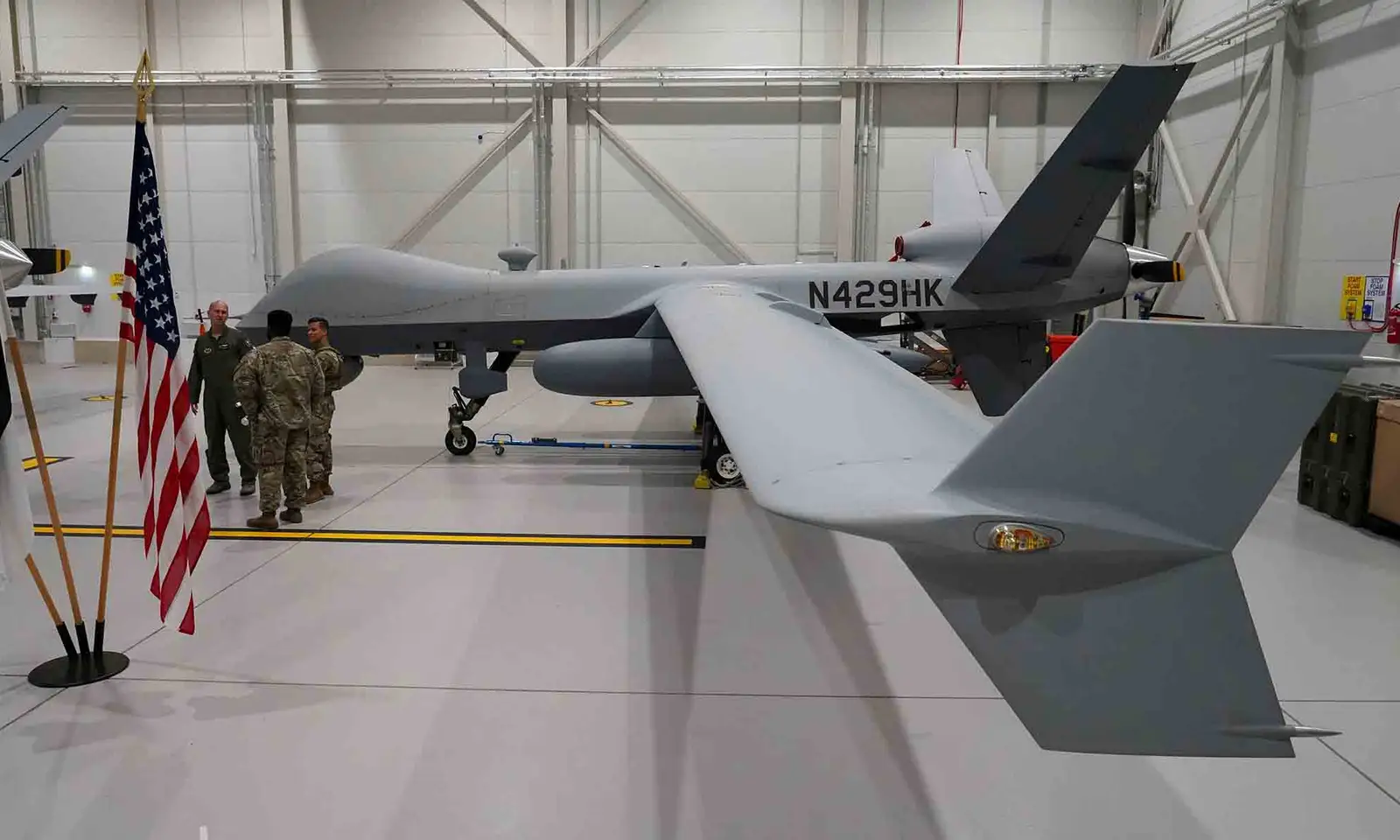
On the menu today: Beware the Ides of March. That U.S. Air Force MQ-9 drone that Russia downed in the Black Sea yesterday was gathering intelligence on the locations and movements of Russian troops, intelligence that would be passed along to Ukrainians for targeting those forces. We may not like Russian fighter jets downing our surveillance drones over international waters, but we should not be surprised that they are doing so. This is a natural and perhaps inevitable consequence of being in a proxy war with Russia.
To Paraphrase Blue Oyster Cult, Russia Don’t Fear the Reaper
Yesterday, a Russian fighter jet struck and forced down a U.S. Air Force surveillance drone in international airspace over the Black Sea, south of Ukraine — the first confirmed time that Russian military forces and a U.S. military craft have deliberately clashed since the invasion of Ukraine began.
U.S. Air Force general James B. Hecker, the commander of U.S. Air Forces Europe and Air Forces Africa, declared in a released statement that, “Several times before the collision, the Su-27s dumped fuel on, and flew in front of the MQ-9 in a reckless, environmentally unsound and unprofessional manner. This incident demonstrates a lack of competence in addition to being unsafe and unprofessional.”
“This incident follows a pattern of dangerous actions by Russian pilots while interacting with U.S. and allied aircraft over international airspace, including over the Black Sea. These aggressive actions by Russian aircrew are dangerous and could lead to miscalculation and unintended escalation,” Hecker added.
Brigadier General Pat Ryder, the Pentagon’s press secretary, said, “We assess that it likely caused some damage to the Russian aircraft as well. . . . The Russian aircraft did land. I’m not going to go into where they landed.”
Ryder said the drone was on an “ISR mission,” which is short for “intelligence, surveillance, and reconnaissance.”
The MQ-9 Reaper is the size of a small plane, with a wingspan of 66 feet, a length of 36 feet, and a height of twelve-and-a-half feet. It is larger and more powerful than the MQ-1 Predator drone, and costs $56 million per unit in 2011 dollars. While the Reaper is capable of carrying a variety of missiles, the Pentagon said this drone was unarmed.
In February 2021, the U.S. Air Force started operating MQ-9 drones from Campia Turzii Air Base in Romania. You can see what appear to be two drones on the runway in the Google Maps image of the air base. Romania is on Ukraine’s southwestern border, and a stretch of its coastline is on the Black Sea.
Ryder said that the portion of the Black Sea where the drone crashed “is an important and busy international waterway. And so, it is not an uncommon mission for us to be flying in international airspace.” International airspace begins twelve nautical miles from the coast.
Call me crazy, but I don’t think the Russian Air Force that is currently bombing civilian targets is going to care about the Pentagon calling it unsafe and unprofessional.
Nonetheless, a senior State Department official told Reuters that Russia’s ambassador to the U.S., Anatoly Antonov, was summoned to the State Department yesterday afternoon “to meet with Assistant Secretary for European and Eurasian Affairs Karen Donfried to discuss Russia’s unsafe and unprofessional operations over the Black Sea, which resulted in the downing today of an unmanned U.S. aircraft.” In other words, the Russian representative to the U.S. got called onto the carpet.
Antonov issued a statement afterward:
I categorically rejected all the insinuations of the U.S. side. I explained the position of the Russian Federation. I stressed that the American UAV that was moving deliberately and provocatively towards the Russian territory with its transponders turned off violated the boundaries of the temporary airspace regime established for the special military operation, which was communicated to the all concerned users of international airspace in accordance with international norms.
At the same time, the Russian fighters scrambled to identify the intruder did not use on-board weapons and did not come into contact with the UAV.
The unacceptable actions of the United States military in the close proximity to our borders are cause for concern. We are well aware of the missions such reconnaissance and strike drones are used for.
Even though the Russian account is that the U.S. drone just crashed by itself, with no contact with the Russian fighter jets, Antonov contended that the drone’s flying sufficiently close to Russia’s definition of its territorial airspace represented an aggressive act:
Let us ask a rhetorical question: if, for example, a Russian strike drone appeared near New York or San Francisco, how would the US Air Force and Navy react? I am quite confident that the US military would act in an uncompromising way and would not allow its airspace or territorial waters to be breached.
We proceed from the fact that the United States will refrain from further speculations in the media landscape and stop making sorties near the Russian borders.
What Russia won’t say is that, in its eyes, that drone was a legitimate target, because the U.S. military is sharing intelligence with the Ukrainians. In December, the Wall Street Journal reported that, “The U.S. has been providing Ukrainian President Volodymyr Zelensky’s forces reams of data on the location and movements of Russian troops and equipment and other battlefield information under a vastly expanded intelligence-sharing arrangement that is virtually unprecedented for a non-NATO U.S. ally.” Yesterday, the New York Times quoted an unnamed official who said that, “Flying at about 25,000 feet, the Reaper’s sophisticated cameras and other sensors could peer into Russian-controlled Crimea while flying in international air space, a typical mission that MQ-9s have been conducting well before the war in Ukraine started.”
That downed MQ-9 drone was gathering intelligence on the locations and movements of Russian troops, intelligence that would be passed along to Ukrainians for targeting those forces. We may not like Russia downing our surveillance drones over international waters, but we should not be surprised that they are doing so. This is a natural and perhaps inevitable consequence of being in a proxy war with Russia.
As noted yesterday, some of the reporting from on the ground in Ukraine has taken a decidedly pessimistic tone. It’s going to be very hard for Ukrainian forces to launch an effective spring counter-offensive and retake territory if they are indeed suffering from “basic shortages of ammunition, including artillery shells and mortar bombs, according to military personnel in the field,” as the Washington Post reported on Monday.
More than a year ago, I asked why the heck President Biden was standing in the way of sending NATO’s spare MiG-29 jet fighters to Ukraine, the kinds of fighters that Ukrainian pilots already know how to fly. Now, one year later, Poland says it may deliver its extra MiGs in four to six weeks, and Slovakia says it might do the same. That’s great, fellas, I’m sure Ukraine couldn’t have found any good use for an additional group of functioning MiGs over the past year.
If you’ve been reading this newsletter for the past few months, you’ve heard this refrain that if Biden wants Ukraine to win the war, he ought to send Ukraine what it says it needs. He should stop hemming and hawing and sending Ukraine Patriot missile batteries and M1A1 Abrams tanks and long-range-missile systems a half-year after they’ve been asked for. As a wise philosopher once said, “Do, or do not. There is no try.” The U.S. never had complete control over the war in Ukraine, but the defense of that beleaguered sovereign state always relied heavily on the decisions made by the man behind the Resolute Desk in the Oval Office. Former secretary of Defense Donald Rumsfeld famously said, “You go to war with the Army you have, not the Army you might want or wish you had at a later time.” America goes to proxy war with the commander in chief it has, not the commander in chief it might want.
Unfortunately, our commander in chief is “famously indecisive,” as CNN told us in August 2022, nearly two years after he was elected.
From the beginning, Joe Biden has veered back and forth between wanting to see Russia defeated and wanting to avoid escalating the war, unwilling to recognize that those two goals often contradict each other. If you want to fight a proxy war against Vladmir Putin’s vindictive, brutal, destructive desire to be remembered as Peter the Great, then fight the damn proxy war; don’t do it halfway.
In war, time is of the essence, and Ukraine’s window of opportunity may be closing.
ADDENDUM: Over in the Corner yesterday, a quick refresher on how what a presidential candidate says on the campaign trail about his desired foreign policy is often no more than a distant cousin with the policies he actually enacts once in office.






Comments
On “U.S. Drone Becomes a Casualty in the Proxy War with Russia”