Dear Weekend Jolter,
Don’t call it a honeymoon. Incoming President Trump’s first 100 days (his second first 100 days) are guaranteed to be filled with rancor, chaos, finger-pointing, and apocalyptic pronouncements daily from political enemies, punctuated by the occasional self-immolation of a subordinate . . . that is, the usual.
But that doesn’t mean he and the Republican-controlled Congress won’t get points on the board in the early months, occasionally with the help of Democrats.
Yes, the candidate whom Democrats portrayed as an existential threat to the republic is seeing initial support on certain fronts from members of the opposition party. In that incipient cohort, expect to see the name John Fetterman a lot in 2025. The hulking Pennsylvanian last weekend became the first sitting Democratic senator to visit Mar-a-Lago since the election, eliciting praise from his host. As James Lynch reports,
He and Trump discussed acquiring Greenland, using tariffs to promote U.S. Steel, supporting Israel, and securing the southern border. . . . Trump also celebrated the overwhelming, bipartisan Senate vote last week to advance the Laken Riley Act, a bill that would empower federal authorities to detain illegal immigrants arrested for theft until they are deported.
Fetterman is just one prominent Democratic supporter of that immigration-enforcement bill. While he and Senator Ruben Gallego (D., Ariz.) are co-sponsors, dozens of Senate Democrats voted earlier this month to advance the legislation after it passed the House with bipartisan support, no doubt having internalized the backlash the party faced on immigration this cycle. Ten continued to stick with Republicans on a critical procedural vote on Friday, and most of those Democrats, including Arizona’s Mark Kelly and Michigan’s Elissa Slotkin, indicate they plan to back the bill in a final vote likely to coincide with Trump’s first week in office.
Another test of bipartisan cooperation involves Trump’s top-level nominees, many of whom appeared before the Senate this past week for confirmation hearings. As Audrey Fahlberg reports, more conventional picks such as Marco Rubio for secretary of state already have the support of multiple Democrats (in his case including Fetterman, again, and Dick Durbin). It’s no surprise that Lori Chavez-DeRemer, Trump’s pro-union pick for labor secretary, is seeing early support as well from the left, including from Senator Elizabeth Warren; unease from the right could be the bigger hang-up for her. Other nominees, of course, are in for hostile treatment at the hands of Democrats, as Pete Hegseth’s contentious confirmation hearing showed. “You will shoot protesters in the leg” was among the charges lobbed at the Pentagon nominee on Capitol Hill on Tuesday.
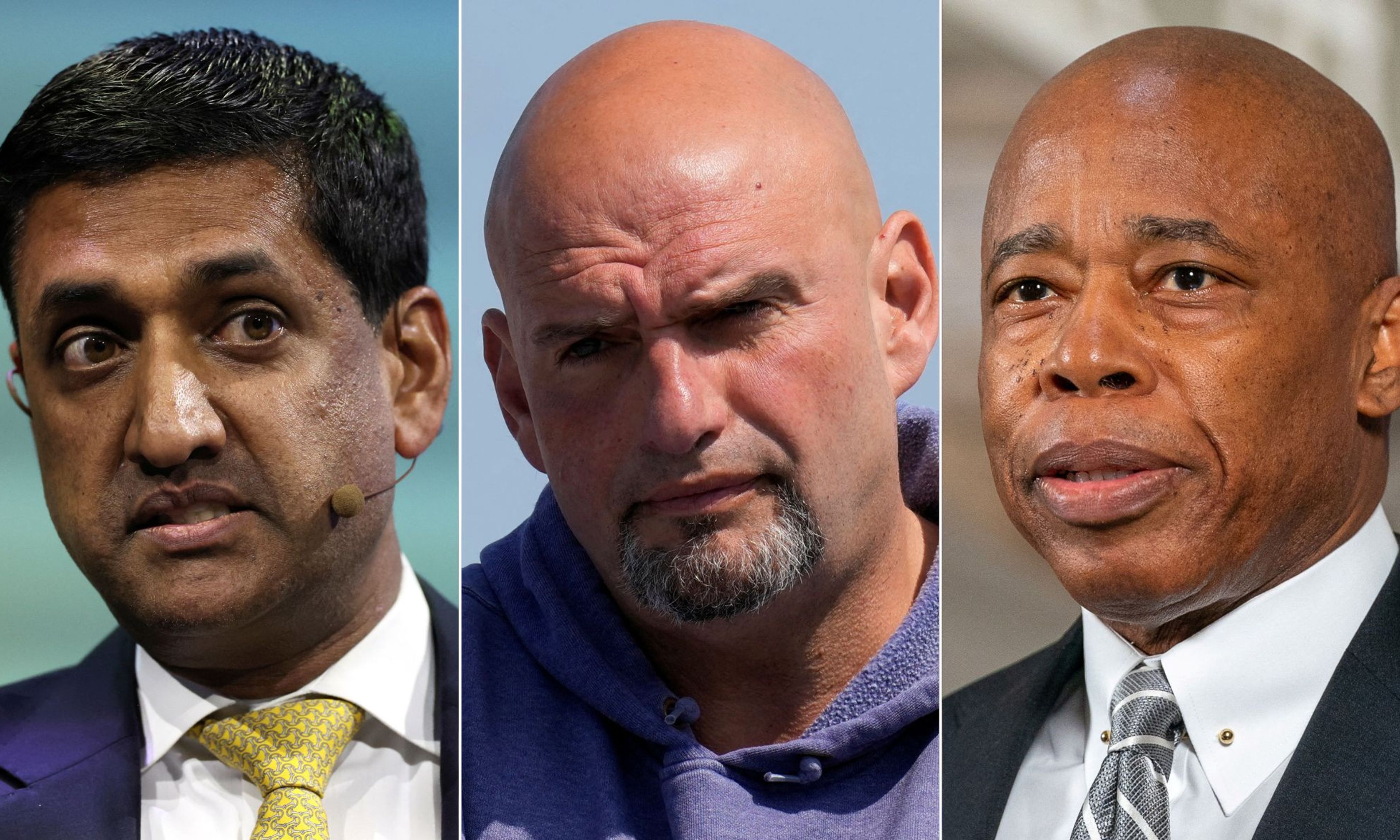
Meanwhile, some Democrats are at least humoring Trump as he engages in his characteristic policy-making on the fly that is one part serious, one part joking, one part trolling, and one part negotiation. Renaming the Gulf of Mexico the Gulf of America? Chuck Schumer’s open to it, on certain conditions. Getting Greenland? Colorado governor Jared Polis says admit Washington, D.C., and Puerto Rico as full-fledged states, then see about making the world’s largest island No. 53. Empowering the Musk/Ramaswamy government-efficiency initiative known as DOGE? Representative Jared Moskowitz (D., Fla.) has already joined the so-called DOGE Caucus in Congress, and Representative Ro Khanna (D., Calif.) is predicting bipartisan cooperation with Elon Musk on this front. At the local level, New York City mayor Eric Adams has made clear he’s willing to work with the Trump administration on immigration and other priorities, though the Democratic administrations of other cities are unlikely to be so cooperative.
The odds are reasonably high that, in time, Trump will blow any grudging goodwill he has from election-stung Democrats, moderate Republicans, Silicon Valley, and corporate America. But with a narrowly GOP-held Congress and a friendly Supreme Court, and now the possibility that Democrats could break ranks on mutually shared goals, the once and future president will have running room at the start of a second term to pursue his MAGA agenda afresh, reflecting the desires of a more diverse coalition than before — a state of affairs nobody save Trump himself could have envisaged after he appeared to bring about his political damnation four frigid Januarys ago.
NAME. RANK. LINK.
EDITORIALS
There’s no stopping Mother Nature, but she can be mitigated: The Los Angeles Wildfire Tragedy
The British government should not be afraid of the truth: Britain Needs a Serious Investigation of the Rape Gangs
It’s the (obviously) right thing to do: Clear Dr. Haim
On the Israel-Hamas deal: A Costly Cease-Fire Deal
On the end of the Jack Smith cases: Lawfare Gets Its Swan Song
ARTICLES
Brittany Bernstein: Supreme Court Upholds Law Targeting TikTok’s Chinese Parent Company
Michael Brendan Dougherty: At Home We Are Equals
Ian Tuttle: Progressivism Faces a Double Blow
Charles C. W. Cooke: Are Californians Near the Tipping Point?
Jim Geraghty: No, Really, Why Is Gavin Newsom Governor of California?
Andrew McCarthy: As a Convicted Felon, Trump Faces Foreign Travel Restrictions
Audrey Fahlberg: Marco Rubio Confronts Multiple Fires on World Stage as He Prepares to Take the Reins at State
James Lynch & Audrey Fahlberg: As Commerce Chairman, Ted Cruz Plans to Make Sure Big Tech’s Change of Heart Is for Real
Jeffrey Blehar: The Biden Era Wheezes Its Way to a Fittingly Deluded End
Dan McLaughlin: How to Pay for Greenland
David Zimmermann: Special Counsel Says Biden’s Criticism of Son’s Prosecution ‘Undermines’ Justice System
Kayla Bartsch: Religious Couples Should Be Free to Foster. Most Americans Think So, Too
Jack Butler: The Rachel Levine Administration
Abigail Anthony: How England’s Legal System Favors Grooming Gangsters over Outspoken Citizens
Abigail Anthony: Be Disturbed
CAPITAL MATTERS
Paul Gessing does the fact check the media should have: New Mexico Governor Plays Game with Data to Claim Child Poverty Success
LIGHTS. CAMERA. REVIEW.
Brian Allen praises the Texas art scene, but read to the end to learn how the Getty has thus far survived California’s devastating wildfires: A Sumptuous New Look at Gauguin in Houston
Armond White finds a film that does alienation right: Eat the Night Confronts the TikTok Crisis
READING MATERIAL FOR THE LONG WEEKEND, IF YOU HAVE ONE
Ian Tuttle marks a potential inflection point for progressivism:
Progressivism is reeling from two disasters, of different kinds. The first was the reelection of Donald Trump. The second is the ongoing Los Angeles wildfires. Each, in its own way, has exposed the feeble condition of progressive politics.
Contemporary progressivism has been attempting of late to combine two competing projects, one quite old, one more recent. The older is progressivism’s century-old commitment to administration: the impulse to centralize and rationalize in the name of efficiency and transparency. The impulse is as old as the Progressive Party and the “modernization” efforts of Woodrow Wilson, and it has endured, more or less intact, for a hundred years, albeit channeled and strained through the New Deal, the Great Society, and the Reagan Revolution. Barack Obama was the apotheosis of the progressive vision of technocratic management. His cadres of wonks promised to bring expertise into every nook and cranny of government. Expert hands would carefully manage everything from the nationwide health-care exchange to Iranian nuclear policy, calibrating the machine of American administration with an unfailing touch. When Joe Biden was reelected and staffed his White House with a host of Obama alumni, the endless refrain, “the adults are back in charge,” signaled progressive relief that expertise would again guide American policymaking after the disastrous finger-painting years of Trumpian populism.
The newer project, distinct from this, is the revisionist social-justice movement that began rising in the early 2010s, crashed to shore in the riotous summer of 2020, and has seeped into almost every aspect of American institutional life, from universities to sports leagues to boardrooms to government. The Woke movement has a different genealogy than the technocratic project: It is a variation less of the Progressive movement of the early 20th century than of the 1960s New Left. Wokeism revises both the racial and sexual politics of the 1960s, replacing the color-blind civil rights vision of the 1964 Civil Rights Act with the dogma of “anti-racism,” and sexual-revolution-era feminism with conceptual frameworks such as intersectionality and gender identity.
Both of these projects are wobbling.
Wokeism was arguably on the wane already in 2024, but Donald Trump’s victory in November has been interpreted as, among other things, a definitive blow to its fortunes. That is certainly how prominent individuals and organizations have responded. Jeff Bezos’s decision, in advance of the election, to overhaul the Washington Post was a monitory sign of a coming shift away from the feverish progressivism that had dominated its pages since at least 2016. Likewise, Mark Zuckerberg’s recent announcement that Facebook would be replacing its fact-checking apparatus with a “community notes” system, modeled on Elon Musk’s X, is another data point attesting that the regnant paradigm of the 2010s and early 2020s is collapsing.
If Trump’s victory upends, at least in certain respects, the woke project, the Los Angeles wildfires call into question the other: technocratic management. California is the essence of the “blue-state model.” Over the past generation, blue states have adopted a high-tax regime with the promise that revenues will fund expansive social services. The lavishly funded state bureaucracy will be able to accomplish not only core government functions but pet projects (such as, in California’s case, electric-vehicle mandates). They will also be leaders on social justice questions, using state power to enforce quotas, DEI initiatives, and the like. The gamble has been that residents would trade higher taxes for this array of tangible and intangible benefits.
It has not worked out that way, and California is a laboratory-grade test case.
Whistleblower Eithan Haim should be at the top of Trump’s list of people to clear as his administration takes office. From NR’s editorial:
Dr. Haim just needs the government to stop persecuting him.
In March 2022, facing scrutiny from the state’s Republican government, Texas Children’s Hospital (TCH) publicly announced that it was shuttering its “gender clinic” and would no longer be offering transgender drugs and surgeries to minors — an effort to forestall government action. But it didn’t really stop. The hospital lied to the public and kept going. It “secretly continued to perform transgender medical interventions, including the use of implantable puberty blockers, on minor children,” treating kids as young as eleven years old. That’s a scandal worthy of public attention.
It took a courageous whistleblower, Dr. Haim, to contact the press and bring the truth to light. After City Journal’s Christopher Rufo reported what he learned from Dr. Haim, Texas legislators changed the law — a step upheld in June by the Texas Supreme Court — to outlaw the use of transgender drugs and surgeries in pediatric medicine. That line from reporting to lawmaking is the central artery of democratic self-governance.
It wasn’t so long ago in America that this sort of thing would make Dr. Haim a hero to the free press, maybe even the subject of a hagiographic Hollywood film. In more recent years, he’d have been at legal risk only if he lived in a deep-blue state such as California, where then–attorney general Kamala Harris initiated the yearslong prosecution of David Daleiden for doing hidden-camera journalism exposing malfeasance at Planned Parenthood. But something was new about the Garland era at the DOJ: Instead of an outlier state government, it was the federal government that brought criminal charges against Dr. Haim for daring to reveal the truth so that the people’s representatives could act on it.
The pretext for the prosecution was that Dr. Haim violated the Health Insurance Portability and Accountability Act (HIPAA), which is designed to safeguard from public disclosure the identities and confidential medical information of patients. The Biden administration has been highly selective in its concern for HIPAA violations. . . . No confidential patient information was in Rufo’s reports (which were public record), and there was no evidence that Dr. Haim ever provided such information to Rufo. In fact, the good doctor was charged under a section of HIPAA that doesn’t address disclosures. In a superseding indictment, DOJ abandoned even the implication that Dr. Haim had revealed such information to anyone. The DOJ, which identified minor patients by their initials in its indictment, disclosed more than the defendant ever did.
The DOJ alleged that Dr. Haim had improperly obtained patient files remotely while he was no longer working at the hospital. That claim, too, had to be walked back when it was revealed that Dr. Haim was still seeing patients at TCH two years longer than the DOJ had originally alleged — and that the FBI had known this all along.
The original indictment claimed that Dr. Haim should face up to ten years in prison for acting for the purpose of “malicious harm” to patients. Only someone thoroughly marinated in gender ideology could believe this of a doctor who was just trying to raise the alarm about deceit in the treatment of children. Yet again, the superseding indictment dropped that claim and fell back on the argument that Dr. Haim intended malice toward TCH and its doctors. The same could be claimed in any case where a whistleblower reveals wrongdoing, knowing that this might have consequences for the wrongdoers.
The prosecution has been a tragedy of errors.
More on this week’s confirmation-hearing spree from Audrey Fahlberg, who looks at one of the less contentious nominations but for a job with perhaps the most daunting challenges:
Donald Trump’s secretary of state pick, Senator Marco Rubio (R., Fla.), testified before his colleagues on the Senate Foreign Relations Committee on Wednesday about his plans to take on American adversaries including Iran, China, and Russia alongside the president-elect’s incoming national security team.
The longtime Florida senator, son of Cuban immigrants, and 2016 GOP presidential primary candidate is expected to sail through his confirmation with significant Democratic support – including from the party’s Senate whip, Dick Durbin (D., Ill.) — making him a shoo-in for the incoming cabinet as other nominees face a narrower path ahead of Trump’s swearing-in on January 20.
Rubio and his incoming national-security colleagues in the White House will inherit a series of challenges that have emerged on the world stage during President Joe Biden’s tenure, including an emboldened Chinese Communist Party, wars in Ukraine and Gaza, and the fallout in the Middle East that has resulted in part from the outgoing administration’s disastrous U.S. military withdrawal from Afghanistan.
During Rubio’s hearing, Israeli and Hamas negotiators announced a cease-fire deal to end the 15-month war in Gaza, underscoring the scale and complexity of ever-evolving overseas conflicts that will soon fall on the shoulders of the president-elect’s incoming national security team. Trump, who praised the cease-fire announcement on social-media statement on Wednesday, has warned that “all hell will break out in the Middle East” if Hamas does not release the hostages that are currently being held in Gaza before his swearing-in. . . .
In the aftermath of Russia’s invasion, Rubio emerged as a key ally in Ukraine’s efforts to stave off Vladimir Putin’s forces. He has adopted a more realist approach as the war has continued, recently voting against additional supplemental funding for Kyiv over concerns that the legislation did not include legislative language to secure the southern border.
“This is not going to be an easy endeavor,” Rubio said of negotiations to bring about an end to the fighting. He said there is “no way Russia takes all of Ukraine” but insisted that there must be concessions on both sides of the conflict to achieve to a ceasefire and ultimately a peace agreement.
Also on Wednesday, Rubio reiterated his support for Israel and maintained that the U.S. must be vigilant in national security threats in the Middle East. On Iran, Rubio says the regime is at its weakest point, and that their air defenses have been “badly damaged,” their “economy is in shambles.” Rubio says the U.S. national security officials must be clear-eyed that any concessions made to the Iranian regime will be used to build up their weapons systems and proxy groups in the region.
CODA
Biden is leaving Washington, and Trump is arriving in it. It feels like we’ve been here before. CSNY sang about this once.




Comments