From the outset of an Iran-sponsored campaign of militancy and terrorism across the Middle East that began on October 7, 2023, the Biden administration communicated that it was more afraid of acknowledging the existence of a “wider, protracted regional conflict” than letting it harm us. The administration met attacks on U.S. forces and interests in the region with bizarre indifference. When it responded to direct acts of aggression, it did so belatedly and in tailored ways that conveyed only the degree to which the president was self-deterred. Observers feared that Joe Biden’s complacency in the face of Iran’s reckless provocations would end up getting Americans killed. And that is what has happened.
On Sunday, Iranian proxy forces launched a one-way drone attack on a U.S. position in Jordan just across the Syrian border. The strike killed three U.S. service personnel and wounded at least 34 more. Media outlets described the attack on the Tower 22 outpost as a “significant escalation” in the hostilities that have been ongoing in the region since Hamas’s 10/7 massacre. It may be an escalation, but it is no surprise.
That outpost is located just miles from the Al-Tanf garrison in Syria, a strategically vital checkpoint in southern Syria bordering eastern Iraq and western Jordan. Hundreds of U.S. troops responsible for supporting anti-ISIS operations are stationed there, and it has come under repeated assault since 10/7. But Al-Tanf and Tower 22 are hardly unique in that regard. Shiite militias under Iran’s control or influence have executed at least 158 attacks on U.S. forces in Iraq and Syria in recent months. The president has authorized a handful of retaliatory strikes on Iranian Revolutionary Guard Corps–linked Shiite militias. But the administration’s delayed and highly calibrated strikes only against the targets from which attacks on U.S. forces originated demonstrated the administration’s unwillingness to confront the sponsors of this violence directly.
In statements provided to reporters following the spectacular attack on the Tower 22 outpost, both the president and his subordinates reiterated their intention to stick with a strategy that has failed to restore regional security. “Iran-backed militias are responsible for these continued attacks on U.S. forces,” read Defense Secretary Lloyd Austin’s reaction. Joe Biden agreed, adding that the “radical Iran-backed militant groups operating in Syria and Iraq” will be dealt with “at a time and in a manner of our choosing.” Implicit in these remarks is the acknowledgment that Iran is the true architect of these attacks. And yet, these statements fail to convey any indication that the administration understands this wave of violence will not stop until the costs of Iran’s campaign of aggression become unendurable.
If this White House is inclined to put a stop to these attacks on U.S. forces, the Trump administration provided a blueprint for the Biden administration to follow. By late 2019, U.S. positions in Iraq had come under regular rocket and drone attacks from Iran-sponsored Shiite militias, injuring several U.S. service personnel and killing an American contractor. Trump’s Pentagon responded to those strikes with a proportionate attack on one of those militia’s facilities, but that reaction only prompted Iran-backed elements to lay violent siege to the U.S. embassy in Baghdad. It was the neutralization of IRGC commander Qasem Soleimani that restored some calm to Iraq’s battlefields. This was “disproportionality” in the eyes of the press and the ‘international community,’ but it was proportionate in the only way that matters: It was the precise amount of force needed to quell the threat.
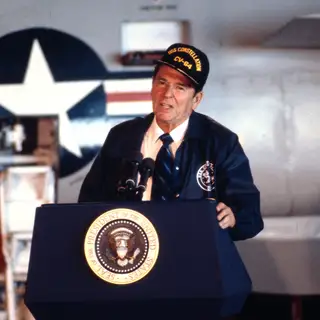
If that is too unsavory, Biden can look to Ronald Reagan’s record. When an American naval destroyer escorting a Kuwaiti oil tanker was hit by an Iranian mine, injuring ten sailors, the Reagan administration responded by engaging the Iranian navy in an eight-hour battle that destroyed half the Iranian fleet. On both occasions, the Iranians backed away from their campaign of aggression — albeit with some superficially hostile maneuvers designed to mask its pullback. Iran can be deterred when the elements of the regime that believe it will not survive a direct conflict with the United States are confronted with just that possibility.
“Do you have a message for Iran, sir?” one reporter asked Joe Biden two weeks ago. “I’ve already delivered the message to Iran,” the president replied. “They know not to do anything.” The question involved Biden’s reluctant decision to finally respond with force against another Iran-backed militia, the Yemeni Houthis, which had crippled international shipping through the Suez Canal with a campaign of terrorism and piracy. That message has not been received — not in the Red Sea, not in Iraq or Syria or Jordan, and not in the hall of power in Tehran.
The Houthis continue to execute successful attacks on Western naval assets and commercial vessels in the region. Iranian proxy groups continue to strike U.S. forces in Iraq and Syria. And from Tehran’s perspective, Iran’s assault on regional stability has been wildly successful. For the low cost of some expendable foreign thugs, Iran has forced the Americans to reposition forces and expend costly defensive ordnance, all but closed the Gulf of Aden to navigation, and now drawn American blood. Whatever the costs Iran has absorbed as a result of its provocations, they are vastly outweighed by their benefits.
The Pentagon will provide the president with a variety of options designed to restore deterrence, none of which will totally obviate the risk of a spiraling confrontation with Iran. But the administration’s paralyzing fear of engaging Iranian assets has failed to advance American interests, and Americans are now dying as a result of the president’s hesitancy.
Americans shouldn’t tolerate another rote response to Sunday’s attack that merely levels a handful of weapons depots or takes some replaceable militants in eastern Syria off the battlefield. The IRGC is the author of these attacks, and Iran must pay for them.





Comments
On “Iran Must Pay”