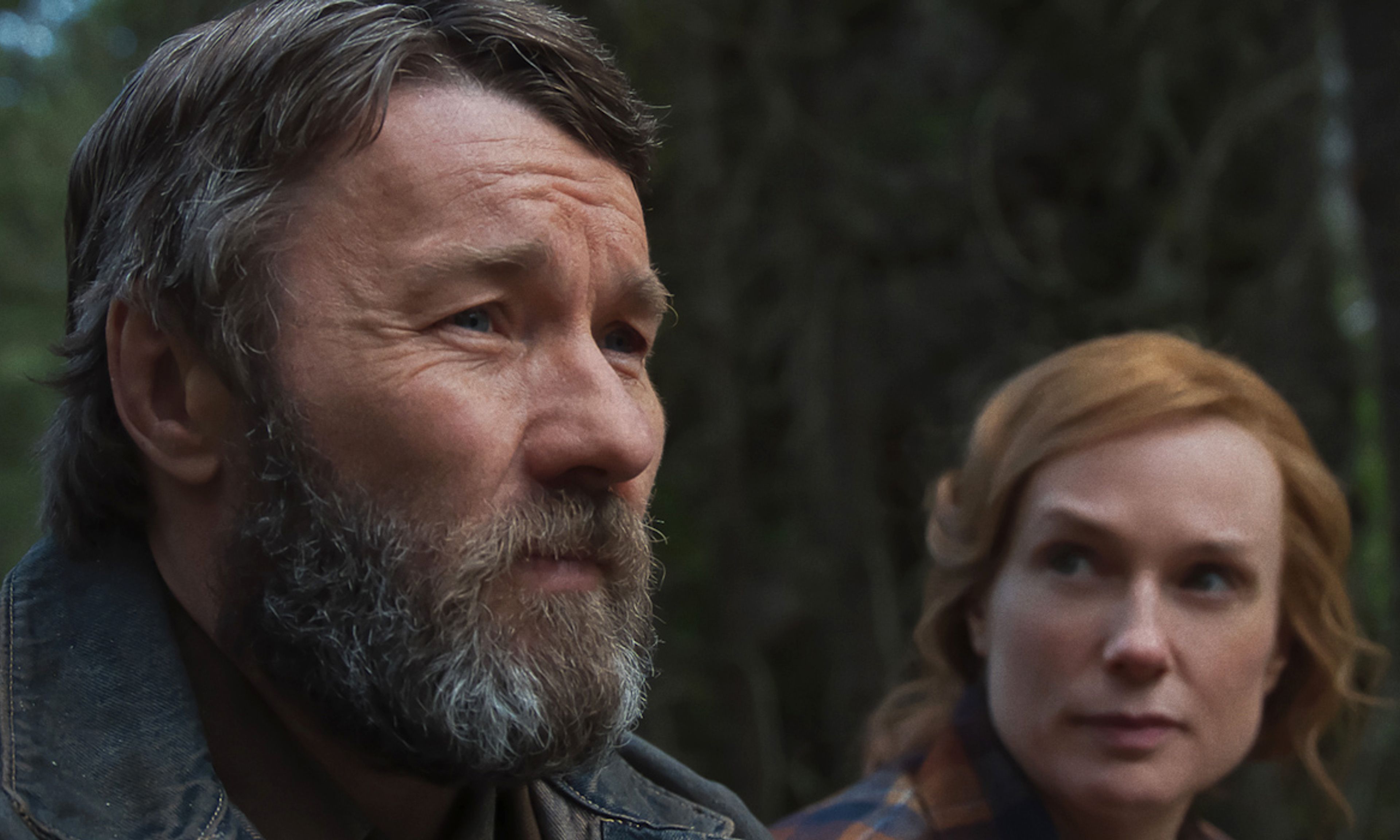
A film as minor as Train Dreams, an Oscar nominee for best picture, provides a perfect example of how politicization has ruined Millennial cinema. For folks who like to think of movies as apolitical entertainment, the concept of Train Dreams proves them wrong. Its protagonist, Robert Grainier (Joel Edgerton), an early-20th-century lumberjack born in Bonners Ferry, Idaho, represents the classic American loner — a fixture in fiction from James Fenimore Cooper’s Leatherstocking Tales to Kelly Reichardt’s Meek’s Cutoff. Grainier is unaware of his existential position in history, but as a solitary white male, his aspirations are shown to be historically deleterious. He possesses a selfishness that is indifferent to political atrocity, and his labor despoils nature.
Using scenes of Grainier in the wilderness, director-writer Clint Bentley illustrates the current distrust of American history, represented by guilty white pioneers. The word “illustrate” correctly describes Bentley’s method of pointing up national character flaws, presenting Grainier as detached, uncommunicative, and pathetic. The idea is to undermine the drive behind American exceptionalism, as Reichardt did in First Cow, her drab imitation of Altman’s exquisite McCabe & Mrs. Miller.
Bentley imitates the animist cinema of Terrence Malick (Days of Heaven, The Thin Red Line, To the Wonder, Tree of Life) where earthly human experience is made metaphysical. Grainier is always a lost figure in Bentley’s pictorialism, and this, too, is deliberate — art serving the purpose of political negativity. Instead of glorying in nature and the spectatorial freedom of cinema as Malick does, Bentley makes pretty pictures about a man always moving toward his demise. When Grainier meets Gladys, the woman who will become his wife and the mother of their daughter, Kate, they are both unrooted people. (Gladys is played by Felicity Jones, the wife in The Brutalist, so this can’t end well.) The couple build a cabin on an acre of land away from society while Grainier goes off as an itinerant laborer, cutting trees to build a railroad. It’s this social grouping of disaffected men (mostly white) that Bentley calls “a temporary family.” These laborers are distinguished by individual eccentricities (Paul Schneider as Apostle Frank, William H. Macy as Arn Peeples) and by random incidents of racial violence — the killing of a Chinese worker, a black man’s revenge killing of a white man “only because of the color of skin.”
These killings take Train Dreams out of the realm of spirituality and romanticism; they expose Bentley’s political intent, his soft-headed topicality meant to frame Grainier’s consciousness. Suddenly, the prosaic narrator (Will Patton) informs us, “One of his earliest memories was that of observing the mass deportation of 100 or more Chinese families from the town. Grainier was baffled by the casualness of the violence.” It’s the same mix of modern terms and nostalgic sentiment that destabilized Nuremberg. We know right away that this film’s period setting and narration language are bogus.
Imagine being a young filmmaker studying Malick and not getting it (or maybe “correcting” it Soviet-style) — not like the great Russian-Ukrainian pantheist Alexander Dovzhenko but as a social justice fanatic. One of Bentley’s artsy études shifts focus from a solemn close-up of Grainier to an anonymous Asian worker staring blankly. It’s the same sort of politicized art fakery that Scorsese gave us in Killers of the Flower Moon, not Malick’s universalizing love — agape. Malick was unconcerned with racism while Bentley seems concerned only with white racism.
Bentley’s view of American history (“You opened up a new part of the country”) follows cynical liberal revisionism. He doesn’t know or seek to see history his own way, which was what made Malick’s founding-of-Jamestown film The New World so astonishing.
Despite cinematographer Adolpho Veloso’s few good images (an interior-lit train at night crossing a low bridge over water, Robert lying in ashes during monochrome dusk with the sun setting in distant trees as rain begins, Grainier rising from bed to approach a Searchers-style doorframe in one fluid shot), Bentley doesn’t match the thematic coherence of Malick’s editing montages. His nature sequences suffer from affectation but without a Wexler, Almendros, or Lubezki to dazzle us. (Those masters would never give us Bentley’s ultimate symbolism — the asinine POV of a tree tumbling to the ground.)
Grainier’s 80-year sojourn is depicted through a series of pensive études. Edgerton’s muted, effective performance has moments of sorrowful depth and adds credible irony when Grainier chuckles at his own useless, mournful daydream. It’s cheapened when one character (Kerry Condon as a feminist land surveyor) summarizes life: “Just waiting to see what we’ve been left here for.” Bentley makes the mistake of feeling superior to the past, to history, unlike the Hollywood pros (Jacques Tourneur’s Westerns) who use the past to understand the present. Nick Cave’s title song, a Dylan imitation that ends the movie, is so on-the-nose about the self-pity of the declining West that it turns Bentley’s politicized nostalgia into a parody of a Malick film. That means Train Dreams is both Malick and Dylan without the artistry and moral purpose.





Comments