
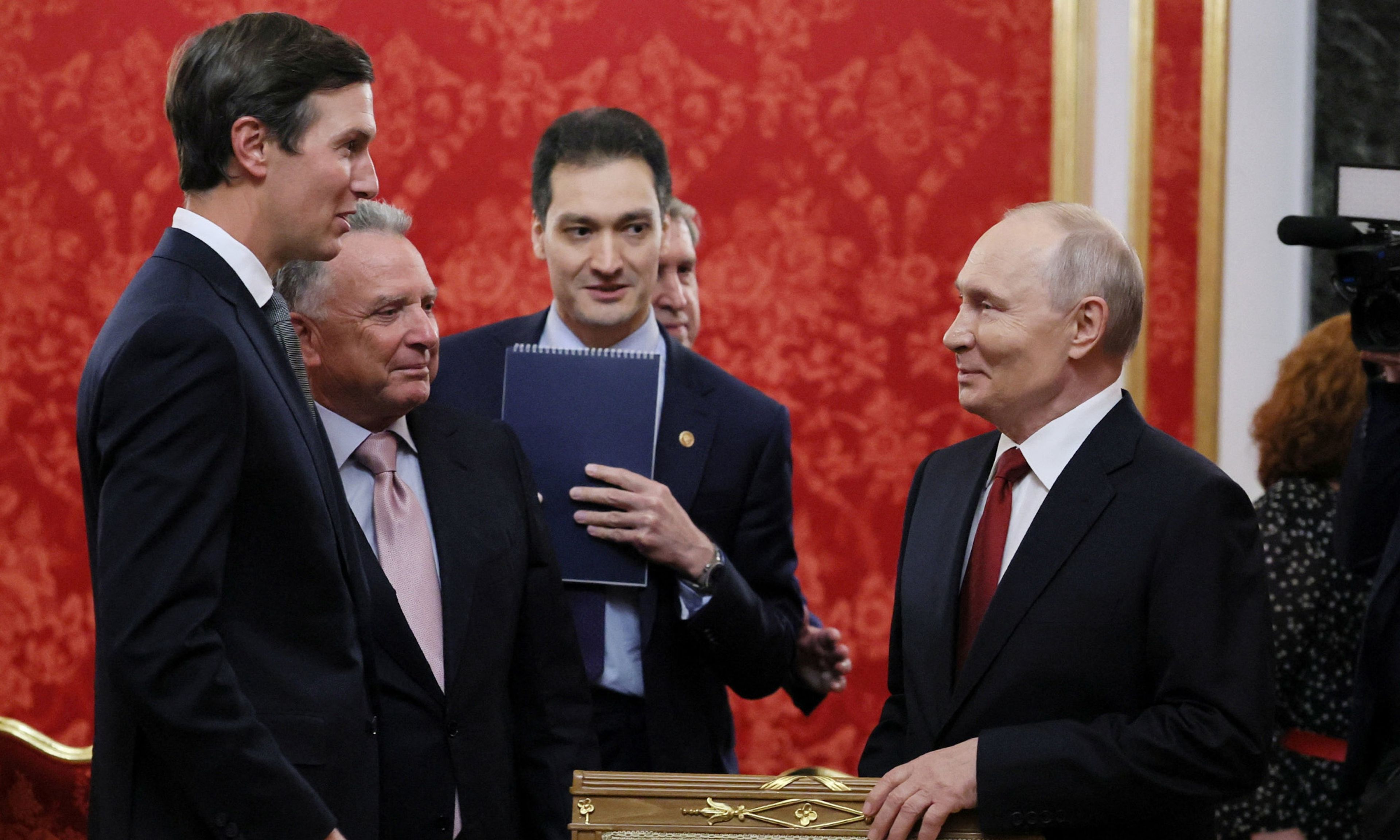
On the menu today: and are meeting with again, as Russia wrapped up the most recent round of peace talks in Abu Dhabi by attacking power plants, and cargo ships carrying grain, with their head negotiator declaring, “Every inch of our land will be returned” and describing Ukraine as “an abscess that burst.” Going great, fellas. Meanwhile, the Trump administration apparently believes that offering Putin a veto over which countries are allowed into NATO will calm things down, and the president reportedly believes that the memorandum of understanding with Iran he signed in June was a costly mistake. Who could have imagined that a treaty signed in Versailles wouldn’t work out well in the end? Read on.
A Veto on NATO Expansion?
Today, Thursday, Russian dictator Vladimir Putin will meet U.S. special envoys Steve Witkoff and Jared Kushner in Moscow. It will be the tenth time in less than two years that Witkoff has met Putin in person. (I’ll bet you haven’t seen some of your relatives in person as often as Witkoff sees Putin.)
In that time, Putin has made zero concessions, unless you want to count prisoner exchanges or a four-day cease-fire in the Oleshky region, a cease-fire that demonstrated that Russia can stop the war any time it wants. (And according to the White House, “First Lady Melania Trump and her representative worked directly with Russian and Ukrainian leadership to define the terms of the localized ceasefire.” Doesn’t sound like Witkoff or Kushner had much to do with that.)
Considering two years of regular meetings have led to almost no discernible progress, you might think that the administration might A) give someone else a crack at it (didn’t we used to have a secretary of state? Have you seen this man?) or B) give up on being an impartial negotiator entirely.
Wednesday, Kushner said, “The reality is there is no trust right now between the sides and that is to be expected after a conflict like this,” adding that the talks in the capital of the United Arab Emirates had touched on territorial issues and that these would be the hardest to resolve.
The Ukrainians have every reason in the world to not trust the Russians. On February 18, 2022, Putin claimed that Russian military drills along Ukraine’s borders were “purely defensive” and “not a threat to any other country.” Days later, the easily and widely predicted full-scale invasion of Ukraine began. The regime in Moscow has broken just about every treaty it ever signed. Why would anybody in his right mind make a concession to Russia in exchange for a promise that Putin or his successor is just about guaranteed to break?
The Russians have their own reasons to not trust the Ukrainians; roughly 1.6 million Russian soldiers killed and wounded since the start of the war. (For perspective, during the Vietnam War, the U.S. had 58,279 service members who died in theater from 1957 to 1975, and more than 300,000 were also wounded during the war. So in terms of soldiers killed and wounded, in four years and eight months, the Russians have suffered about four and a half Vietnam Wars.)
But apparently the latest move from the Trump administration is . . . to offer Russia a role in future decisions by NATO. I wish I were making that up.
For years, Russia has sought a European security deal that limits NATO expansion and scales back its military presence in Eastern Europe. The U.S. has rejected those demands in the past but now appears open to them in some form as part of a broader agreement to end the war in Ukraine.
Why on God’s green earth should Russia get a veto over which countries join NATO?
Whether or not there are any countries we want to invite to NATO is almost immaterial to this. (Bosnia and Herzegovina, Georgia, and Ukraine are non-member “partner countries” that have declared a desire to join the alliance.) The question is, who makes the decisions about which countries are in NATO? Since its founding, the answer was simple: All member states had to agree, unanimously, on admitting a new member.
Now, suddenly, the Trump administration’s position is that Vladimir Putin should get a say.
And Russia wants NATO to shrink. From the Wall Street Journal:
In late 2021, shortly before launching the full-scale invasion of Ukraine, the Kremlin demanded an effective rollback of the North Atlantic Treaty Organization in countries that were formerly Soviet satellites or part of the Soviet Union, such as Poland and the Baltic states.
Moscow also demanded a ban on admitting any new members to NATO and the removal of U.S. nuclear weapons from Europe.
Note that the U.S. is offering this concession to Russia as A) Moscow is intensifying its hybrid war against our allies in Europe and B) night after night, all or almost all Russian ballistic missile attacks target civilians in Ukrainian cities, not military targets.
Under this deal, do we get a veto over Russia’s alliances with China, Iran, and North Korea? If not, Moscow can go pound sand.
The Journal had a revealing detail in another scoop, that Vice President JD Vance is considering face to face talks with a top Iranian security official as he emerges as the lead negotiator with Iran:
Trump in recent weeks has privately criticized the June memorandum of understanding that Vance helped negotiate and questioned whether it was a costly mistake, two officials said, arguing that it gave Iran critical time to regroup and rake in oil revenues before the U.S. imposed a naval blockade. A White House official denied that Trump had second thoughts about the MOU and said the negotiators had operated in good faith. A spokesman for Vance declined to comment.
Now, think back to what people said about the memorandum of understanding in June.
The Editors: “Trump has said in the past that Iran has never won a war yet never lost a negotiation. As the president and his administration now make the case for a memorandum of understanding that doesn’t meet any U.S. strategic objective, it’s impossible to say he was wrong.”
Rebeccah Heinrichs: “The MOU gives the momentum to Iran. There’s not much for Americans to like about the Memorandum of Understanding with Iran.”
This newsletter: “The U.S. government end[ed] up giving away the store to Tehran. There’s a lot to unpack in the U.S.-Iran memorandum of understanding, and almost all of it is bad.”
Meanwhile, what was the president saying back in June? “We reached an agreement with Iran that achieves everything we set out to accomplish, everything and much more, ending the current conflict, reopening the Strait of Hormuz, and preventing Iran from ever obtaining a nuclear weapon.”
Now, the president reportedly thinks the memorandum of understanding with Iran was a “costly mistake.” Often what the administration’s fans perceive as baseless criticism and “Trump Derangement Syndrome” is just clear-minded folks trying to save the administration from its own bad judgment.
Some serious questions: Does the president truly understand what his negotiators have agreed to on his behalf? Or whenever they come back with, “We’ve got a deal,” does Trump just reflexively start telling reporters that he is signing the most consequential document since the Magna Carta?
And if the president thinks the memorandum of understanding with Iran was a “costly mistake” . . . why is he trusting the same crew to keep negotiating on his behalf?
ADDENDUM: Over in the Corner, an observation that former President Joe Biden seems oddly blasé about his doctors not doing a PSA test on his blood — the kind of test that would have detected his prostate cancer earlier, before it spread — for more than a decade, and pointing out that while we should always stand up against hatred and discrimination against any religious group, including Hindus. We do not have to make Diwali a federal holiday to do this.






Comments