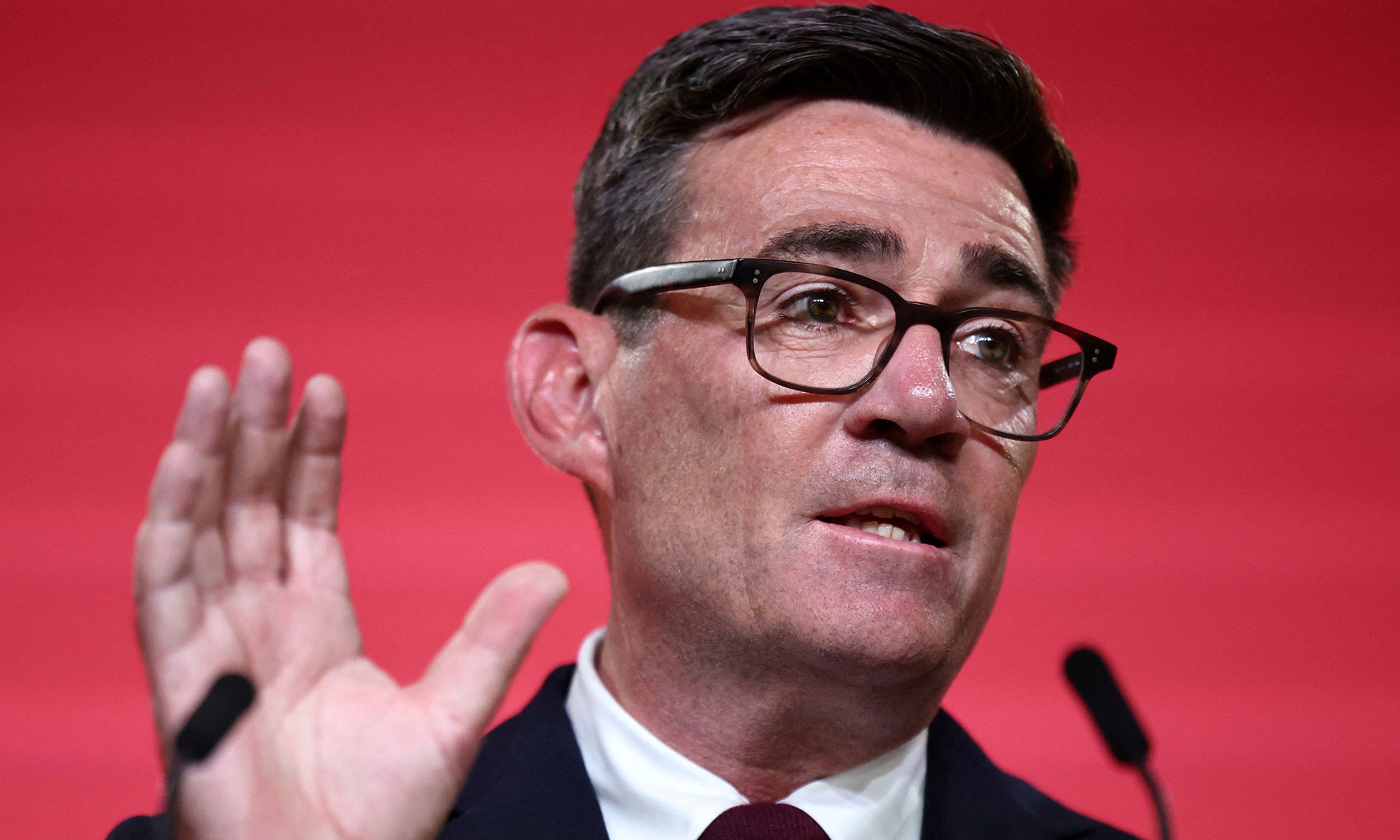
On Friday, Andy Burnham, who becomes prime minister of the United Kingdom today, gave his inaugural speech as the new leader of the Labour Party. He stated that he will “be a pro-business leader.” If Burnham’s past is any indication, nothing could be further from the truth.
Burnham has had a long career in politics, having first been elected to Parliament in 2001. Burnham served in the governments of Tony Blair and Gordon Brown, the latter of whom he ran to succeed in 2010 after Labour’s defeat in that year’s election. Instead, party members went with Ed Miliband, who appointed Burnham to his shadow cabinet. After Miliband’s defeat in the 2015 general election, Burnham tried once more, losing to Jeremy Corbyn, who again appointed him to his shadow cabinet.
Elected mayor of Greater Manchester in 2017, Burnham went on to develop a legendary reputation for implementing working-class, left-wing policies. During the Covid lockdowns of 2020, as British deficits reached levels unseen since World War II, Burnham held that Manchester and north England were — just like under Margaret Thatcher! — being left behind by evil Tories. His confrontations with Boris Johnson’s government raised his national profile and earned him widespread acclaim. In 2023, he launched an integrated public transport system in Manchester with fares capped at £2 ($2.70) — in great contrast with the rest of the country, where fares were rising — which generated additional positive coverage. His embrace of a “Housing First” program to fight homelessness further endeared him to Labour’s grassroots activists, who, despite having twice rejected him, soon began to speak of Burnham as the prince who was promised.
Over the course of his career, Burnham has shown a malleability in his positions on many issues that seems to depend on whether his boss’s name is Blair or Corbyn. Yet there are overarching themes on which he has been consistent — and because of this, Burnham is bad news for business.
Burnham has always been a major supporter of local government and of devolution. He has correctly noted that London is the only real economic engine left in Britain. While growth in most of the U.K. has been dismal since the financial crisis of 2008, London has kept the lights on. The reason is that London is home to most of the few British industries that remain internationally competitive — most crucially, the country’s financial and tech sectors. To Burnham, however, this relative success is proof of a great injustice inflicted on the rest of the country by a London-centric government.
He is set to reverse the AI-friendly policies that were among the few pro-growth measures enacted by his predecessor, Keir Starmer. Unlike Starmer, Burnham is skeptical of “AI growth zones,” where data centers may be built without the typical red tape. Nor is he a fan of the driverless cabs that were recently launched in London, arguing that they take away jobs. In classic socialist manner, he seems more concerned with punishing London for the audacity of growth than he is with lifting up the rest of the country.
The London government does not think only of London. To the contrary, the goodies Burnham handed out in Greater Manchester during his time as mayor were to a great extent funded by ever-growing regional grants, courtesy of Westminster. This reflects the fundamental flaw in Britain’s devolution. Mayors and first ministers can act as the “good cops” who hand out subsidized bus fares or even free university tuition in their territories, whereas all the “bad cop” elements of governing (such as raising taxes) are handled by London. Local government without local accountability has successfully catapulted mayors like Burnham (and Johnson) into political stardom, yet it is a poor way to run a country.
The real injustice done by the London government is not that it’s London-centric but that it has destroyed British competitiveness by raising marginal tax rates, embracing net-zero, and allowing local NIMBY councilors to stop or delay new infrastructure and housing. Unfortunately, Burnham has already indicated that he will raise taxes further, and while there are hints that he may allow some already planned oil and gas drilling in the North Sea to go ahead, he is committed to the green transition. On housing, rather than deregulation, he intends to “launch the biggest council house building programme since the post-war period,” despite the documented distorting effects of such housing.
This fits seamlessly with Burnham’s story of a Britain that was supposedly destroyed by Thatcher’s “neoliberal” policies — including the sale of council homes to tenants — and never recovered. To hear him tell it, Britain’s high point was during the 1970s: a zenith perhaps for punk rock and aspic but certainly not for business.
Perhaps Burnham, who was born in 1970, views the decade through the rose-colored glasses of a child. He appears utterly bewildered as to why Brits elected Thatcher in the first place, and he has made misrepresentations of Thatcher’s legacy a frequent talking point. He cannot comprehend that the reason his first boss, Blair, had to move the Labour Party to the right and accept the “neoliberal” consensus was precisely because Thatcher’s approach had proven so irrefutably successful. During the Thatcher era, Britain’s real GDP per capita outpaced the United States’, which it hasn’t done since.
Last month, Tory leader Kemi Badenoch made a pointed remark on the plenary floor to the effect that Burnham is just like Starmer, only with “a pair of eyelashes and a black T-shirt.” As bad as the status quo is, British businesses should count themselves lucky if that is all the change that Burnham brings.




Comments