Key Takeaways
- Allegations surrounding Nvidia expose potential national security vulnerabilities at the heart of America’s AI advantage.
- Washington must demand accountability without crippling a company essential to beating Beijing in the AI race.
Share this story
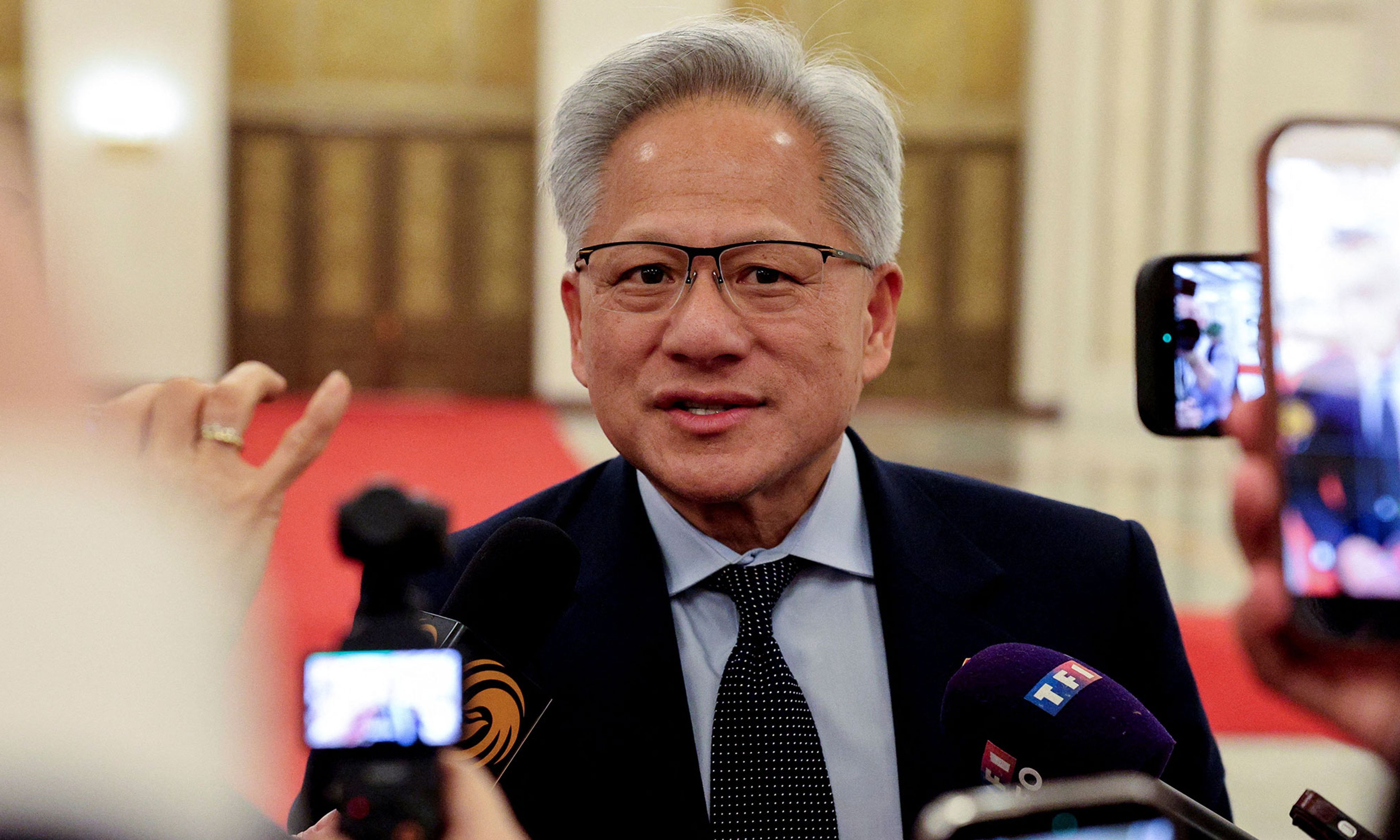
Nvidia CEO Jensen Huang speaks to the media on the day he attends a meeting between Chinese Premier Li Qiang and U.S. business representatives at the Great Hall of the People in Beijing, China, May 14, 2026.
Go Nakamura/Pool/Reuters
Many Americans have their doubts about our cutting-edge AI, but as the drama now surrounding seems to suggest, the Beijing regime does not feel the same way.
As a reminder, , Nvidia’s CEO, put out a statement in which he admitted to having had an extramarital affair. The “other woman” has been identified in numerous reports as Alice Huang (no relation), a Chinese national.
Ms. Huang joined Megaspeed, a Singaporean company at around the time it moved into the data-center business shortly after a Biden-era tightening of . She was briefly its managing director and sole shareholder and is believed to retain an executive role. She has not commented publicly on Mr. Huang’s admission. Her current whereabouts are unknown.
The principal focus of Megaspeed’s operations has been described as renting out computing power relying on Nvidia’s advanced chips (which it has bought in huge quantities) to its customers, enabling them to use it remotely. This is allowed, with exceptions, under U.S. law. What is not permitted is for the most advanced chips of this type to be exported to China. Little is known about Megaspeed’s client base (other than that it included Alibaba, the Chinese technology and e-commerce group), ultimate ownership (Ms. Huang had meanwhile sold her interest), or funding.
Megaspeed and, reportedly, Ms. Huang have attracted the attention of the U.S. authorities. Megaspeed has been accused of smuggling contraband chips to China. U.S. intelligence is said to have been aware of Ms. Huang’s relationship with Nvidia’s CEO and identified her as a Chinese spy, information reportedly passed on to senior officials in Washington. Megaspeed has denied the allegations against it (investigation of which was abruptly transferred from the Commerce Department to the Justice Department). Up until now, Nvidia has said that it found nothing amiss. China has rejected allegations of any spy plot.
Mr. Huang has said he will cooperate. The FBI is also digging, and Congress is taking a closer look. The investigations will reveal what they will reveal. Mr. Huang’s obligations as a husband are a matter solely for him and his family. As a CEO, however, it looks as if, to put it mildly, he has taken risks that he should not have. Unless he made some preemptive disclosures, the affair posed obvious intertwined questions about conflict of interest (Megaspeed was a large client after all), national security, and the threat of blackmail, all issues of which he must have been aware. Even if he has broken no laws, he appears to have put Nvidia into a position in which it should not have been. This story, as we know it so far, also raises issues about Nvidia’s corporate governance (who, if anyone, was keeping an eye on Huang?) and its relationship with the government. Who knew what and when, and what did they do, if anything, about it?
Handling this will be complicated by the nature of the AI “arms race” with China. It is a competition in which the U.S. is primarily participating through its private, not public, sector. To be sure, private companies were heavily involved in the Cold War’s arms and space races but mainly as government contractors, a relationship in which Washington, as the customer, set the agenda — and the rules. This time around, the private sector is leading the way, driven by its ambition to compete commercially. It is ahead of China to a degree that an effort dominated by the government would not match, but it’s a lead that Washington, if it mishandles its response to this mess, could all too easily undermine. China wants to win the AI race. So must we, and we must act accordingly.
That will require recognizing how critical Nvidia currently is. It supplies about 90 percent of the microchips used for training AI and 70 percent of those needed to run LLMs, and it is using its cash to play an important part in funding the development of America’s AI ecosystem. Its role will become less dominant — free markets and changing market leadership go hand in hand — but for the government to apply a wrecking ball to the company now would be madness.
There clearly need to be changes to the way that Nvidia, which is unusually dependent on one man, Jensen Huang, is run, and there needs to be accountability for what has taken place. But assuming his missteps turn out to be a matter of a terrible lapse and nothing more, the changes needed will probably be evolutionary rather than revolutionary. We should not want the disappearance of the executive energy that has made Nvidia the colossus it has become.
We do, however, need once again to examine what chips U.S. companies may sell to China. The efforts that the Chinese appear to be making to get hold of a U.S. product make the case for not selling it to them. Mr. Huang has argued that if the U.S. withholds more advanced chips, the Chinese will develop their own. They will try to do so anyway. Beijing’s instincts are autarkic. There is no sense in the U.S. making that task any easier.
Finally, it must be hoped that politicians do not exploit the fresh indignation now being stirred up about an already unpopular industry for their own purposes. To do so risks hobbling American AI. And that would hand Beijing a win far greater than anything that Megaspeed or Ms. Huang might have delivered.

About the Author
The Editors comprise the senior editorial staff of the National Review magazine and website.
Advertisement
Advertisement

Enjoy this article on us.
Create a free account to keep reading.




Comments