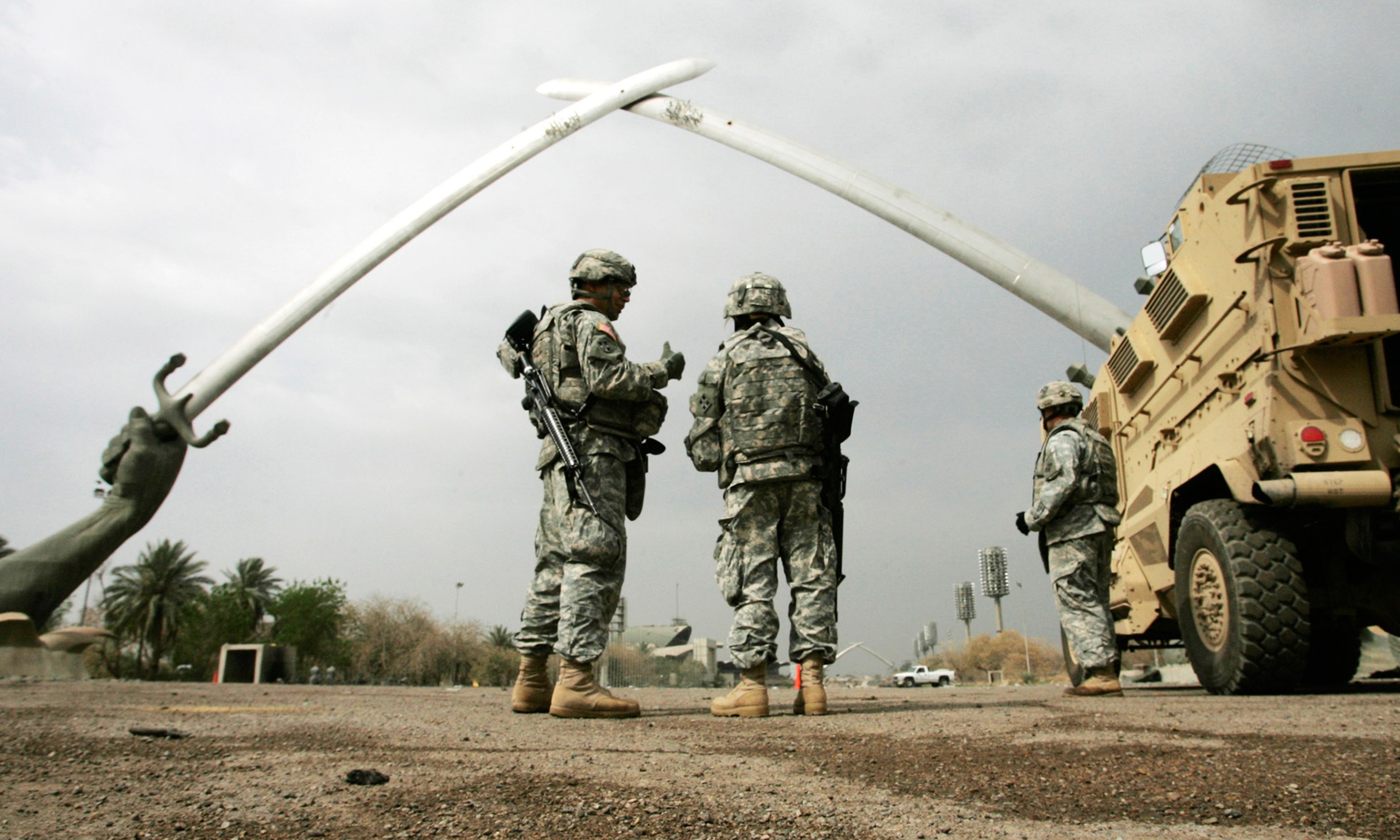
Baghdad
You hear certain things over and over, as you spend some time in Iraq. You hear them from Iraqis, Americans, and others. What you hear is: We’ve made great progress in 2008. Al-Qaeda, the militias, and the rest of those lovelies are on the run. But our progress is fragile and reversible. If the coalition leaves too soon — before Iraq can defend itself — there will be hell to pay. If we leave too soon, our work will be for nought.
You also hear, Iraqis don’t want Americans and other foreigners in their country. (That includes foreign terrorists too, of course.) No one likes to be occupied. At the same time, Iraqis are very, very worried about the American departure: a departure that precedes stabilization. It’s “Yankee, go home — but don’t leave us at the mercy of the wolves. Go home at the right time.”
One word you hear constantly is “normalcy.” That is the great Iraqi desire: normalcy — a normal life, in which one can study, marry, have children, work, and pray, as countless people do elsewhere. Normalcy is not a modest goal, it is the shining ideal.
Four of us journalists are here in Iraq, invited by the State Department. The feeling at State, it seems, is that Americans have lost touch with Iraq. The war is off the front pages, and sometimes doesn’t even make it to the inside pages. Is that because it’s going better? Can Iraq be news when it’s not a debacle?
The American embassy in Baghdad is one of Saddam’s old palaces. Our GIs are swimming in his pool, an amazing fact. In the ballroom, missiles shoot upward — that is, they do so in a painting on the wall. The painting is as crude as Saddam’s ideas and ambitions. In this ballroom are makeshift offices, and the sign on one of them catches my eye: “U.S. Department of Justice —Committee on Integrity.” History is a remarkable thing.
We have a tour of the International Zone, or Green Zone, conducted by an Iraqi. He mentions the depravities of Saddam’s regime, and you can almost hear the fear in his voice (a remembered fear). I’m reminded of the title of an invaluable book: “Republic of Fear” (Kanan Makiya). It seems to me that Westerners forget about Saddam’s regime, or will themselves to: the “rape rooms,” the children’s prisons, the feeding of men into industrial shredders, the cutting out of tongues for dissent.
I often think, during my stay here, “It’s good we got rid of Saddam. It’s good that we overthrew him. No matter the difficulties that ensued — it was a good thing in the world.”
We meet with an army of generals, led by Lt. Gen. Frank G. Helmick, who wears two hats: He’s head of the “multinational security transition” — the handing over of responsibilities to Iraqi authorities; and he’s head of the NATO mission. “A lot of people don’t know NATO is here,” he says. A lot of people don’t know a lot of things about Iraq.
For two hours, the generals brief us about what is happening: about what the coalition is doing to stand Iraqis on their feet. In sum, the coalition is watching over every Iraqi sparrow. And I have a couple of main thoughts: One is, have foreigners ever done so much for a country? I think of another book title: “The Foreigner’s Gift” (Fouad Ajami). Of course, you could say, “We broke it, we have to fix it” — but the country was broken before, badly. And we are changing it.
I also think, why aren’t these guys on television? Why aren’t they famous, explaining Iraq and our mission to the American public (and other publics), just as they’re explaining it to us now? They are hardly Pollyannas or snowers; they are sober and realistic. And people could stand to hear from them. PR failings in this war have been pronounced.
Before we leave, Helmick, who likes football, quotes Coach Lou Holtz at Notre Dame: “We know we’re not where we need to be. But we’re glad we’re not where we used to be.”
HOUSE TO HOUSE, ROOM TO ROOM
Our group goes to a series of training centers, to see Iraqi forces being prepared to take over more of the fight. They practice going from house to house, and room to room, looking for terrorists. They learn to disable IEDs (improvised explosive devices). They show us how they protect dignitaries — cabinet members, judges, and the like. “Dignitary protection” is an extraordinarily important function.
From year to year, Iraqi officials come in for a lot of criticism, and criticism is no doubt deserved. (Saddam did not come in for much criticism, of the open kind.) But I try to remember: These guys risk a lot, when they assume their posts. They make themselves targets of terrorists, and they make their families, friends, and associates targets, too. How many of us would be willing to step up?
Where special forces are trained, we ask a man some basic questions. “Why did you join up?” “To defend my country.” “Against whom?” “Terrorists.” “Did your family suffer under Saddam Hussein?” “Yes, a lot of families did.” “Are Americans occupying your country?” “‘Occupation’ has different meanings. Saddam Hussein occupied this country.” Incidentally, this man’s brother was killed not long ago, because terrorists learned that he — their victim — had a brother in the special forces. We hear a lot about sacrifices such as this.
An American who works with Iraqi special forces says, “They’re all in. They’re committed. This is their home. I can leave, but they have nowhere else to go. They have to stand and fight.”
No one is more keen to stand and fight than Colonel Abbas, whom we talk to elsewhere. He says he was the first man to join the Iraqi army — the new Iraqi army, in July 2003. He calls you “my brother.” No one is more grateful for American assistance than he. And he calls the enemies of Iraq — al-Qaeda, the militias, the Saddam remnant — “the bad people.” That is his shorthand: “the bad people.” To many, that would be simplistic, even laughable; but, to me, it sounds about right. Abbas has ample experience with the bad people: His infant daughter was killed when they attacked his house. And his father later died from the effects of that day.
Abbas wants one and all to realize what is at stake in Iraq. He says that, if the coalition pulled out — before its time — it would hand victory to al-Qaeda and Iran. And hand Iraq to those elements, too. “I wish I could talk to Obama, to tell him the reality of Iraq, instead of whatever is in his mind.” About President Bush, he says, “He’s a great man in the world. I want to see a monument to him in Baghdad. A man like him comes every 300 years.” You don’t hear this about Bush very often — at least at home. But Abbas is entitled to his opinion too, isn’t he?
He has great faith in the American people, upcoming election or no upcoming election. In fact, I sense an almost naïve faith. And as our group walks to waiting helicopters, I think of Vietnam (as I do throughout this trip). There were lots and lots of Vietnamese like Abbas. The luckiest of them ended up in California. I think of April ’75, one of the most shameful months in our history — all those people, desperately clinging to the helicopter skids. Could this happen to Iraq? Could we turn our backs on them, leaving them to be devoured?
In front of the “helos,” Abbas embraces us and says, “God bless you.” I say the same to him, and mean it, deeply.
IDEALISM IN ACTION
On our schedule is a tour of a market called Doura, in Baghdad’s Rashid district. As we make our way there, I meet a man named Walter Koenig, who works with a PRT, or Provincial Reconstruction Team. He calls himself a “State Department reservist.” And I’ll tell you his story, briefly.
A businessman, he worked in the Middle East for a number of years. He is now the CEO of a manufacturing company in Florida. He took a leave of absence from his company to come do this (after talking with his board and his family — not necessarily in that order). Why’d he do it? Why’d he come here? “I wanted to serve my country.” Also, “it sort of makes up for not having been in the military.” And “it’s exciting to see things develop here” — to see Iraqi communities come back to life, or have a chance at life.
There is no doubt much cynicism in Iraq, and many Americans and other Westerners are surely tired. But I see a striking amount of idealism, too.
Rashid and Doura were once dead and deadly, but are now alive (more alive) and safe (more safe). We see a bridal shop and ask the owner, “How’s business?” “Good, thank God.” “How do you account for it?” “When people are more secure, they’re more likely to marry.” His best wedding gown rents for $60 a day.
Capt. Daryl Carter knows this neighborhood like the back of his hand, and he leads our tour. He greets the kids, throws out bits of Arabic. He has coaxed many storeowners back to their stores, assuring them it is safe to return. That’s the job of a captain? Yes, part of it. I’m often amazed, as I tour Iraq, at all the U.S. military does. This is really Erect-a-Nation.
And I note the easy interaction between American soldiers and Iraqi citizens, many of them. When doing so, I think of a German friend of mine. Earlier this year, he told me that his grandfather was a POW of the Americans, and always remembered the Americans fondly: because of their humanity. But such humanity is not being shown in Iraq, said my friend — at least as far as he could tell. What’s happened to the American spirit and the American heart? No wonder the world has turned against America.
It’s all baloney, of course: Bonds are being formed here as in WWII and other conflicts. But stories aren’t getting out, that is true.
I walk through the market with Gen. Robin Swan, and he notes a key distinction between Iraq now and Iraq then — Iraq post-surge and Iraq pre-surge. Terrorists can still perform spectacular bombings, for sure. But sectarian violence does not now follow those bombings. Life goes on. And the bombers are denounced.
He also answers a question of mine in an interesting way. Earlier, in a meeting, I asked, “Why are these terrorists so hard to beat? Why can’t we subdue them, after all these years?” Swan points to a man browsing a stall and says, “Is he AQI?” (meaning Al Qaeda in Iraq). “How about this guy? And how about him? Are they AQI?” You can’t tell. They don’t wear uniforms. They melt into the population. All it takes, really, is one guy to wreak havoc. Say he rolls a grenade in a crowded place like this. It makes the news, and countless Americans say, “See? They don’t want us there.” What do you mean, “they”?
As we chopper from this district back to the Green Zone, Swan points below to an amusement park, recently reopened: “I really wanted to get that park open again. It’s a return-to-normalcy issue.” There are thousands of such issues in Iraq. And, to say once more, isn’t it amazing what our military is doing — working to get people to reopen their amusement parks? Is that what the boys went to West Point for? This is, indeed, Erect-a-Nation — or “a full-service military,” as Swan says, with a smile.
REALLY, REALLY IMPORTANT
Ryan Crocker is the U.S. ambassador here, and he has been ambassador in many Middle Eastern countries — also in Pakistan. He gives us an extremely interesting and informative hour. And at the end, I ask one of the most clichéd questions (but often a useful question): “Is there anything else you’d like to say? Is there anything that people should know?” Yes, actually: “Iraq is really, really important. How things go here will transform the region and America’s role in the region, one way or the other. . . . People are tired of Iraq. They say, ‘Let’s get it over and done with. We don’t want to watch the Iraq movie anymore.’ But the Iraq movie will go on for many more reels, with or without us. And it will have a big effect on us, whether we like it or not.”
We visit the detention center at Camp Cropper — a place where they bring in jihadists, holding them for a spell. Must be a hellhole of torture and deprivation, huh? Not really. Detainees are treated to the best medical care, and to conscientious nutrition. To “life skills” classes, “Islamic discussion” sessions, and so on. They get regular visits with their families —“which is more than we get,” comments a soldier. When they’re released, they’re given a choice of clothing — Western or Arab — and $25 to put in their pocket. Some mothers ask the center to keep their sons for longer.
Among the classes is a sewing class, and the instructor shows us the “graduation piece” — it is a stuffed camel, known as “the Cropper Camel.” I’m thinking, “What does al-Qaeda teach the people they capture? What is their graduation piece?” But those are bitter thoughts, and one must not be bitter. It’s hard to avoid, however, when thinking about Abu Ghraib: and how the world rejoices in identifying a few misdeeds with the entire American project in Iraq.
Our group wends its way to the Faw Palace — one of Saddam’s pleasure palaces. Hideous debauchery, and horrible crimes, took place here. But now it is coalition headquarters. And the place is crawling with American soldiers, which does my heart good — just as it would have to see them crawl around Berchtesgaden.
Guarding the palace are marines from Tonga — yes, Tonga. And I see or hear about other foreign nationals working here in the coalition: Brits (of course), Aussies, Italians, Danes, Romanians, Bulgarians, Ukrainians, Ugandans, Peruvians, Salvadorans . . . I think about what Donald Rumsfeld once told me about the small countries, and the modest forces they send: “Yes, the countries may be small, and they may be contributing relatively few men.” (I’m paraphrasing.) “But maybe it took political or personal courage to contribute even that number. And maybe those men constitute a significant percentage of their country’s armed forces. Does anybody ever think of that?”
No.
In the Faw Palace, we sit down with Gen. Ray Odierno, who is “CG” —commanding general—of coalition forces in Iraq. He gives us an overview. And we question him hard. He has a knack for putting things plain. For example, “In 2006 Iraq was a failed state. Now it is a fragile state.” We have not yet reached the point of Iraq’s being a “stable state.” But that is what we’re driving toward. Gradually, we are turning matters over to the Iraqis, alone. “I want our forces to reduce their visibility yet maintain their effectiveness. I tell them I want everything.” We have invested so much, over these five and a half years: “I hope we’ll be able to finish this and do it right.”
I chew over those words: “I hope we’ll be able to finish this and do it right.” Me too.





Comments