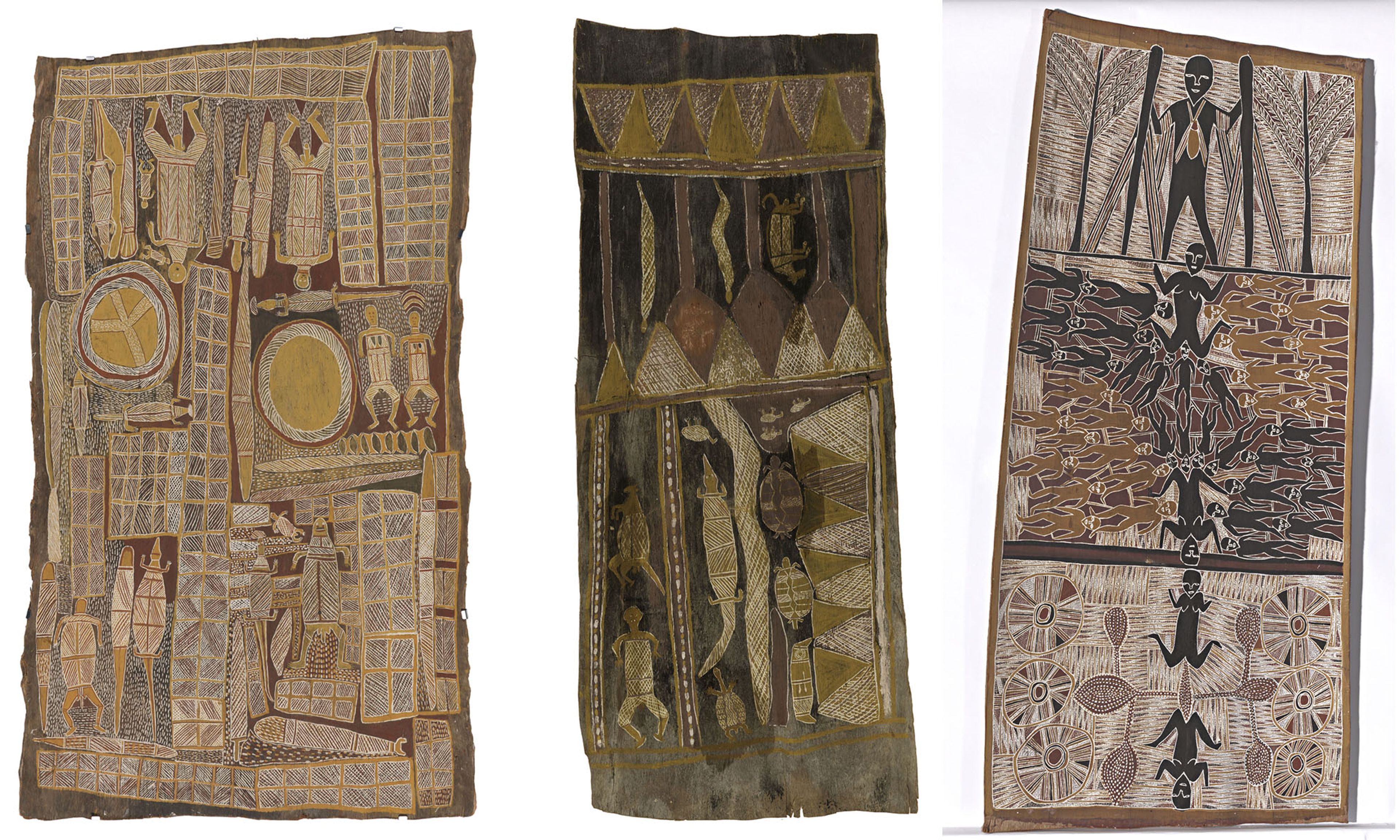
From stories about Pompeii last week to a piece about Australia today. I did indeed spend a day in Pompeii but not in Yirrkala, a knob on the north coast of Australia where bark — the flattened bark of eucalyptus trees — is a painting canvas for Aboriginals who’ve lived there for thousands of years and for those who now keep the aesthetic tradition alive in Australia’s big cities. Madayin: Eight Decades of Aboriginal Bark Paintings is the new exhibition at the Asia Society in Manhattan, on Park Avenue and 70th Street. It’s one of my favorite places, not only for good art new to me, an American art scholar, but for clear interpretation and lovely, human-size galleries.
I’d been looking forward to this exhibition and wasn’t disappointed, though the curators might say “for all the wrong reasons.” I went to the exhibition agnostic on the plight of Australian Aboriginals. I didn’t know much about the place, though I do follow Australian politics because it’s a close, indispensable American ally. I like Australians, who seem good-natured, but it’s never been a must-visit destination for me. No place could be further from Vermont, except the Moon, and Australia might be too much like California, where I can travel in a few hours.





Comments