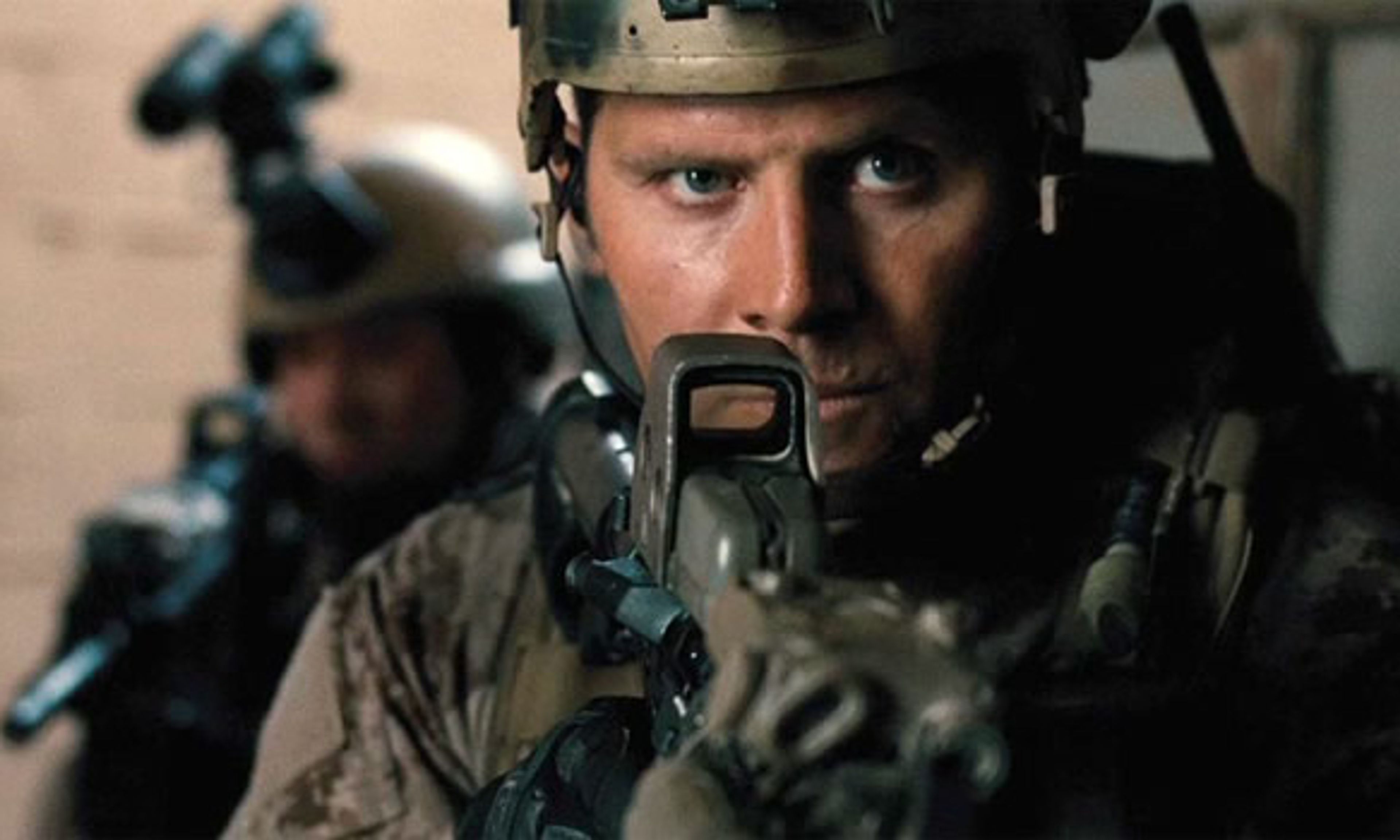
The movie Act of Valor debuted last week, making $24.4 million in its opening weekend and bringing in $28.4 million in its first five days in the theaters. The action movie offers a unique twist to the genre: The main characters, a Navy SEAL team, are played by actual active-duty Navy SEALs. Director Mike “Mouse” McCoy touts the movie as a new genre of film, “the authentic action film.”
On the film-review aggregation site Rotten Tomatoes, only 30 percent of professional critics gave Act of Valor a good review, while 86 percent of site users said they liked it. Some of this is self-selection, of course; if an ordinary moviegoer doesn’t want to watch a particular movie, he’ll just avoid it.
But the criticism of a movie that set out to offer unparalleled realism has taken an unexpected direction. It seems some critics find it . . . not all that believable.
Does it seem ironic to find Richard Corliss of Time calling a movie starring professional military men “amateurish”?
Does he mean that those behind the camera are amateurish? But large chunks of the cinematography feel straight out of well-reviewed action movies like the Jason Bourne series. Take the opening scene, in which the cameraman jumps out of the plane with the SEALs during training — a high-altitude, low-opening parachute jump — or the scene giving us the view from the front of a motorcycle weaving through the crowded streets of Manila. A lot of the action sequences are quite well edited; they maintain the strangely lost art of making sure the audience can tell where everyone is in relation to everyone else, and what’s happening moment to moment. There’s a reason people joke that the Transformers series looks as if the film was edited with a food processor.
The sound editing? During the action scenes the movie will pause and let us hear only the breathing of the SEALs.
The score?
Corliss sneers of the villains, “Virtually all ethnic and religious stereotypes are represented, including one that hasn’t been seen much in movies lately: the avaricious, hook-nosed Jew. That’s Cristo [sic], whose merger with Shadad may be meant to show that Muslims and Jews can work together. Alert Iran.”
There is much that needs to be unpacked here.
First, what is “stereotypical” about a Chechen jihadist? It was not long ago (2008) that there were complaints that Hollywood had entirely ignored Chechnya. When did that character become stereotypical?
Or would Corliss deem the Central American and Mexican drug cartels in the film stereotypical? Should the filmmakers have pretended that these groups don’t exist? Should the plot have involved an effort to sneak across the border from Canada in order to seem more original?
The character of Christo appears to be inspired by one of several notorious smugglers and arms dealers from Ukraine in recent history. (Ukraine is the eleventh-largest arms exporter in the world.) One is Victor Bout (the inspiration for the film Lord of War); Bout was born in the Tajik region of the Soviet Union, but some intelligence sources have indicated that his heritage was Ukrainian. Leonid Minin was another notorious international arms smuggler, also Ukrainian. A third is Semion Mogilevich, a Ukrainian-born organized-crime boss tied to many criminal enterprises around the world, and one of the FBI’s Ten Most-Wanted Criminals. Mogilevich and Minin are reportedly of Jewish heritage, and Bout is rumored to be Jewish.
As for Christo’s faith, it comes up precisely as one might expect: The SEALs express surprise that a Jew would work with a jihadist, but then shrug and get down to business. There is no indication that Christo is religious or any suggestion that he is representative of Jews as a whole. As for the movie’s notion of the Ukrainian Jew and the Chechen growing up together, relocation of ethnic groups under Stalin began in earnest in the 1930s and continued to the 1950s, including in Ukraine and Chechnya.
Finally, Corliss gripes that the villains “also can’t shoot straight,” even though the movie depicts three SEALs being shot.
Many of the reviews complain about “stilted dialogue.” One can’t help wondering if Hollywood skews our sense of what is real. Perhaps we’re used to the commanding officer being played by a Gene Hackman or Morgan Freeman type, dispensing bits of worldly wisdom to a nodding junior officer, articulating each word with the precise tone and nuance that would transfix any listener. Except that the world is full of people who speak tersely, curtly, flatly. I’ve spent about 15 years transcribing interviews and recorded events; off the cuff, large swaths of people speak in a manner that most audiences would find dry, monotone, undramatic, or not “natural.” (For a movie with allegedly stilted acting, one leader of the team gets a pretty riveting, tense-but-funny interrogation scene, featured heavily in the “making of” featurette. Chalk it up to his intense stare.)
Tim Grierson of the Independent Film Channel raises a better question: Do audiences want realism in their action movies? After laying out the joys of escapism, he concludes:
The answer may lie in the trailers I saw before Act of Valor. In trailer after trailer — whether it was for John Carter or The Raven or G.I. Joe: Retaliation — I was struck by how effects-heavy and, honestly, fake they all seemed. They could all be great films, but with our current obsession for CGI [computer-generated imagery], we’re inundated with action movies in which everything is possible but not much looks real. Act of Valor is a forgettable film, but its success this weekend is a reminder that there’s always an audience craving something that feels a little truer. We all love the escapism of movies, but sometimes the illusion of authenticity can seem pretty appealing as well.
A fascinating phrase: “the illusion of authenticity.”
Modern audiences may have seen so many action movies, with so many well-worn concepts — film has an entire world of tropes that audiences have grown used to and come to expect — that perhaps some viewers have come to believe that film’s traditional portrayals of these things are more “realistic,” so that actual reality seems fake.
Part of what makes Act of Valor work in a way that no recent action movie has is the way it throws out almost the entire system of tropes that action movies have conditioned audiences to expect. (This is what makes it ironic that the most critical reviews have sneered that it is clichéd.)
When you see Tom Cruise playing a spy in the Mission: Impossible series, how many audience members watch and think, “That’s Ethan Hunt up on the screen,” and how many think, “That’s Tom Cruise up on the screen”? Even the best war movies succumb to this; during Black Hawk Down, how many audience members briefly paused during an early scene for a moment of recognition: “Hey, it’s Ewan MacGregor! It’s Josh Hartnett!” This is why some actors never quite equal their first breakout performance; in that first role, to the audience’s eyes, they are the character. Once they’re stars, they’re stars, recognizable from all the previous times a viewer has seen them. All stars brings the baggage of their past roles.
Characters played by the biggest stars in the movie almost never die. (The producers need them for the sequels. Of course, look out, black sidekicks.) On some subconscious level, every moviegoer goes in with this knowledge or expectation. The hero will save the day when all appears lost; the sidekick will save the hero and offer a wisecrack; the boss character will set up the plot, lay out the stakes, and worry; and the supporting cast will do whatever the plot requires.
In Act of Valor, suddenly we’re tossed into a movie where all the SEALs are unknown faces to us. Two SEALs get the most screen time, but we have no “stars.” No character is “too important” to die. The critics are complaining that the characters seem interchangeable, but within the mission, the SEALs need to be interchangeable, every man capable of performing every role that might be needed when they’re in the line of fire.
We get quick sketches of their backgrounds — hometown, personality, a particular toughness or trait — but the movie isn’t interested in telling us much about their personalities.
Perhaps this is what the professional movie reviewers are recoiling from; in a traditional movie, personalities and characterization are the bread and butter. They’re what make Rambo distinct from James Bond, Indiana Jones distinct from Martin Riggs, John McClane distinct from Harry Callahan.
Act of Valor offers the truly revolutionary notion that to follow the story of these men, we don’t really need to know that much about their personalities. At the very least, their personalities don’t actually matter that much on the mission. The SEALs go where they’re needed, seek out the enemy, and execute the mission. When things go wrong, or the situation changes, they improvise. Nobody has much time to emote or offer wisecracks.
In most movies, no matter how hard an actor tries to convey authenticity, we know that we’re watching a movie. We’re not really watching a pirate on screen; we’re watching Johnny Depp pretend to be a kooky, perpetually half-inebriated, but still charming pirate. That’s fine; not every movie needs to be a documentary, and audiences still love movie stars.
So this may be a brief experiment in the world of action movies; depending upon the Pentagon’s desire to cooperate with similar projects, we may never see anything like it again. And perhaps one Act of Valor is enough to show audiences how the real-life heroes do it.
But judging from the audience reaction, many of us would like to see another.
— Jim Geraghty writes the Campaign Spot on NRO.






Comments