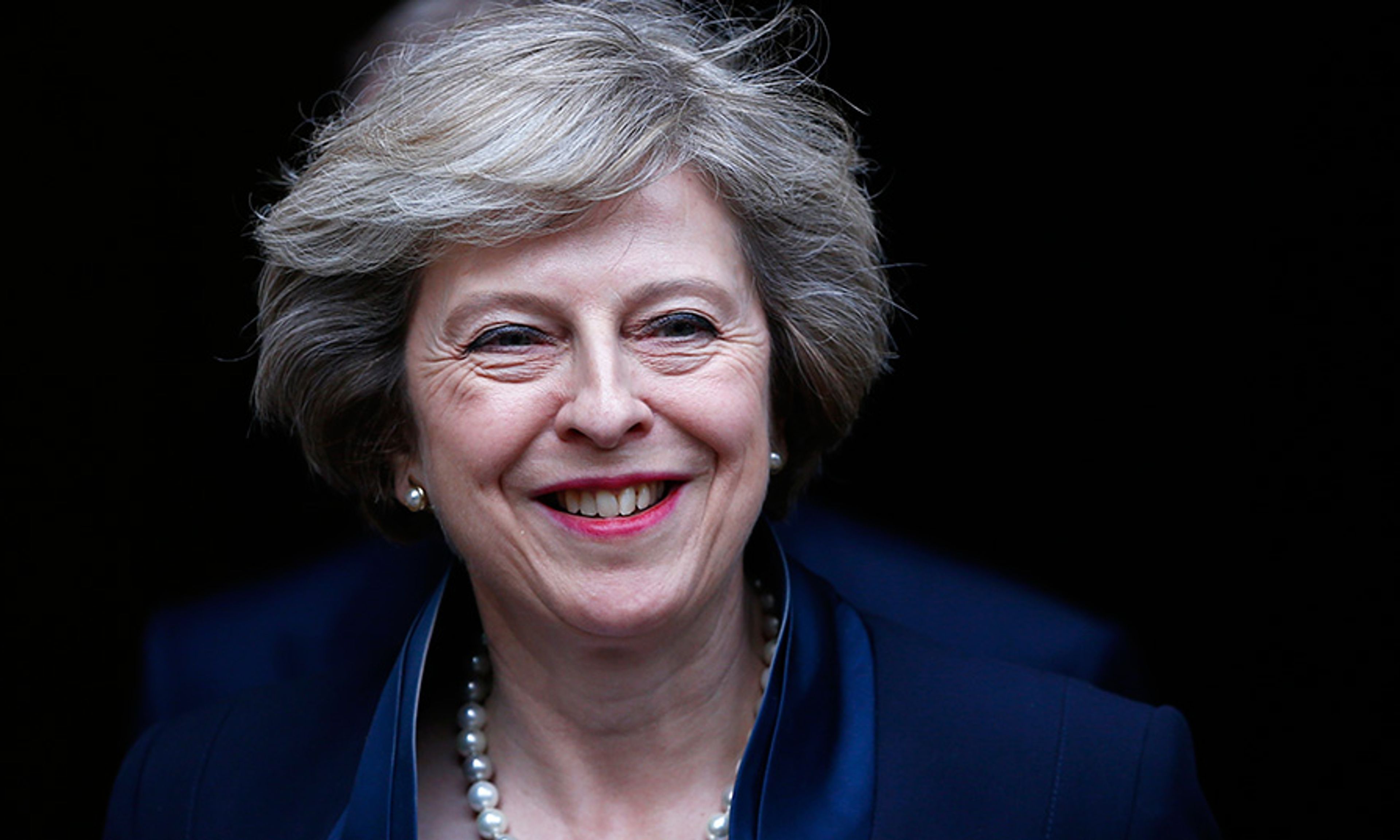
So the thrilling contest to become the next British prime minister comes to an end, and in the most unexpected way.
Once Tory MPs eliminated Michael Gove from the leadership race last week, the stage was set for a contest between two women: Theresa May, the current home secretary, and Andrea Leadsom, the energy minister. The contest was to take place over the next two months before the announcement of its results in early September. The membership of the Conservative party, a mere 150,000 strong, would choose the next prime minister and determine the fate of the United Kingdom. Or so it was supposed to be, until this morning, when Leadsom ended her outlandish, inscrutable, and wholly improbable campaign.
It’s hard to single out a single aspect of Leadsom’s candidacy as the most bizarre. Was it that, during her recent pitch to Tory-party leaders, she stressed the importance of massaging the prefrontal cortex of babies’ brains? Was it her proposal, in a Commons debate in 2012, that there be “absolutely no regulation whatsoever” for “the smallest companies that are trying to get off the ground”? Was it that many people, such as reporters at the Sun and the Guardian, thought her name was Angela? Her repeated overstatements and exaggerations, if not outright lies, about her experience as a banker in the City before her election to Parliament? Or was she finally done in by her preposterous statement to the Times of London that Theresa May’s childlessness made her less fit to serve as prime minister? Or, after the paper published this comment, was it her tweet that the press had engaged in “despicable, hateful reporting”? The Times backed up its reporting by releasing a transcript and an audiotape of the interview.
Leadsom’s comment that being a mother made her more fit for the prime ministership than May, who has only “nieces, nephews, lots of people,” is probably the worst of the lot — perhaps because, in a certain light, it seems to make at least some sense. Politicians often speak of older generations passing on a burden, be it the national debt or the Brexit vote, to younger ones; May, having no children, would supposedly have less investment in the younger generation and therefore less investment in the future. (Let’s ignore the fact that young people vote.)
RELATED: The Biter Bit: Gove Comes a Cropper
Leadsom isn’t the only person to fall into this trap: Some readers might remember Niall Ferguson’s unfortunate quip that John Maynard Keynes, being gay and childless, didn’t care about future generations. (Ferguson apologized “unreservedly” for making “stupid and tactless remarks.”)
It might seem odd that Leadsom’s comments about motherhood — one of the least outlandish among her many bizarre statements — proved the most damaging. But there’s good reason for that. Massaging prefrontal cortexes is weird, sure, but it’s farcical, not the sort of thing that can threaten democratic institutions. Neither is talk about eliminating labor laws for small businesses. But saying your opponent’s reproductive decisions make her unfit to hold office cuts straight to the heart of democracy. After all, a democratic republic can function well only when most members of the polity accept on faith that most politicians, regardless of circumstance, care about the health of the republic in the present and the future. By stereotyping an entire swath of citizens as unworthy to serve, and by rejecting the notion that they can even feel the same way toward the nation as others do, Leadsom undermined democratic principles (not to mention the sheer ugliness of denigrating those who are childless).
RELATED: The Stunning Collapse of Boris Johnson
Leadsom’s rapid rise from her post as a junior energy minister to the second-place spot in the race for the prime ministership should give us pause: It is an echo of the Trump and Carson anti-political candidacies in the United States. But her equally rapid downfall — it all happened over the course of a single weekend — is reason to celebrate. Despite the various prognostications over the fate of democracy in the era of “post-truth politics,” as Michael Deacon so wonderfully and worryingly described it in the Telegraph, the reality is that Leadsom just wasn’t up for the job.
#share#Being prime minister, and commanding the entire apparatus of the British state, is a lonely, high-stress business; it requires handling oneself with the utmost care and subjecting oneself to the most withering criticisms in the public sphere. And upon entering that brutal spotlight, Leadsom quickly proved she couldn’t handle it. She botched her first extensive interview with a major paper. The U.K. press performed the role that the American media did not during the Republican primaries: It weeded out a candidate who was unfit to handle the rigors of high public office.
RELATED: The Conservatives, and the U.K., after Brexit
And it’s good she’s gone, because her departure will give the prime ministership to Theresa May, who has pursued what we now see as the brilliant strategy of sitting back, sipping champagne, and watching her rivals do everything they could to tank their own chances of winning the race. Michael Gove backstabbed Boris Johnson, forcing him out of the race; but in doing so, he inadvertently ruined his own candidacy. Liam Fox and Stephen Crabb were very long shots from the outset. And Leadsom, the last, best hope of those stalwart Leavers who believe that only a Leaver can be trusted to deliver Brexit, fell spectacularly short.
For May to stick to the hard line she has set on Brexit — ‘Brexit means Brexit, and we will make a success of it’ — would be a welcome sign of union.
May will enter office Wednesday evening. The prospect of a months-long Tory leadership contest has been mercifully avoided, and May can start implementing the Brexit the people asked for. What exactly that should look like, nobody quite knows — hence the speculation that the Tories will call a snap election to receive a popular mandate for negotiations. Whether or not May will call a general election, it certainly seems as if she should, with Labour engaged in internecine warfare, Jeremy Corbyn clinging to power amid “peace talks,” and polling numbers looking very favorable for the Tories. And simplistic comparisons to Margaret Thatcher aside, May is no orthodox Tory; what sort of pure hard-rightist would launch her campaign by criticizing insular elite circles and calling for reductions in corporate bonuses?
May also has a hidden tool in her arsenal, one that may bode well for the future unity of the nation. A historical precedent is apt here. For some time in the early 1880s, the great Liberal prime minister William Ewart Gladstone believed that Irish Home Rule, the defining issue of the era, should be implemented not by his own party, but by the Tories, the party that had been most hostile to Home Rule from the start. His logic was compelling: Home Rule was more likely to be accepted as a legitimate act of government if it came from the party least likely to support it.
RELATED: Brexit: Sovereign Kingdom or Little England?
A similar situation exists in the United Kingdom today. Theresa May was a Remainer — a reluctant one, to be sure, conspicuously silent on the matter, but a Remainer nonetheless. For her to stick to the hard line she has set on Brexit — “Brexit means Brexit, and we will make a success of it” — would be a welcome sign of union, a sign that people on the losing side of the Brexit debate can and should recognize the will of the people and do their best to implement it. A Brexit implemented by a hard Leaver such as Leadsom or Gove would have run the risk of being too narrowly partisan, uninterested in bringing the other half of the nation into the fold. For a Tory Remainer — especially one such as May, all hard truths and no nonsense — to head the Brexit government seems like the best of scenarios.
#related#Some of the turbulence of the immediate post-Brexit period now comes to an end. David Cameron exits 10 Downing Street, humming a merry tune as he goes and dreaming of pleasant evenings with his family in the Cotswolds countryside. Theresa May will trigger Article 50 of the EU, which states, “Any Member State may decide to withdraw from the Union in accordance with its own constitutional requirements.” Whether she will face the electorate in a snap election is still anyone’s guess. The questions that now face the United Kingdom aren’t about who will lead (though, admittedly, the Labour party has yet to figure out what to do about Corbyn). Instead, they’re about where the leader will take the country and how the leader will use her power. The first stage of the political crisis will soon be over. Now, the hard work begins.





Comments