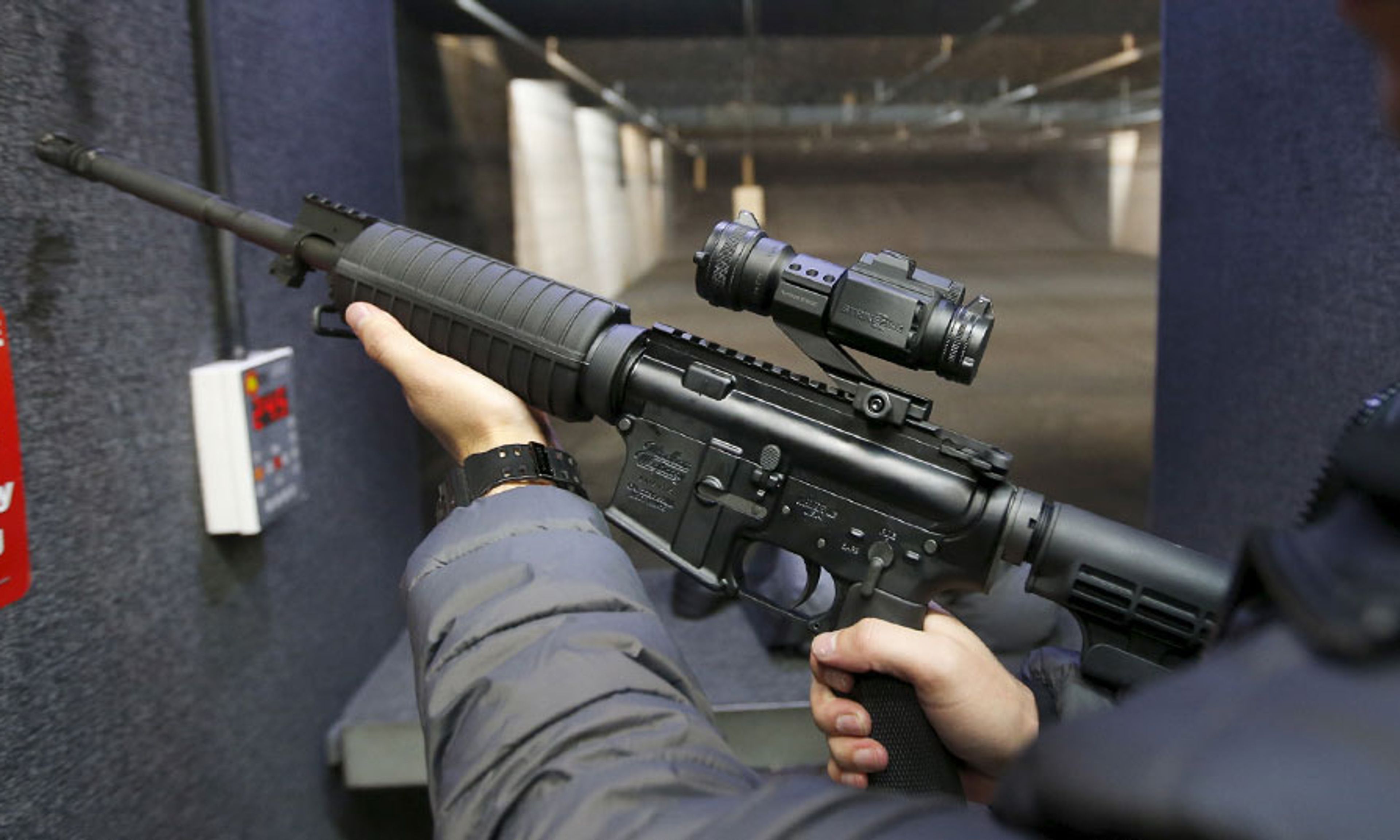
The Left is fixated for cultural reasons on firearms, which are associated in the suburban minds of sociology professors with backward rural life and government-mistrusting Second Amendment activists. Hence, Democrats constantly are seeking gun-control solutions to problems that have little or nothing to do with gun control, and hence the entirely unsurprising call by Hillary Rodham Clinton and others, in the bloody aftermath of Orlando, for a renewed ban on so-called assault weapons.
A problem: Assault weapons do not, strictly speaking, exist.
“Assault weapon” is an almost exclusively aesthetic category, having nothing to do with the ballistic characteristics of the firearms in question. A sporting rifle with a walnut stock is just another sporting rifle; pull that walnut stock off and replace it with a black plastic one with an L-shaped grip and you have an “assault weapon.” The operation of the firearm remains unchanged, but the configuration of the stock (“the shoulder thing that goes up,” as New York Democrat Carolyn McCarthy famously put it) or the presence of barrel threading to accommodate a muzzle-flash suppressor (an accessory of keen interest to those who shoot in arid, wildfire-prone areas) makes an ordinary rifle an “assault weapon,” as does the presence of a lug for mounting a bayonet, though it has been a while since bayonet charges were much in the news.
An “assault weapon” is the Sicilian widow of the firearms world: a little scary-looking and all dressed in black. Firearms makers themselves haven’t been above using “assault rifle” in their marketing materials, appealing to the aesthetic sometimes derided in gun-enthusiast circles as “tacti-cool.” But the wicked looks have nothing to do with the function of the gun, no more than putting a big rear wing on a Honda Civic makes it go faster.
The idea that American streets are running with blood because of ‘assault weapons’ is entirely unsupported by the evidence.
The hard facts help establish perspective here: Of all the gun deaths in the United States in a given year, the large majority — 60 percent or more — are suicides. Of the ones that are homicides, all rifles and shotguns together account for about 4 percent, and so-called assault rifles account for such a minuscule number of murders that law-enforcement agencies do not even keep statistics on them. The idea that American streets are running with blood because of “assault weapons” is entirely unsupported by the evidence.
Which shouldn’t be that surprising: Such weapons generally are expensive and difficult to conceal. For many years, the firearm most often put to criminal use in the United States was the .38-caliber revolver. And while that handgun did enjoy a certain cultural cachet in Mickey Spillane novels and private-eye movies, there wasn’t anything about it that was particularly conducive to crime: Compact and handy, it was simply the most common handgun among Americans, and hence, unsurprisingly, also the most common handgun among American criminals.
#share#The most popular rifle in the United States today is the AR-style rifle, similar though not identical to the Sig Sauer rifle used in the Orlando slaughter. Given how common AR-style rifles are, it is surprising that such weapons are as seldom used in crimes as they are. But the AR has a way of attracting myths: Contrary to urban lore, the “AR” in the name denotes “Armalite,” the name of the firm that designed the weapon, not “assault rifle.” It is not, contrary to the pronouncements of any number of Hollywood’s finest thinkers, a “machine gun” or a “fully automatic” rifle; instead, it is a semiautomatic rifle, meaning that it fires one round each time the trigger is pulled, like a revolver or a duck-hunter’s shotgun. There is nothing particularly fast about its rate of fire or remarkable about its accuracy, and, contrary to so many media reports, it is not a “high-powered” rifle, firing, as it does, the .223 Remington or 5.56mm cartridge, which isn’t even powerful enough to be used to hunt deer or similarly sized game legally in most of the United States.
It is, however, more than powerful enough to murder 49 unarmed and undefended clubgoers, as the horrifying scene in Orlando demonstrated. But then, practically any firearm would be. And, indeed, many of the worst atrocities in American history involved no firearm at all: The Oklahoma City bombing relied on a truckload of fertilizer; the worst school massacre in U.S. history (in Bath, Mich., in 1927, long before Columbine) employed dynamite; the 9/11 attacks were perpetrated in part with $2.99 box-cutters available at any hardware store.
From 1994 through 2004, a federal ban on ‘assault weapons’ was in place, and it had no detectable effect on crime.
We have a unique advantage in judging calls for a ban on so-called assault weapons: We’ve done it before. From 1994 through 2004, a federal ban on “assault weapons” was in place, and it had no detectable effect on crime. The independent Task Force on Community Preventative Services found no evidence that the assault-weapon ban prevented any violence. The National Research Council’s review of the academic literature on the question found that the data “did not reveal any clear impacts on gun violence.” The Justice Department’s own study suggested that any effects of the law were too small to be statistically measured. Indeed, the only statistically significant outcome that could be detected was a steep rise in prices for various firearms that weren’t banned. Political realities being what they are, it is no surprise that Smith & Wesson shares went up almost 7 percent after the Orlando murders.
Many Americans do in fact have high-powered rifles in their homes: These are the very hunting rifles that the Left always promises it has no intention of going after, but which are far more powerful than .223-chambered AR-style rifles, and many of which operate in the same semiautomatic fashion. It’s rare that anybody is murdered with one. The fact is that the United States does not have an assault-weapons problem, nor does it have a general gun-control problem. It has a series of interconnected problems related to defective criminal-justice practices and a failed mental-health system, the collapse of the family, and the predictable spiritual crisis belonging to an age of nihilism. And, most relevant to Orlando, it has the problem of being an open, liberal society rather than a garrison state, which means that its public places will always be vulnerable to terrorism of the sort perpetrated by the ISIS groupie responsible for the Orlando atrocity, whether they use guns and bullets or matches and gasoline.
Some of these things can be addressed by public-policy reforms, but having Washington micromanage “the shoulder thing that goes up” isn’t one of the more promising ones.



Comments