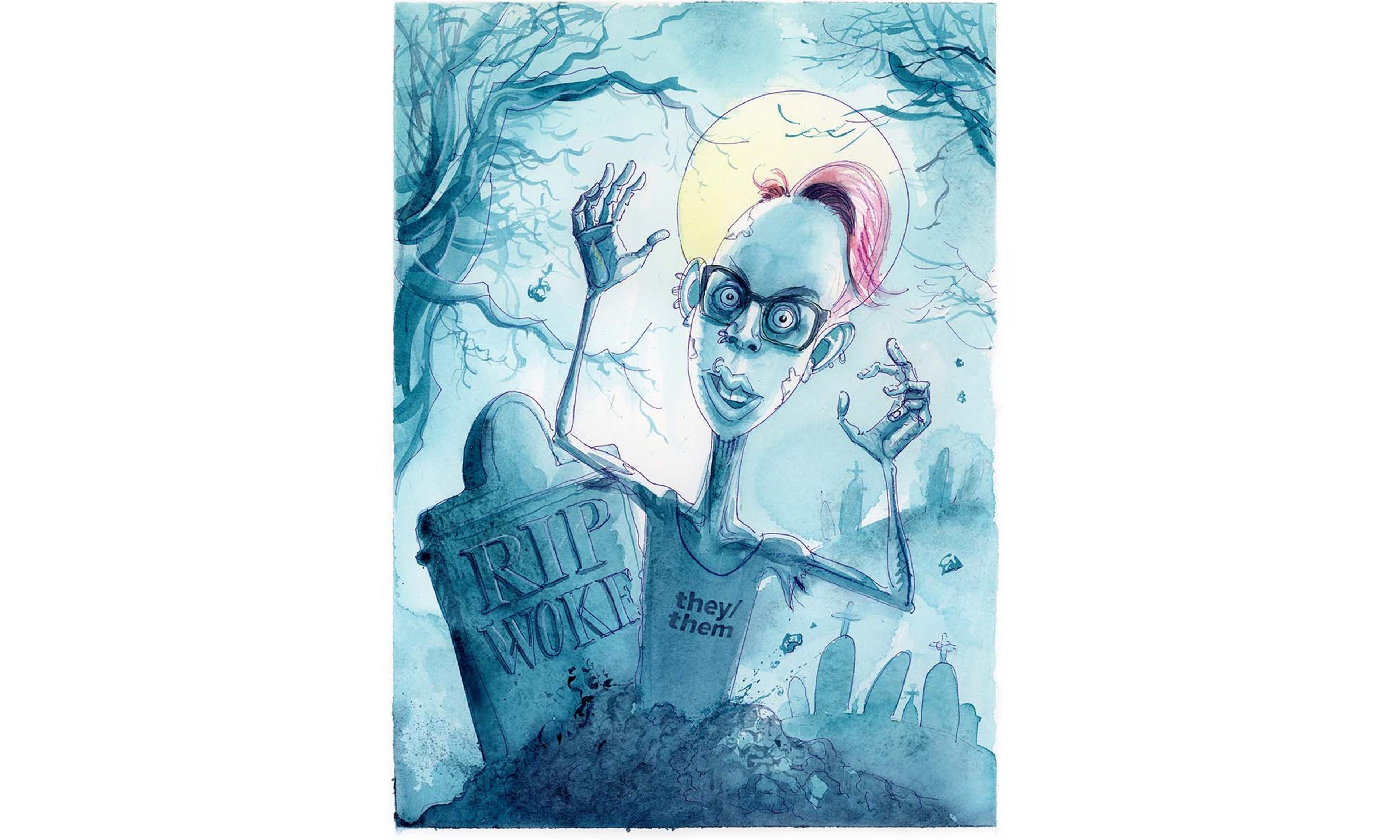
• Hamas may not be able to win a war, but wow, can they perform in Democratic primaries.
• Some Republicans have been dismissing concerns about affordability. But conservatives, more than most people, should recognize that modern government makes it harder to make ends meet. We should insist that the Federal Reserve take its inflation target more seriously — and write into law a tighter mandate for the central bank to produce macroeconomic stability. Conservatives should legislate against the overregulation that has increased housing prices via zoning, building codes, and rent controls. The expense of health insurance, meanwhile, eats into paychecks. Conservatives should advocate lifting regulatory barriers to the sale of renewable insurance policies that protect owners from the risk of high medical costs. One weak point for Republicans is that two of the major policies associated with the GOP this election year — the on-again, off-again prosecution of the war in Iran and President Donald Trump’s obsession with tariffs — are contributing to high prices. Many Republicans will, unfortunately, balk at breaking with Trump on trade. But they ought at least to refrain from dismissing voters’ unhappiness with prices as Democratic propaganda or as whining. Unless, that is, they want the voters to conclude that keeping Republicans in office is unaffordable, too.
• Inflation remains stubbornly above target, but the Federal Reserve is sitting still. Its governing committee voted to keep interest rates where they have been since the beginning of this year. In a rare rebuke, three members dissented, having noticed that inflation has not met the Fed’s target in any month since the pandemic. It’s true, as doves note, that surging fuel costs have distorted average price figures — yet inflation indices that exclude energy and food costs are also persistently elevated. Sluggish employment numbers are another excuse to hold off on rate hikes. But Chairman Kevin Warsh has committed to restoring price stability as his highest priority, and he says that he will settle for no inflation rate above 2 percent. Since inflation is a monetary phenomenon, and growth in the money supply is still too rapid, high inflation will not be tamed without tighter policy. The Fed must work hard to repair its credibility.
• The Trump administration announced sweeping new tariffs on 60 of America’s largest trading partners, with rates between 10 and 12.5 percent. Its justification is that these countries are complicit in forced labor practices that undermine domestic industry. Yet the tariffs apply to Switzerland just as they do to China. In truth, Trump is using whatever legal pretext he can to reconstruct the global tariff regime that the Supreme Court struck down. Like the old duties, the new ones will hit American consumers and businesses, alienate friendly nations, and hurt manufacturers. Trump’s tariff obsession is proving costly — and it looks likely to be especially costly for Republicans this fall.
• As the Senate tried to pass key pieces of legislation before the annual August recess, Trump continued to harangue Republicans to blow up the filibuster in order to pass the SAVE America Act. Unfortunately for Trump, and fortunately for the country, scrapping the 60-vote threshold has nowhere close to enough support among Republicans in the Senate. While it has worthy goals, the SAVE America Act — which, in the version Trump favors, would introduce national voter ID requirements, require proof of citizenship for voter registration, and restrict mail-in voting — would unwisely intrude on states’ primary responsibility of running elections. Even if we set that concern aside, ending the filibuster for this bill would be a mistake: It would make it that much easier for Democrats, in a few years’ time, to prohibit voter ID nationwide. Trump is characteristically failing to think past his own presidency.
• In a national address, Trump continued to insist that the 2020 presidential election was stolen from him. The president described intelligence that allegedly pointed to China’s acquisition of 220 million U.S. voter files, which include names, addresses, phone numbers, and party registrations. He said that members of the “deep state” had withheld evidence of attempts by China to meddle in the 2020 election from his daily intelligence briefings during his first term. Obviously, any effort by China to hack voter files or interfere with U.S. elections should be investigated. But Trump presented no evidence that China deleted or changed votes in an effort to elect Joe Biden. After years of flyspeck examination of the 2020 elections, Trump has still found no evidence that cheating accounted for the results.
• Yet it is also true that voter fraud occurs, as scandalous revelations from New Jersey confirm. Democratic Governor Mikie Sherrill has admitted that the state’s voter rolls include thousands of noncitizens. Hundreds of them are believed to have voted in the past three years. According to Sherrill, these were voters who made no attempt to conceal their noncitizen status when registering, and the problem was computer error rather than deliberate fraud. Even so, the fact that these errors went undetected for two to three years shows why periodic reviews of voter rolls are essential. If voters had to show proof of citizenship to a human being when registering, it is less likely that they could be registered without some entry in the system clearly classifying them as ineligible to vote. Measures such as voter ID, or allowing states to check for citizenship when registering voters, could address these problems. While our elections may never be perfect, our democratic system depends on correctly counting legal votes. There is no excuse for failing to take reasonable steps to ensure that.
• Senator Rand Paul (R., Ky.) released 1,141 pages of notes taken by Dr. Anthony Fauci during his time as director of the National Institute of Allergy and Infectious Diseases. The diary reveals that Fauci knew in early 2020 that the Covid-19 pandemic did not originate at the Huanan Seafood Market in Wuhan. Yet he refused to say so publicly. Fauci has insisted that he was not responsible for the draconian lockdown measures enacted by many localities during the pandemic. But entries show that he privately advised state leaders to close schools, bars, and restaurants. Senator Paul and Senator Ron Johnson (R., Wis.), however, also presented a series of text messages sent by Fauci in January 2021 as proof that he hid the risks of the Covid vaccine to pregnant women. This narrative spread rapidly on the right, but it was based on a misreading of the texts. Fauci said in the texts that the vaccines could “theoretically” pose a risk to pregnant women and that further study was needed. His public rhetoric reflected the fact that the existing data did not show that the vaccine posed any such risk in reality. At the time of the texts, the Centers for Disease Control and Prevention had not taken a position on pregnant women’s getting the shot. It was not until three months later, after evidence of the vaccine’s safety and efficacy for that population emerged, that the agency began recommending vaccination for pregnant women. Fauci has a lot to answer for, and releasing his diaries has done much to expose his duplicity. The record is bad enough without his critics’ having to misrepresent it.
• Vaccines save countless lives, but they have long given rise to episodes of quasi-superstitious dread. Such fears were boosted by the arrogance of the public-health world during the Covid-19 pandemic — and by unmerited speculation linking the mumps, measles, and rubella vaccines and some other childhood vaccines to autism. The latter has proved to be an unusually popular blend of conspiracism and pseudoscience promoted by, among others, Secretary of Health and Human Services Robert F. Kennedy Jr. The Trump administration’s new “gold standard” recommendation that the vaccines for mumps, measles, and rubella are best administered separately reflects this thinking. And since there are no approved single-shot vaccines for these scourges, the results could be literally sickening.
• On a party-line vote, the Senate Judiciary Committee approved Todd Blanche’s nomination to become attorney general. Two Republicans, John Cornyn (Texas) and Thom Tillis (N.C.), threatened to torpedo the nomination over Blanche’s refusal to put in writing his testimonial assurances that Trump’s “Anti-Weaponization Fund” is dead. This was a $1.776 billion slush fund that Trump established to provide payouts to January 6 defendants. The defendants, including those who assaulted police and vandalized the Capitol, had already been pardoned. Trump had schemed to pry $10 billion from the Treasury through a lawsuit he filed against his own IRS for leaking his tax information during his first term. Ever the loyalist, Blanche abetted the scheme: Under his direction, the Department of Justice agreed to “settle” by creating the slush fund. For good measure, Blanche threw in sweeping tax-audit immunity for Trump, his elder sons, and the Trump Organization — even though, as Trump’s former private attorney, Blanche should have recused himself. Right before a committee meeting to vote on the nomination, Blanche agreed to put the rescission of the fund in writing. This alone satisfied the two holdout senators, even though the (likely illegal) audit immunity remains. And Blanche’s writing is insufficient, because the settlement agreement calls for Trump to sign any modification of it. Trump, however, continues to advocate establishing the fund. Republicans are not meeting the Senate’s constitutional duty to check the abuse of executive powers.
• Senator Sheldon Whitehouse (D., R.I.) reintroduced his bill to expand the Supreme Court and limit the terms of justices. The Court would have a maximum of 18 justices, with presidents appointing new justices in the first and third years of their terms without there being vacancies. Aiming to hasten the end of the current conservative majority, the bill would sideline the most senior justices (Clarence Thomas, Samuel Alito, and John Roberts) from ruling on most of the Court’s docket, effectively stripping them of the powers that every justice since 1790 has exercised. Aside from undermining judicial independence, it would create two classes of justices with different powers. In turn, it would make a mockery of Articles II and III of the Constitution, which treat the justices other than the chief as holding a single “Office.” The bill is an unprecedented assault on 236 years of American constitutional tradition.
• The American people were led to believe that Trump’s Qatari luxury airliner was so insecure that he was compelled to fly home from a recent NATO summit in Turkey on the old Air Force One. The real story is somehow worse. Trump was seen boarding Air Force One in Turkey, but that was a ruse. The president was, in fact, spirited off the plane and onto a catering truck, along with a handful of trusted aides, after which he boarded a smaller aircraft that took him to a military base in the U.K. Only there did he board his preferred, Qatari jet to return to the U.S. The ruse, we learned, was necessary because of an Iranian plot to attack Trump’s plane. As the New York Times reported, American security was aware of “a specific threat of a surface-to-air missile against Air Force One.” In fact, according to the Times, “someone in the vicinity of the NATO summit had been spotted with a shoulder-fired missile.” Snubbing the press gaggle by leaving it on the decoy Air Force One might have been a bonus for the president.
• The Lincoln Memorial Reflecting Pool has been plagued by bad plumbing, leaks, and algae blooms since it was built a century ago. Trump made a show of cleaning it up before America’s 250th anniversary celebration. On the pretext that the imminent anniversary was an “emergency,” Trump and Interior Secretary Doug Burgum flouted the normal procurement rules to award an inflated, no-bid contract to a firm that had done pool work for Trump’s golf club in Virginia. When the repair work proved incompetent, Trump blamed vandals. Jeanine Pirro, the Trump-appointed U.S. attorney for Washington, D.C., indicted former Olympic canoer David Hearn, among others, for allegedly ripping a piece of the sealant. Facing the likely implosion of the case in court, which could also have exposed Department of Justice misconduct, Pirro then moved to dismiss the indictment. In an astonishing court filing, Pirro related that Burgum’s department had withheld significant evidence from the DOJ that the overhaul was plagued by construction problems from the start. Burgum is pushing back at Pirro, and Trump is fuming at her. All three should be angry with one another, and themselves.
• The Trump Media & Technology Group has launched a new offering: early access to certain high-profile posts on the Truth Social social media network. This benefit costs subscribers up to $100,000 per month. This is corruption. In essence, the president is charging his fellow citizens a fee for the chance to learn about his official actions — actions related to the federal government’s foreign policy, financial regulation, business oversight and more — earlier than those who cannot afford the charge. Why? So that those subscribers can use that information to make money, naturally. Democratic Senators Elizabeth Warren (Mass.) and Adam Schiff (Calif.) have described Trump’s plan as “an outrageous abuse of the President’s office for his personal benefit that undermines everyday investors and the integrity of our markets, while enriching Wall Street and other wealthy insiders.” If only just this once, they’re right.
• The aircraft carrier USS Abraham Lincoln has found itself beset by something even more irritating than incoming missiles: politically advantageous concern. Accounts of sailors considering jumping off the ship, poor food quality, and plumbing issues have drawn the attention of the American public. Such conditions, however, are nothing new. Life at sea is hard on men and materials. The aircraft carrier exists to project American power a thousand miles in any direction. So long as the ship can accomplish that, it is functioning as designed. Pressure from left- and right-wing groups who wish to see a reduced American presence in the world led the Pentagon to recall the Lincoln from the Middle East, replacing it with the USS George Washington — which, in turn, had to cease its operations in the West Pacific and leave the Seventh Fleet without a carrier to contend with North Korea and China. The public, sailors, and political leaders will have to reckon many more times with a finite number of aging carriers in an increasingly hostile world. Deployments will be extended, conditions aboard will worsen, and crew turnover will increase until the Navy builds ships at a pace that meets the moment.








A U.S. Navy F/A-18E Super Hornet attached to the “Vigilantes” of Strike Fighter Squadron VFA-151 prepares to launch from the flight deck of the Nimitz-class aircraft carrier USS Abraham Lincoln (CVN-72), under way in the U.S. Fifth Fleet area of operations, February 15, 2026.
Mass Communication Specialist Seaman Daniel Kimmelman/U.S. Navy
• Republican Congressman Max Miller’s reelection campaign is rapidly descending into new levels of depravity. The Ohio representative’s ex-wife, Emily, the daughter of Ohio Senator Bernie Moreno, claims that Miller held a gun to her head and threw boiling water at her. Miller denies these allegations. As part of his efforts to exonerate the congressman, his attorney, Aaron Minc, released nude photographs of Miller’s toddler daughter, which he now says was “completely unintentional and a mistake.” It has been a gross spectacle. The Republican lawmakers who have called on Miller to resign know that his conduct will likely cost the GOP his competitive House seat in the fall. GOP voters who are now tuning in to the midterms might rethink their commitments if what they see is a train wreck.
• Cheers and applause erupted as Massachusetts Governor Maura Healey (D.) signed a law explicitly making abortion legal at any stage of pregnancy and for any reason. Nine Democrats in the legislature had balked at going this far. A provision to protect “mental health” in the previous law already effectively allowed abortions late in pregnancy. Abortions after the 20th week, we are told whenever the subject comes up, are “rare”; but they are much less rare than, say, gun homicides of children. (How often does the press call those “rare”?) The available evidence indicates that most of these abortions are elective. The only conceivable rationale for this practically meaningless legislation is that Massachusetts Democrats want you to know that they are fine with that.
• Luigi Mangione pleaded guilty to federal charges of stalking UnitedHealthcare CEO Brian Thompson before fatally shooting him in Manhattan. Explaining his actions in court, Mangione said that he was frustrated by the difficulty of navigating the health-care system while he suffered from chronic back pain. His admission drew another round of plaudits from the most virulent activists on the hard left, who champion Mangione as an anti-capitalist icon. Anyone mentally competent, however, will recognize that there is no justification for cold-blooded murder. At his next hearing, scheduled in December, Mangione faces a maximum sentence of life in prison. Throw away the key.
• A coalition of Catholic religious orders, including the Dominican Sisters of Hawthorne, filed a lawsuit challenging New York’s newly enacted Medical Aid in Dying Act, arguing that the law would unconstitutionally force them to facilitate assisted suicide in violation of their religious beliefs. The law nominally allows health-care providers to opt out of directly participating in assisted suicide but still requires religious providers to engage in referrals, counseling, evaluations, or patient transfers to willing providers. The plaintiffs argue that these requirements would make Catholic groups such as the Dominican Sisters — who are concurrently suing the state over a law requiring them to affirm gender dysphoria — complicit in a practice that their faith condemns. The Dominican Sisters, who have long operated Rosary Hill Home, a hospice serving terminally ill cancer patients free of charge, are invoking the First Amendment in their defense. They should not have to be in federal court at all, but New York’s zealotry on behalf of progressive ideology has left them no other recourse.
• A new report from the FBI shows an accelerating decline in violent crime in America. The violent crime rate fell by 9.7 percent last year, the largest annual drop since the FBI started tallying these numbers in 1936. The U.S. murder rate decreased by 18.1 percent, to its lowest level since 1956. Trump has tried to take credit for the trend, citing the deployment of national guardsmen to cities such as Washington, D.C., and Nashville. But the decline in violent crime is too widespread and consistent to be attributable to any one set of policies. Factors including the advancement of surveillance technology, the rise of the internet, and even the decline of lead content in paint have all been recognized by experts. But it will take years of study to more firmly establish the most salient causes. What’s not in doubt, however, is that the fall in violent crime is another sign that America’s doomsayers are wrong.
• For the better part of two decades, American and South Korean forces have held a joint large-scale military exercise at this time of year. It is in part designed to emphasize to North Korea that the U.S. stands behind its southern neighbor. For Trump to scale back American participation in this year’s exercise was an act of recklessness made worse by the reasons he gave for it: his good relationship with Kim Jong-un and the “unthreatening and respectful” nature of his regime. It seems more likely (and the president hinted as much) that Trump was irked by South Korea’s refusal to take part in the campaign against Iran, as well as its slow progress in making the investments agreed to as part of a trade deal. The result, however, will be to weaken American deterrence in Asia at a very dangerous time.
• “Speak softly and carry a big stick,” said Teddy Roosevelt — words that Trump would do well to remember, especially when we appear to be running a little low on sticks. Oman, located on the southern side of the Strait of Hormuz, has been a U.S. ally for decades. Its leadership will therefore have been taken aback to hear Trump’s comment that he would “bomb the sh** out” of the country if it got in the way of a U.S. peace deal with Iran. There are suspicions that Oman, which is supposedly acting as a mediator between the U.S. and Iran, may have gotten too close to Tehran in the course of the talks. Any rebuke should have been delivered in private, not in public and in this manner — especially when other countries are already starting to discount the president’s threats.
• America’s supply of munitions is running shockingly low. Maintaining our traditional role as the West’s leading arsenal is strategically vital, and replenishing the munitions supply will require significant resources and fresh thinking. The Trump administration wants to focus on lower-cost munitions that can be manufactured faster and at scale. Manufacturing cheaper systems in bulk to deal with lower-end threats must be a priority. We must reassess the extent to which our munitions are still dependent on Chinese raw materials. Wherever that dependency exists, it should be brought to an end as quickly as possible. War is a stern teacher, as Thucydides wrote.
• Ukrainian President Volodymyr Zelensky visited Trump in the Oval Office. Both men said that the meeting went well. In recent weeks, Trump has publicly praised Zelensky’s leadership as Ukraine’s position has improved. For this positive relationship between Zelensky and Trump to continue, Trump must accept that a quick peace will remain elusive. Ukraine remains under sustained attack. Russian President Vladimir Putin shows no interest in any kind of compromise, and there are no serious signs of a Russian collapse. Moreover, with Ukraine’s drones having reduced Russia’s advance in the east to a crawl and essentially paralyzed its Black Sea Fleet, the Kremlin has turned to its ballistic missiles to regain the initiative. This is already taking a heavy toll. Ukraine is well equipped to shoot down drones and cruise missiles. But to down ballistic missiles takes Patriot interceptors, and Ukraine’s stock of interceptors has run very low. As Russia moves its war of attrition to the sky, the West should resupply Ukraine so long as it can safely afford to. But with Patriots taking as much as two years to manufacture, trouble lies ahead.
• For years now, Russia has been battling Western nations in the “gray zone,” at the threshold between acts of war likely to trigger retaliation and deeds that fall just short of it. To take examples from a lengthy list, undersea cables have been cut, buildings have been torched, and GPS signals on flights have been jammed. Russia appears to be stepping up these efforts for three different but overlapping purposes. The first, perhaps best represented by “accidental” drone incursions, is to test Western responses. The second is to rehearse what Russia would do in the event of an actual war (cable-cutting, cyberattacks, etc.). Third, acts of sabotage that cannot be provably linked to Russia are valuable tools to stir up fear. Detonating an explosive-laden drone next to a Ukrainian cargo plane — which was allegedly carrying ammunition — at Leipzig Airport in Germany fits that bill. Fortunately, a passing bus driver spotted the drone and knocked it out of the air, probably averting a major disaster. Later examination of the drone revealed clues connecting it to Russia. What to do now? And what would Germany have done had the drone exploded, destroying the plane as well as the possibly incriminating evidence?
• An incursion of about 70,000 illegal migrants from Morocco afflicted Ceuta, a Spanish city of 80,000 people on the North African coast. Earlier this year, Spain’s far-left prime minister, Pedro Sánchez, forced through an amnesty for illegal immigrants. About 1 million people applied. Eventually, family reunification provisions might increase the total admitted or regularized to between 2 million and 3 million. Not surprisingly, the news of this amnesty horrified many members of the European Union. The Spanish government’s response has ranged from denial to the somewhat more credible position that it was given no warning of the size of any incursion. Ursula von der Leyen, the president of the European Commission, is calling for tighter external border controls. These would, however, have done nothing to stop Sánchez’s amnesty. We recommend offering EU member states a choice. If they want to preserve their prerogative to unilaterally pass such measures as Spain’s amnesty, they should agree to withdraw from the EU’s border-free Schengen Area. It’s doubtful that this will happen, however. More likely is that Schengen will limp on until it collapses.
• The hapless Keir Starmer is no longer Britain’s prime minister. Unfortunately, he has been replaced by Andy Burnham. The new PM, a more skilled media performer than his predecessor (low bar), may prove more effective at selling the Labour Party’s policies. He might also, with his even greater emphasis on an activist state, push Britain still further to the left. So far, Burnham has promised greater devolution and a war on “neoliberalism.” The first means that London and the southeast, the region that drives the United Kingdom’s ever shakier economy, are in for a kicking. The second means reversing what little remains of Margaret Thatcher’s reforms. This promises a reenactment of the country’s 1970s, a decade of crises the most humiliating of which was then–Chancellor of the Exchequer Denis Healey’s going to the International Monetary Fund with a begging bowl. As it happens, Burnham has appointed John Healey (no relation) to the same post. With some luck, a reenactment of the 1980s, too, might soon follow.
• Former Cambridge University sociology professor Jason Arday is dead, apparently by his own hand. In addition to his becoming Cambridge’s youngest black professor, in 2023, Arday’s personal story seemed inspiring: Born to extreme urban poverty as the son of Ghanaian immigrants to Britain, Arday claimed to have been unable to speak until age eleven. He taught himself to read at age 18 and earned a doctorate at age 30. (During this time, he was also apparently a world-class ultramarathoner who raised millions of dollars for charity.) Alas, Arday turned out to be a plagiarist — most of his scholarly work, including his doctoral thesis, was pilfered from others — and a wild fabulist, who invented a life story so spectacular that he was paid $1.4 million by Simon & Schuster to write a memoir. Cambridge, having first supported Arday, announced that it would formally investigate him. Days after Arday resigned, he was found dead in his home. His death is a tragedy, of course. Notwithstanding the insistence of certain media outlets, however, those who noticed Arday’s fraudulence — and those who suffered from it — are not responsible.
• The Supreme Court’s 2023 decision in Students for Fair Admissions v. Harvard prohibited race-conscious admissions. Apparently, the leadership at Duke University’s law school took that as a challenge to discriminate in less obvious ways. The Department of Justice found that Duke Law School has intentionally discriminated to the benefit of black and Hispanic applicants, and against whites and Asians, since 2023. The law school’s staff emphasized “DEI” as one of their “most important values” in 2023, and they committed to “work even harder” to achieve “a racially diverse class.” The Department of Justice calculated that Duke Law School’s consideration of race gave a “black applicant a roughly 3.5x higher probability of admission than an equally strong Asian applicant with similar academic credentials.” As we know from previous DOJ investigations, Duke isn’t the only university that has refused to comply with the SFFA decision. Yale’s and UCLA’s medical schools have similarly evaded the law. The universities need a stiff reminder that the law is not a suggestion.
• Beginning in the fall of 2027, incoming freshmen at the University of Michigan’s College of Literature, Science, and the Arts will not receive permanently recorded letter grades for their first semester in college. Although instructors will give students letter grades, their transcripts will reflect only whether they passed or failed, and their letter grades for that semester will not affect their GPAs. The goal of the so-called grade-covering program is to “help students start strong and curb the mental health crisis unfolding among college-aged individuals,” according to the school. That’s one way to combat grade inflation.
• Team presidents and general managers on the WNBA’s “anti-hate” task force held an all-day meeting to determine whether it’s fair for men to compete in professional women’s basketball. Apparently, they need more time to deliberate. The assembled executives, all of whom hold jobs that wouldn’t exist without sex segregation in sports, couldn’t bring themselves to rule out male participation, but they did have time to craft a statement condemning “bad-faith” critics who are cynically using the trans issue to “demean or marginalize others.” That description presumably applies to former NBA players Enes Kanter Freedom and Royce White, who announced their intention to declare for the WNBA draft in an effort to force the league to confront the absurd consequences of its gender policy. (A recently signed collective-bargaining agreement states that “only players who are women are eligible to play in the WNBA.” There is no definition of “woman” provided.) In a memo to team presidents and general managers, WNBA Commissioner Cathy Engelbert announced her intention to “continue to have important conversations with all of you and the Players Association.” One wonders how much conversation is necessary before reality can be acknowledged.
• Ann Widdecombe was determined to be a Conservative member of the U.K. Parliament. When she finally became one, she was equally determined to stick to her principles. She was a Catholic convert, a social conservative, a euroskeptic firmly on the Tory right, and, beneath a formidable carapace, a kind woman. Her wit, intelligence, unusual charisma, and forthright views contributed to, and capped, her rise in government. Later in life, she briefly served in the European Parliament and became a spokeswoman for Reform UK. She was scheduled to be interviewed on television on the day she was murdered in her cottage. Although the apprehended suspect’s motives remain unclear, police have confirmed that she was the victim of a targeted attack. Dead at 78. R.I.P.
Politics
Summertime for Socialists America’s major parties are shaggy coalitions periodically open to influence and even capture by outside forces. With regard to the Democratic Party, 2026 has been summertime for socialists.
The Democratic Socialists of America is an organized pressure group with a radical agenda: opening borders, eliminating prisons, abolishing the Senate, having the House appoint the president, controlling the means of production. Its votaries range from those who endorse the entire program to sympathizers who see socialism as a way of making daily life more affordable.
DSA members won nominations in a number of Democratic congressional primaries in New York, Colorado, and Michigan, occasionally beating longtime incumbents or established local figures. In the primary to pick a successor for retiring Michigan Senator Gary Peters, DSA hanger-on Abdul El-Sayed bested Representative Haley Stevens. Angie Nixon, who joined the DSA this year, scored a surprise victory in Florida’s Democratic Senate primary. Other Democratic candidates who are not formal DSA members might as well be. Minnesota Lieutenant Governor Peggy Flanagan, who got the nod to run for Senate, was endorsed by Bernie Sanders and Ilhan Omar; former Maine State Senator Troy Jackson, who became the Democrats’ choice to challenge Senator Susan Collins after Graham Platner’s campaign imploded, has been a Sanders supporter since 2016.
Floating over these struggles like the piccolo solo in “The Stars and Stripes Forever” is the trial rollout of Alexandria Ocasio-Cortez’s presidential run. The 36-year-old four-term representative from New York was among the first of the new breed of lefties and has always been the most media-savvy. Her announcement that she has decided to freeze her eggs is classic AOC: novel, progressive (she’s a strong woman who takes charge of her body), and hard to pin down completely (she may want a family after all). Similarly, her laughing off the “Woke 1” excesses of the frenetic summer of 2020 might reflect some political farsightedness. She might run instead for the Senate in 2028, succeeding Chuck Schumer or thrashing him if he runs against her. But time and tide wait for no woman; peak novelty is now.
Who are the core supporters of these people? One primary revealed the demographics like a land survey map. Adriano Espaillat, leader of the House Hispanic Caucus, faced Darializa Avila Chevalier in New York’s 13th district, which stretches from the South Bronx to Upper Manhattan, including Harlem. The former portion is poor and Dominican; Espaillat won there. But Harlem has been gentrifying for years, and it put Chevalier over the top. In her early thirties herself, she clicked with a young electorate.
Another draw for the DSA is the new antisemitism. The GOP has its haters, but the party, to its credit, has tried to expel or marginalize antisemites. Democratic primary voters lap them up. The anti-Israel and anti-American influencer Hasan Piker has endorsed Jackson and campaigned with El-Sayed. Chevalier and New York City’s democratic socialist Mayor Zohran Mamdani touted Students for Justice in Palestine in their recent college days. The DSA replicates the strategy of Karl Lueger, mayor of Vienna on the eve of World War I, who built a career on populism and Jew-bashing.
The DSA surge has not swept all before it. Francesca Hong, the party’s candidate for Wisconsin’s gubernatorial nomination, was too weird even for the brand (she criticized Thanksgiving as a hateful holiday); Sanders declined to campaign for her, and she lost narrowly. El-Sayed, meanwhile, has driven longtime Jewish Democrats to support Republican Mike Rogers, who welcomes them.
Are there enough baffled kids and antisemites to take over a major party? We shall see.
Correction
In “Chronic Melancholic” (September 2026), James Rosen stated that Tom Wolfe had “never borrowed money”; it has since come to light that Wolfe acknowledged he had.
The Stat
$9.8 billion — the cost of a Biden administration insurance-company bailout enacted without Congress.
The so-called Inflation Reduction Act of 2022 made significant changes to Medicare Part D, the prescription drug benefit for seniors. It lowered the cap on out-of-pocket spending for stand-alone plans. That didn’t actually reduce costs; it just shifted them to premiums. The law built in some extra subsidies for premiums, shifting the costs again to taxpayers. But the surge in Part D costs turned out to be even larger than the law’s drafters anticipated. So the Biden administration in 2024 said it was doing a “demonstration” program for Part D. The demonstration authority is supposed to be used for testing program design changes. This “demonstration” was to “stabilize” premiums by sending subsidies directly from taxpayers to the insurance companies that sponsor stand-alone Part D plans. According to the Government Accountability Office, no previous demonstration program that affected Part D cost more than $1 billion. To spend roughly ten times as much on something that was clearly a bailout and not a test is not something the law should allow.
by Dominic Pino






Comments