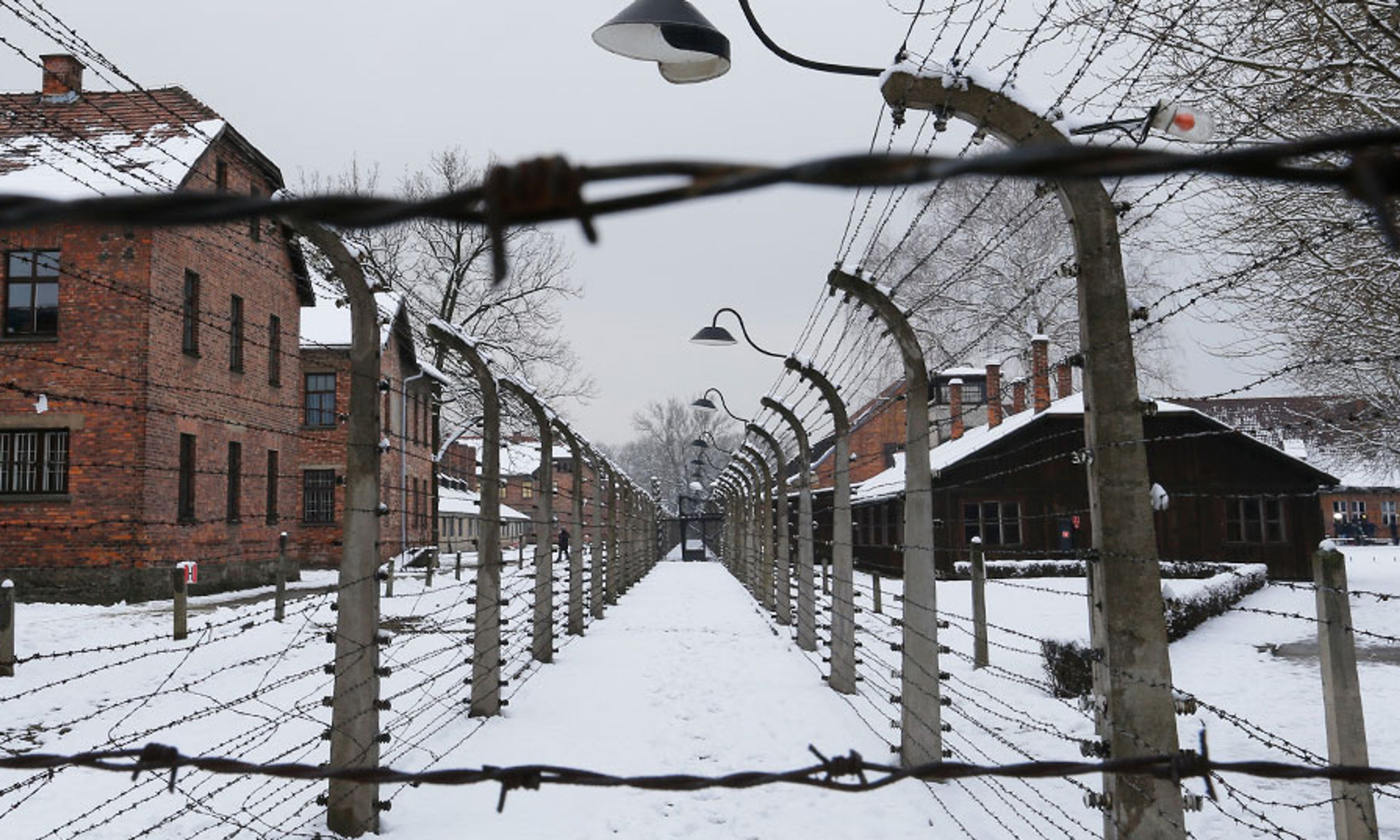
Oswiecim, Poland – The first things you notice as you approach the former Nazi concentration camp are the billboards for real estate, an Italian restaurant, a snack bar — things furthest from your mind as you make your journey here. Down the block, in a park, children were playing. Twin girls in pigtails ran down the street. Life goes on, even in the shadow of such still-recent evil. There’s something jarring about it. There is also something hopeful.
Horror happens, but evil doesn’t win.
Sister Mary Veronica held a flower in her hand, a weed that grows, with some beauty, in the midst of the memory of torture and death. “If I weren’t Christian, if I didn’t believe that there is life after death, I would lose hope,” she observes candidly.
Silence falls, appropriately, as we approach the memorial. “It’s the only way to reverence the lives that ended here,” Sister Mary Veronica says.
“Sorrow and shock,” Sister Bethany Madonna says as we walk along the Birkenau trails. “You never get used to evil.” And here, so many remark, it is overwhelming.
“I had a sense of one or two or maybe three people who had died,” Sister Maris Stella tells me as we travel from Auschwitz, en route to Birkenau. “I think of their stories and the sacredness of every single life that was lost there. And there were so many.”
“Each person here had a unique life,” Sister Mary Gabriel says. “It’s very easy to see the darkness here. But there is also light — the stories of virtue here.”
The people who were here, whether they survived or died — their memory calls to us to be light, Sister Mary Gabriel adds. We revere them when we seek to be light in the darkness of the world today.
“We have it within ourselves to give in love — even when people are trying to take from us,” she says, recalling the story of Maximilian Kolbe, who died in place of another. There are so many stories we don’t know of such selflessness and charity.
“It is holy land,” Sister Bethany Madonna tells me. Here more than many places one grasps the need to be ever more determined to protect each and every human life, to see the Creator in each and every person.
I’m here with about 40 Sisters of Life and College Knights of Columbus — pilgrims to the upcoming World Youth Day gathering centered in nearby Krakow, a multi-day event focusing on freedom, vocation, cross, and witness. Twenty-five years ago, the Sisters of Life were founded with a charism to protect innocent human life, after their founder, New York’s Cardinal John O’Connor, had a powerful experience at Dachau in Germany. “With all the theology I studied, all the philosophy through the years, nothing hit me as standing in Dachau, outside Munich,” he recalled. “Beautiful little town. Flower boxes in the windows.”
He, too, noticed the life in the midst of the memory of death: “It looks just like a playing field, a playing field with a big cyclone fence. Expect that they have a couple of wooden barracks . . . [and a] crematorium.”
“Jews and Christians. Rabbis, ministers, priests. Children. Adults. I thought, ‘Good Lord, could human beings do this to human beings?’” he remembered in an interview. “I think this was my first real insight into the worth and the dignity and the worthiness of the human person. A real understanding that everyone is made in the image and likeness of God. I determined, from that point onward, everything I would do, please God, would keep in focus the sacredness of the human person. At whatever age, in whatever condition.”
“Every threat to human dignity and life,” he continued, “must necessarily be felt in the Church’s very heart; it cannot but affect her at the core of her faith in the Redemptive Incarnation of the Son of God, and engage her in her mission of proclaiming the Gospel of life in all the world and to every creature.”
This is the land of St. John Paul II, whose Gospel of Life was a plea for an ecumenical commitment to reverencing human life.
This is the land of St. John Paul II, whose Gospel of Life was a plea for an ecumenical commitment to reverencing human life, to insisting that nothing like what happened here is tolerated again. A visit to Auschwitz brings his words to life. The pilgrims kneeling outside Kolbe’s cell block #11 and the crematorium are a witness to hope “that there is something more,” Sister Maris Stella says.
“Love is stronger than death,” she reflects. Kneeling alongside them — women who have dedicated themselves to helping people embrace life, in all its difficulties and challenges — praying for the repose of the souls of those who died here, praying for peace and healing and a halt to the violence that plagues our present day — as we do this, that unbelievable statement seems as if it could be plausible. Even here.
If John Paul II had been leading our pilgrimage here, he would probably have said, as he did say to Jewish leaders meeting at the Vatican in 1994, “it is not enough that we remember; for in our own day, regrettably, there are many new manifestations of the anti-Semitism, xenophobia, and racial hatred which were the seeds of those unspeakable crimes. Humanity cannot permit all that to happen again.”
“As a matter of historical fact,” he went on, “one cannot forget that in my own homeland, as in other countries and also here in Rome, in the terrible days of the Shoah, many Christians, together with their pastors, strove to help their brothers and sisters of the Jewish community, even at the cost of their own lives. In the face of the perils which threaten the sons and daughters of this generation, Christians and Jews together have a great deal to offer to a world struggling to distinguish good from evil, a world called by the Creator to defend and protect life, but so vulnerable to voices which propagate values that only bring death and destruction.”
It’s the miracle of virtue in the midst of evil. And it’s only in sowing virtue in daily life that we have a chance of fostering that heroic virtue, clarity, and courage that will lead our current day, lest we gravely fall where we were not long ago. There are poisons that remain in our world, in our very nation and its laws today. The blood here cries out for us to be stewards of these memories, insisting that nothing even remotely close to the Holocaust happen again.



Comments