Imagine the following scenario: A handsome, charismatic minority candidate defeats a heavily favored Democratic insider for the presidential nomination in an acrimonious race that drags out all the way to the convention. He then finds himself running in the general election against an aging, moderate Republican senator frequently at odds with his own party.
The current presidential race? Maybe, but it’s also the plot of the final season of The West Wing, which aired in 2005 and 2006. The similarities are not entirely coincidental.
Barack Obama’s chief strategist, legendary political consultant David Axelrod, was fresh off Obama’s successful Senate race when Eli Attie, a former speechwriter to Al Gore who was writing for The West Wing, had several conversations with him. Attie says he drew considerable inspiration from Axelrod’s impressions of Obama when conjuring Hispanic congressman Matt Santos, the successful dark-horse candidate on the show. Earlier this year, the web magazine Slate even edited the speeches of Obama and Santos together into an almost indistinguishable whole.
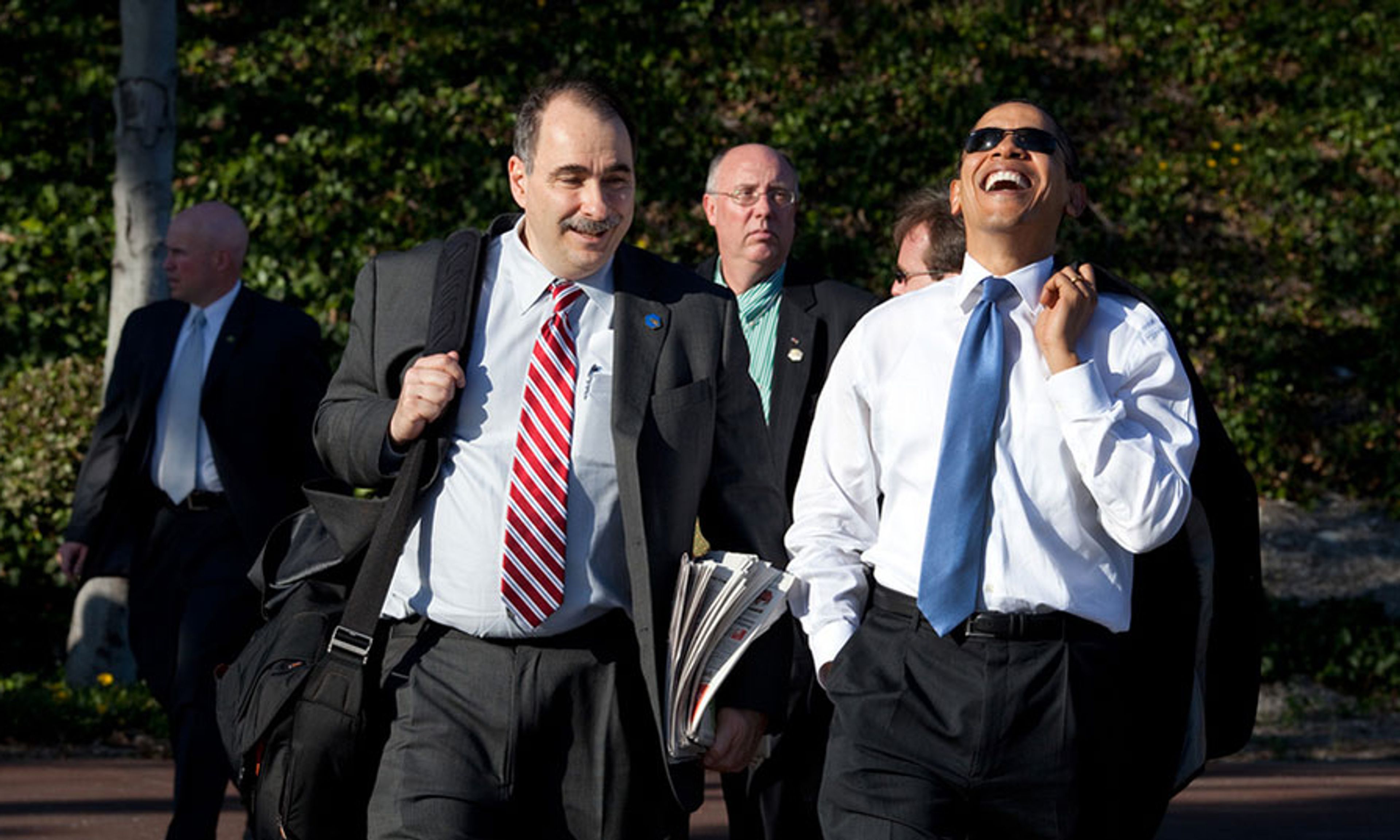
It appears that Axelrod, after decades of tinkering in the political laboratory, finally has in Barack Obama the perfect embodiment of his ideas about what makes a candidate appealing. Sometimes it’s hard to know where Axelrod ends and Obama begins — a lengthy profile of Axelrod in The New York Times Magazine observed: “When he talks about his own ideas, Axelrod has a habit of substituting anecdotes not from his own life but from Obama’s . . . as if his is a compounded, and cultivated, existence.” Indeed, a close look at the career of David Axelrod suggests that Obama is the magnum opus of a brilliant political consultant.
Axelrod was raised in New York, the son of a psychologist father and a mother who worked for the left-wing newspaper PM in the 1940s. (David Mendell’s Obama: From Promise to Power quotes Axelrod’s referring to his parents as “classic New York leftists.”) Axelrod began working as a journalist while still an undergrad at the University of Chicago, and was hired by the Chicago Tribune straight out of college. The paper soon let him loose on City Hall, but Axelrod wasn’t content to sit on the sidelines, and many believe he used his perch to champion the 1979 mayoral candidacy of Jane Byrne. Against the odds Byrne got elected, but her mayoralty was not successful, and Axelrod’s coverage turned accordingly negative.
Axelrod left the paper in 1984, citing (according to Mendell) concerns over its “corporatization” and disagreements with his superiors. When Axelrod walked away from the Tribune, he was unusually close to Chicago’s influential media players and labyrinthine political establishment. Despite having no real political experience, he was almost immediately hired by Democrat Paul Simon. Axelrod helped handle Simon’s ultimately successful Senate bid, and the consultant’s career took off like a rocket. Of the eight candidates who ran for the Democratic presidential nomination this election, Axelrod had worked for five.
Axelrod is known for two things. One is race. He has been particularly adept at running black candidates and helping them win support from white voters. He has helped elect black mayors in Cleveland and Chicago, as well as in majority-black cities such as Detroit and Washington, D.C. In 2006 he helped elect Deval Patrick, the current governor of Massachusetts and the first black person to hold that office. Patrick’s election was seen by many as a trial run for Obama’s presidential campaign. The themes are notably similar. Patrick’s slogan was “Together We Can.” And, as Hillary Clinton’s campaign noted at the time, one of Obama’s speeches heavily plagiarized one of Patrick’s. Axelrod was probably the primary author of both.
The second thing that distinguishes Axelrod is his willingness to be merciless, even borderline underhanded, to political opponents. Republican consultants fear him. Ed Rollins, who’s handled campaigns ranging from Ronald Reagan’s 1984 presidential bid to Mike Huckabee’s shot at the nomination this year, put Axelrod on the top of his list of “guys I never want to see lobbing grenades at me again.” Mike Murphy, who’s advised Arnold Schwarzenegger and Mitt Romney, calls Axelrod “very, very dangerous.”
Before Axelrod signed on with Obama’s Senate campaign, he interviewed to work for Blair Hull —Obama’s main challenger and then the favorite to win the Democratic primary. A former professional gambler turned securities trader, Hull was exceedingly wealthy and willing to spend millions. During interviews with Hull, Axelrod mentioned some ugly rumors surrounding Hull’s divorce. Hull acknowledged the rumors but declined to give Axelrod specifics. Axelrod eventually joined Obama’s Senate campaign and, wouldn’t you know it, right as Obama’s television ads began in earnest, the details of Hull’s divorce surfaced in the Tribune. Many found the timing suspicious — even if Axelrod wasn’t given details, he had a good idea of Hull’s vulnerabilities and where to start looking for the dirt.
Axelrod is an expert at clandestine political attacks. According to BusinessWeek, he is the “master of ‘Astroturfing’” — the art of planting messages on the Internet and elsewhere to make it look like there’s a grassroots movement supporting your position. Axelrod operates ASK Public Strategies, an incredibly secretive PR company that “discreetly plots strategy and advertising campaigns for corporate clients to tilt public opinion their way.” Axelrod won’t talk about ASK and has rebuffed media requests to see a client list, though BusinessWeek determined the firm had worked for big-name corporate clients such as AT&T and Cablevision.
Throughout the presidential campaign a number of suspicious “anonymous” attacks have been traced back to the Obama camp. First, an anti-Hillary YouTube video (parodying Apple’s infamous 1984 Super Bowl ad) turned into an Internet sensation, with 2 million views in two weeks. Obama’s campaign denied involvement, but it was later revealed that the ad’s creator had multiple ties to the campaign, and had lived with the campaign’s press secretary. More recently, a professional PR firm with extensive Democratic ties was caught uploading videos to YouTube that spread falsehoods about Sarah Palin. The videos used the same voiceover artist employed by Axelrod’s firm and the Obama campaign. Similar incidents abound.
If there’s any common thread to Axelrod’s work in politics, it’s that — as The Economist recently put it — he “firmly believes that the candidate is the message. The important thing is to tell a positive story about the candidate rather than to muddy the narrative with lots of talk about policy details.” Unlike many political consultants, Axelrod is not known for his interest in policy; his acumen appears to stop at the water’s edge of governance. He is drawn to candidates who are exciting, rather than proven or capable.
Many of the politicians he has supported, starting with Byrne, have failed in office. Patrick’s governorship has been unpopular, marked by fiascos involving the gutting of educational standards and a failed attempt to expand gambling in Massachusetts to deal with overwhelming budget woes. And the administration of Chicago mayor Richard M. Daley — whom Axelrod faithfully supports — has been marked by rampant corruption. Former Chicago alderman and University of Illinois political science professor Dick Simpson told the New York Times, “David Axelrod’s mostly been visible in Chicago in the last decade as Daley’s public relations strategist and the guy who goes on television to defend Daley from charges of corruption.”
For the inexperienced Obama, a better comparison than The West Wing might be Robert Redford’s Candidate, in which some shrewd political consultants help an inexperienced lawyer run for office. Having won the race, all Redford’s character can do is stare and ask, “Now what?” Should Obama ask that question, it’s unlikely Axelrod will have answers.






Comments