
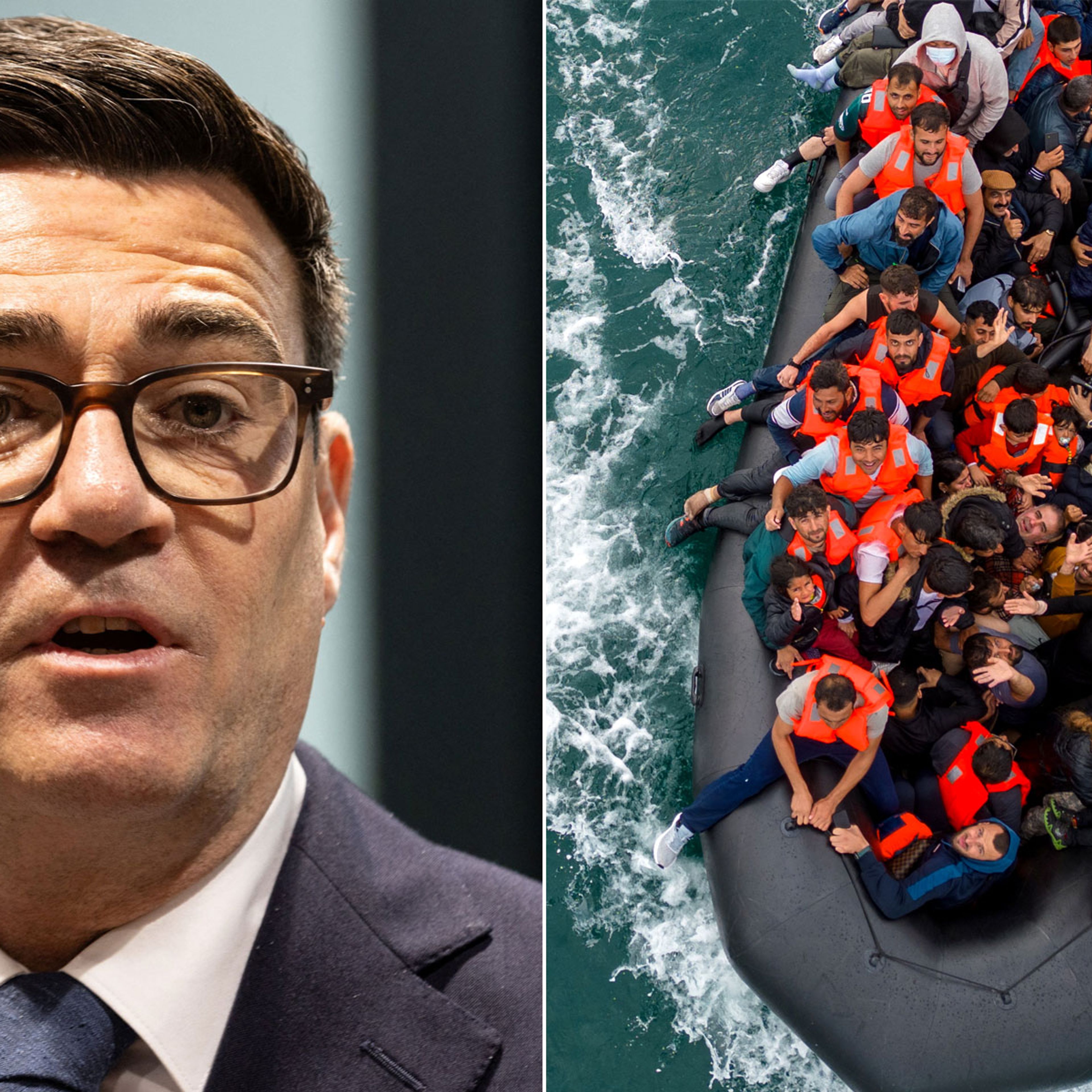
In Lancashire on Wednesday, on the referendum trail, Brexiteers Boris Johnson and Michael Gove released proposals for a new immigration system that would take effect should the British vote in favor of leaving the European Union. Johnson and Gove’s new system would be modeled on Australia’s points-based immigration scheme, and would end the status quo under which all EU citizens may enter and work in the U.K. as they please.
David Cameron and George Osborne, the Tory ringleaders of the Remain campaign, were quick to lambaste the proposals, which are designed to target migrants who have specific skills that would benefit the economy or fill labor shortages. Cameron argued Johnson’s and Gove’s scheme would actually increase migration to the U.K., not lower it. Indeed, the prime minister noted, Australia has higher levels of migration than does the U.K.
Nigel Farage, the pro-Brexit leader of the United Kingdom Independence Party, refuted Cameron. “The point about an Australian-style system is that you choose,” Farage told the Guardian. “Every single year, Australia looks at what it thinks it needs to expand its country. . . . But the point about it is that we can choose.”
Both camps are talking past each other, neither quite engaging with the arguments made by the other: With many, though not all, on the Remain side branding the Brexiteers as petty quasi-racists, meaningful debate gets lost in the fray. Alastair Campbell, a former communications director for Tony Blair, in recent essay for the International Business Times, was typical: “There has been in recent days a hint of, at best, borderline racism in the way Leave has sought to use” the immigration issue.
None of this does the U.K. — or the EU — much service. There is a substantive debate to be had in the Brexit campaign, but it has little to do with the precise levels of net migration, a discussion that operates mostly in the realm of national identity instead of material circumstances. Instead, the debate to be had concerns costs and benefits. Whereas back-and-forths over immigration do little but stoke pre-existing animosities, a focus on what the U.K. gives to the EU, and what the EU sends back to Britain in return, would allow the Brexit debate to occur on more dispassionate, reasoned grounds, while also allowing the British people to take a critical look at what the EU does for Britain.
This is not to say, of course, that immigration has no place in the debate, but the Leave camp should focus on its economic effects. Focusing solely on the immigration issue poses a distraction from other critical areas in which EU membership exerts a more direct effect — economic regulations, for example, or restrictions on Britain’s sovereignty over its own affairs. Also, when the Leave campaign makes immigration its main focus, it can often project the wrong image of itself and risks tarnishing its own legitimacy.
There are good reasons one might want to leave the EU. There are also bad reasons.
To their credit, both Remain and Leave have made progress in this regard. See, for instance, the Guardian’s recent analysis of which districts receive the most EU funding for infrastructure projects. As it turns out, the southwest of England does quite well for itself: “Cornwall and the Isles of Scilly receive 41 times the funding allocated to Thames Valley/Buckinghamshire.” This is the sort of information that elucidates for voters the nature of the EU and its often-byzantine funding mechanisms. Or see the new slogan on Johnson’s bright-red campaign bus, which emphasizes the opportunity cost of EU membership: “We send the EU £50 million a day. Let’s fund our NHS instead.” This sort of discourse directly invokes the material costs and benefits of membership, rooting the debate not in a demagogue-inspired frenzy over Middle Eastern migrants in Britain’s cities but instead in a discussion about what would improve the lots of most Britons. It reminds Britons that EU membership comes at a certain cost, and turns the debate into one essentially over the distribution of tax revenue.
There are good reasons one might want to leave the EU. There are also bad reasons. Emphasizing the good reasons strengthens democracy; emphasizing the bad erodes it. Placing at the center of the Leave campaign the argument that the U.K. should leave the EU to reduce net migration, like some in the Leave campaign have done, does little but inflame passions that will eventually come to threaten the institutions of representative democracy — look no further than Poland or Hungary for evidence of the havoc the far-right swing can wreak on individual freedoms.
Instead of seeking to stoke the fire, the Leave campaign should make a calm, economically and democratically minded case for Brexit. In advancing their cause, advocates must address the concerns raised by the hundreds of economists and historians who have come out against Brexit; they must assure the people that Brexit would harm neither the British economy nor Britain’s stature among the nations of the world; and, crucially, they must interact with the argument, put forth by some on the Left as well as the Right, that the EU is an essentially anti-democratic institution that is contrary to traditional British values and that all too often infringes on individual rights.
Above all else, the Leave campaign must veer away from the uglier strains of ethnic nationalism. Though electorally tempting, such paths only lead down the rabbit hole to illiberalism, tainting the politicians who push them as well as the public sphere in which vital political discourse is conducted. Make a utilitarian case, not a nationalist one. Only once the immigration issue is made secondary to economic and democratic concerns can the Leave campaign be taken seriously as a movement seeking merely to do what it believes best for Britain’s future prosperity.





Comments