If you’re the sort of filmgoer who thinks of the Coen brothers as American cinema’s most nihilistic, misanthropic double threat, tittering behind their movie camera at the duncery and pointlessness of human affairs, you’ll find vindication aplenty in Burn after Reading, the sibling act’s 13th film and easily one of their most unpleasant. As for those of us who prefer to think of the Coens as misunderstood humanists whose taste for the absurd and the grotesque obscures their underlying moralism — well, there’s nothing to be done after a film like this except slink off to our dens and slip Raising Arizona or even Fargo in the DVD player, in the hopes that the bighearted charms of H. I. McDunnough or Marge Gunderson will wash the sour taste of Burn after Reading from our palate.
This is not to say the brothers’ latest effort is without its pleasures. Critical accolades seem to inspire the Coens to pursue parody: The much-lauded Fargo was followed by The Big Lebowski, a shaggy send-up of a Raymond Chandler whodunit, and now they’ve followed up last year’s much-garlanded No Country for Old Men by taking aim at the D.C. spy thriller. All the familiar elements are in place — the Langley corridors, the gliding black cars, the Georgetown gunshots, the A-list stars (George Clooney and Brad Pitt), and of course the much-prized, much-pursued disc encoded with top-secret information. Except that the information on the CD is worthless, the A-list stars are playing dolts, the guns go off by accident, the gliding cars are carrying process servers, and Langley doesn’t have a bloody clue what’s going on.
At the center of the idiocy is Osborne Cox, an aging spook with a penchant for bow ties, mixed drinks, and pronouncing words like “penchant” with a distinctly Francophone lilt. Cox is played by John Malkovich as a man oscillating between wounded hauteur and alcohol-fueled fury: Fired from his job as a CIA analyst, he retreats to his Georgetown rowhouse to pen a tell-all memoir — which he pronounces “mem-wah,” of course, in conversation with his chilly, exasperated wife (Tilda Swinton), who’s plotting to leave him for a cheery, womanizing goof named Harry Pfarrer (Clooney) and swipe his assets along the way. Her plot, hatched with a divorce attorney, requires downloading the details of Osborne’s finances onto a compact disc — the same disc, naturally, that includes the notes for his memoir, which is then lost on its way to the divorce attorney’s office, and eventually finds its way into the hands of two co-workers at a suburban gym called Hardbodies, Linda Litzke (Frances McDormand) and Chad Feldheimer (Pitt).
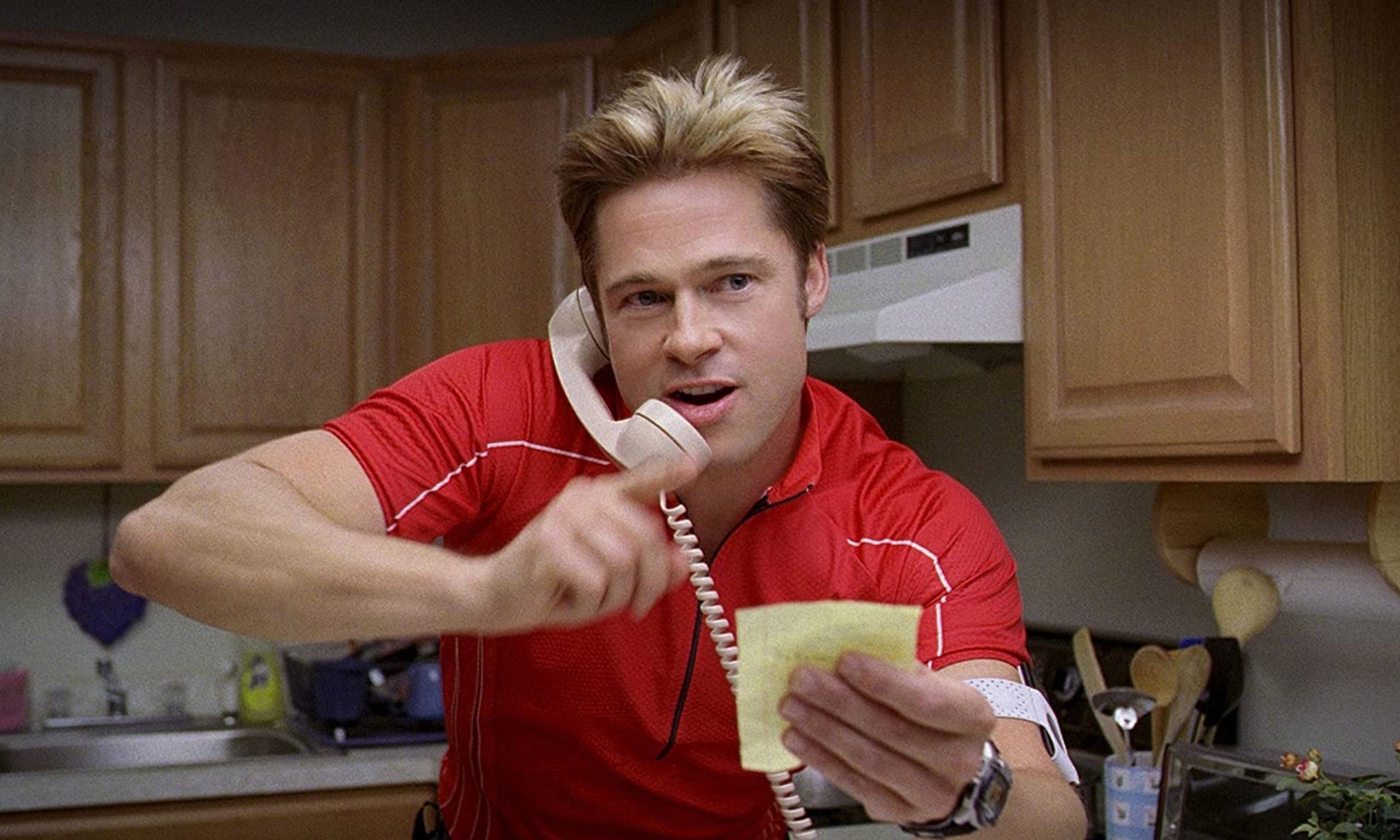
In a film populated by fools and blunderers, Chad and Linda are in a league of their own: They’re exemplary morons, though Linda has just enough cunning to make her idiocy a danger to everyone around her as well as to herself. She’s lovelorn and fitness-obsessed, convinced she’s just a few (expensive) plastic surgeries away from finding Mr. Right; he’s more fitness-obsessed still, a wide-eyed, bouncing man-child, guzzling sports drinks and sporting an outrageous pompadour. (Pitt is operating in the same manic key as he did in his Oscar-nominated turn as a mental patient in 1995’s 12 Monkeys, and — as in that film — he’s entertaining without being particularly believable: It feels like a Saturday Night Live sketch more than an actual performance.)
Together — but with Linda as the “brains” of the operation — they decide that the CD must contain high-grade spy secrets, and plot to sell it for enough cash to fund Linda’s surgical self-improvements. The baffled Cox is their first target, and when he won’t pony up the money they assume the disc is worth, they set their sights on the Russian embassy — while an increasingly baffled CIA (“Report back to me when this makes sense!” barks J. K. Simmons’s head spook to his subordinates) surveils them and everybody else from the sidelines.
There’s plenty of funny business woven into this story of international intrigue and epic stupidity — I particularly liked the moment when Cox’s wife is revealed to be the world’s most terrifying pediatrician, with Swinton channeling her turn as the White Witch while she inspects a pre-teen patient — and the cast is capable and game for anything. But the film turns dark, and then darker still, and the violence, when it comes, is punishing rather than funny.
The Coens have made movies about idiots before, but from The Hudsucker Proxy to Oh Brother, Where Art Thou? they’ve usually delivered some of their fools to happy endings, and their outright tragedies (even Blood Simple, their pitch-black debut) usually generate at least a trace of sympathy for the feckless, doomed protagonists. In Burn after Reading, though, everyone is doomed, and nearly everyone is dislikable. (The lone exception to the latter rule is Richard Jenkins’s Ted — Chad and Linda’s boss at Hardbodies — and his fate is more unpleasant than most.) If you respond to McDormand’s surgery-mad virago, or Clooney’s grinning philanderer, with anything resembling sympathy, then you may find more to appreciate in the film than I did. But by the end of the movie, it felt like I was watching an art-house version of a Friday the 13th–style slasher flick: The characters were too stupid to live, but it was still unpleasant to have to sit and watch them suffer awful fates, and I couldn’t wait for the Coens to just get the whole thing over with.






Comments