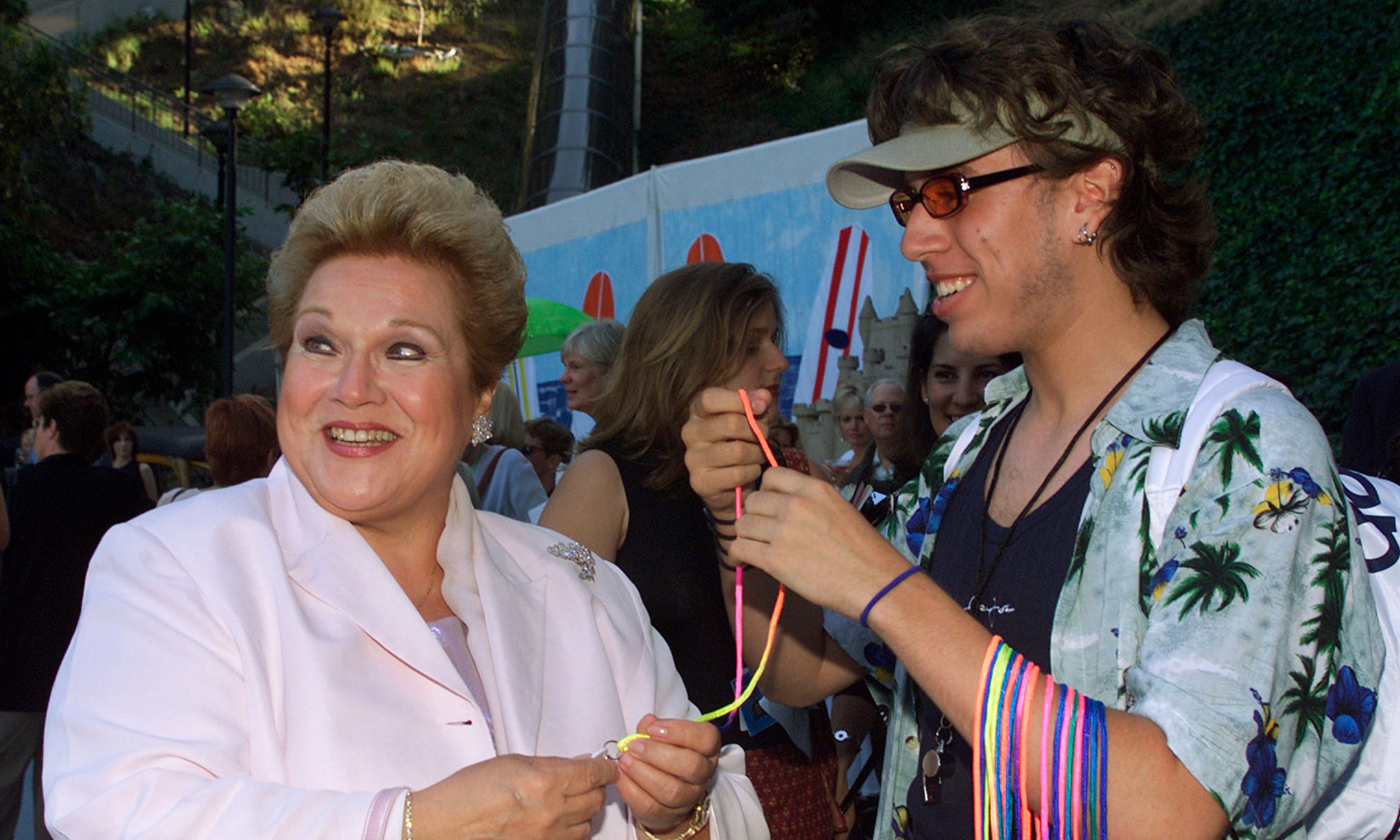
Publicists wrote me to say, “Marilyn Horne is about to celebrate her 75th birthday. And her foundation is about to celebrate its 15th. Would you like to interview her?” Let me give you a word of advice, dear readers: When you have a chance to talk with Marilyn Horne, don’t pass it up. She is not only one of the greatest singers who ever lived (yes, who ever lived — since man first opened his mouth to make a sound). She is an extremely smart, interesting, and fun woman.
I had a couple of hours with her in her New York apartment, overlooking Central Park. Around the apartment are busts of Rossini, Schubert, and other gents with whom Horne has been friendly. There are also pictures of her grandchildren: the three of them. “Someone said that having a grandchild is like falling in love again,” says Horne. “And it’s so true.”
She started out in Bradford, Pa., did this legendary mezzo-soprano — and I remember that she had some hard things to say about Bradford in her memoirs, published years ago. I ask whether she retains any ill feelings toward the town. No, she says: none. “I think I was disappointed, because when my father tried to get people to subsidize me in some way — to go to Europe or whatever — they declined.” I ask whether Bradford claims her now. “Oh, yes! As a matter of fact, there’s a bust of me in the new concert hall.”
The amazing Horne girl finished her growing up in the L.A. area. And she speaks of “a gilded time in my life,” from about age 17 to age 22. She rehearsed with Stravinsky in his home, she heard Aldous Huxley speak, she ran into Schoenberg, though “I never got to know him.” (His widow, she knew very well.) And then there were the many Hollywood figures: such as Judy Garland, with whom she once sang during a party at Rock Hudson’s.
She eventually married Henry Lewis, a double-bassist and conductor. He was the first black player in a major symphony orchestra, the first black conductor to lead a major orchestra: a pioneer. Horne speaks of him frequently during our conversation together. “He was quite something. We divorced, ultimately, but I miss him very greatly. He’s been dead now for quite a while” (1996).
Naturally, we talk a fair amount about singing, and Horne says this: “A lot of us are born with voices that work — but you have to put an awful lot into it,” with studying, practicing, being coached, and so on. “It’s a very hard profession. I have argued with ballet dancers that it’s the hardest there is — singing.” And the challenge is as much mental as physical: actually, more. And a singer is, roughly speaking, as Horne says, “half artist, half athlete.”
Like plenty of others, she is not too pleased about some shifts in opera today. For example, “you’ve got many lighter voices singing things that should be sung by heavier voices.” Take the role of Mimì, in La Bohème: “My Mimì, when I was coming along, was Renata Tebaldi, and she had probably the biggest voice I have ever heard. Renata had a huuuuge voice — I think it was even bigger than Birgit’s.” That would be Birgit Nilsson, the Swedish Wagnerian. “Birgit had a laser beam on hers, but Renata also had a laser beam,” and more. “Now I’m hearing lyric sopranos — light lyrics — sing Mimì, and that’s not for me.”
Reviewing some singers of the past, I ask about Ebe Stignani, Horne’s mezzo forebear. “Wow,” she says. “I mean, that’s a wow. She was absolutely great.” She also has something highly, highly interesting to say about Marian Anderson, the beloved contralto: She was magnificent, of course. But she also had “technical deficiencies,” as everyone knows. And, in truth, “she might have been a soprano” — a soprano who never developed in that direction.
And how about two great mezzos of Horne’s own time, Christa Ludwig and Janet Baker? She has nothing but glowing things to say about each. In early days, “Christa and I sang madrigals of Gesualdo together, with Hindemith conducting, in Vienna.” How about that? As for singers on the scene today, we spend some time on René Pape, the German bass: “Unbelievably great,” says Horne. I concur, of course, but suggest that, in some Italian roles, he is not especially Italianate. Horne isn’t really buying: “I just love him, in everything he does — and there just aren’t voices like that around.”
We turn to conductors, including Leonard Bernstein — who “had so much to give. One could learn so much from Lenny, just by having a meal with him.” And she says something funny about George Solti. Solti would say to her, “You’re flat, darling, you’re flat!” (Think Hungarian accent.) Now, Horne’s intonation was the envy of the music world. “I think George heard high,” she says.
She is a great lover of popular music, which is to say first-class popular music: Gershwin, Porter, Arlen, and the like. She is also a wonderful exponent of such music: Anyone who heard her sing “In the Still of the Night” will never forget it. Horne has admired many a pop or jazz singer, but I ask who really did it for her: Ella, Sarah, Peggy? “Lena,” she says — her fellow Horne. They became good friends, and Lena would tell her, “We’re sistahs under the skin.” Were they ever confused for each other? Yes, from time to time. “One of my closest friends went to a recital of mine, and the woman sitting behind her said, ‘But I thought we were going to hear Lena Horne!’”
Speaking of recitals, this institution is not doing very well in America — the recital, I mean. And that is one of the problems that the Marilyn Horne Foundation seeks to address. The foundation trains, supports, and encourages young singers — and it dots the country with recitals. If the recital eventually dies, perish the thought, it will not be the fault of Marilyn Horne.
Does she ever sing for herself, alone in her room, for example? Not really, she says. But she teaches a lot, and she does a good amount of demonstrating in her teaching. Also, she’ll listen to Sinatra CDs in her car — and sing along with them. “Now they’re in the right keys for me,” she notes. (The historic Horne instrument is getting lower.) And look: She does some demonstrating in this conversation of ours, too. For example, she sings a little of the aria from Oedipus Rex. She imitates Pavarotti at the end of “Pourquoi me réveiller.” She even imitates Schwarzkopf singing “Danny Boy”! (And no, you can’t listen to my tape — well, maybe we can talk about a fee.)
Horne had a phenomenal technique, being a virtuoso of the voice: “No one taught me to sing coloratura,” she says. She just did. And she had a stunning range stretching two and a half octaves. That is a true accounting. Don’t believe those who claim a bigger range, for themselves or others. Horne puts it this way: “I hear people talk about having three-octave ranges, and I say, ‘Bullsh**!’” Quite right.
Our conversation turns to Gustav Mahler, who loved the mezzo voice, and wrote immortal music for it. Horne sang it all, including the solo part in the Second Symphony, known as the “Resurrection.” (Actually, she sang the solo part for soprano, too.) She relates something extremely personal, and perfectly understandable, to me: Her brother was killed in a plane crash. And “I could not get over it, it was such a blow. I just walked the floor at night with the headphones on, listening to the ‘Resurrection,’ trying to find some peace. It took me about ten years to put that one on the backburner.”
I ask whether there’s any music she feels closer to now than she once did. She answers, “You know, I’ve become so partial to Brahms. I just love Brahms. He makes me feel good when I hear his music, when I sing it, when I teach it.” She was one of the great singers of “Von ewiger Liebe,” an especially good Brahms song. “It has a little story in it,” she says. “And that’s one of the great things I learned from Lotte Lehmann: You make each song a story.”
Before we part, Horne talks about her health, her family. She is overcoming pancreatic cancer — the disease from which Pavarotti died last year. They talked about it quite a bit toward the end of his life. And she speaks to me again about her much-loved grandchildren. Many singers — I could name you a few — never had children, and feel it keenly. Horne has a vivid memory of Tebaldi: “When she would see pictures of my grandchildren, lights would come into her eyes. ‘Oh, you’re so lucky to have these children,’ she would say. I always tell my students, especially the women: ‘Don’t miss that, if you can help it. Having children is worth it — especially when you get old.’”
At her doorstep, I mention that I have already done two pieces on her for National Review. The second was a Horne-at-70 number. She exclaims, “And now we have Horne at 75 — thank God!” She has a lot to be thankful for, yes, and so do those who have heard her — at La Scala, in her living room, wherever.





Comments