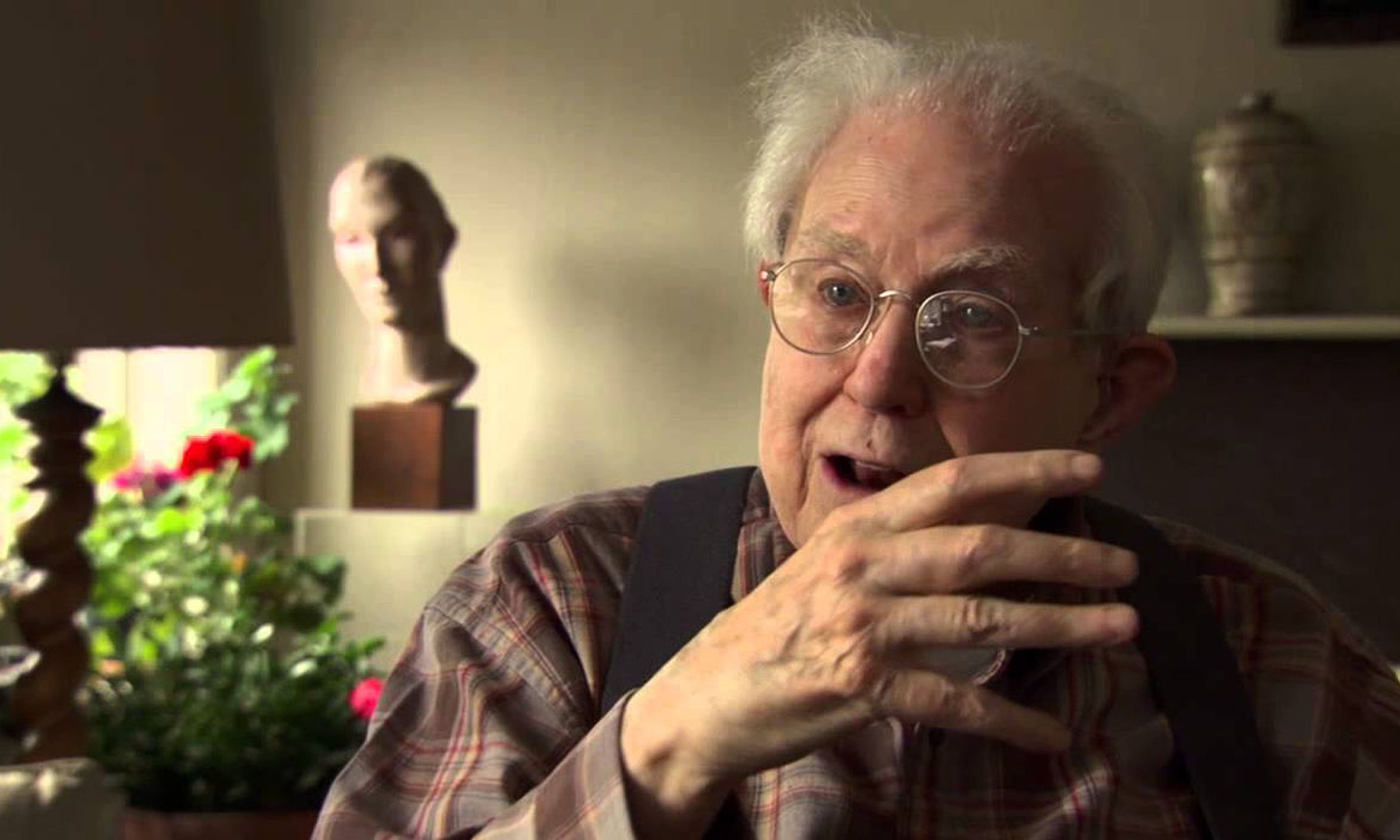
Elliott Carter, the American composer, turns 100 this month — and the music world is duly celebrating. There are Carter-centered concerts, there are boxes of retrospective CDs. Carter is surely the senior composer in the world, and he is steadily working. But he is not the longest-lived composer we’ve had. That distinction probably goes to Leo Ornstein, who lived from 1893 to 2002 — to the age of 108. The musicologist David Dubal once told me that Ornstein must be the only person to have written music in three different centuries.
When Carter was born in 1908, Theodore Roosevelt was president. Mahler and Debussy were still working. Rimsky-Korsakov had died a few months before. Richard Strauss was only in his mid-40s. Rachmaninoff was merely in his mid-30s. As Carter himself points out, he has seen tremendous changes, in music and elsewhere.
Amid the celebrations, I pay him a visit. Carter is a native New Yorker, and still lives in the city: in Greenwich Village. He has occupied the same, gracious apartment since 1945. Among his neighbors were E. E. Cummings, Marianne Moore, and the composer Edgard Varèse. In conversation, Carter is quick and amusing, with a ready smile and a twinkle in his eye. He talks in a way that very, very few New Yorkers do now: New England-y. You encounter this type of speech, in Manhattan, only once in a while.
Carter’s paternal grandfather, Eli, fought in the Civil War. He was at Gettysburg, in fact — and Carter knew him well. “Grandpa was a jolly old man, who had lots of fun, and was very shrewd. How he made the transition from fighting in the Civil War to becoming the leading lace-curtain importer in New York City, I cannot understand, but that is what he did.” Eventually, the grandfather sold the business to the father (Elliott Sr.). He did so “at a considerable price, meaning we were quite poor for some time!”
Carter was already eight years old when America entered World War I. Living on 114th St. at Riverside Drive, he saw a little bit of this war: “The Hudson River was full of British warships, and I remember very distinctly British sailors wandering around on Riverside Drive.” Radio was new then, and the young Carter toyed with them — homemade — on the roof of his building.
After the war, his father took him on several trips to Europe, and they saw the devastation that had occurred: “dreadful things.” Hunger was acute. A later trip took them to Baden-Baden in 1923 — and Carter remembers reading in a newspaper that President Harding had died.
Neither of Carter’s parents was musical, and they would certainly not have chosen a composing career for their son. But Carter caught a break at the famed Horace Mann School (whose students included Eugene O’Neill’s son, who became one of Carter’s best friends). A teacher introduced the kids to Charles Ives, and the composer took an interest in Carter. “Mr. Ives used to subscribe to a box in Carnegie Hall, and he’d occasionally invite me to sit with him.” He also played the young man some of his own compositions — for instance, the Concord Sonata (in a version different from the one known by the public).
A pivotal moment came when Carter heard Stravinsky’s Rite of Spring, a notorious departure in music. He figured, then, that he had to be a composer.
He went to Harvard College, in part to be near the Boston Symphony, which, under Serge Koussevitzky, was playing a lot of modern music. He did not enroll in the music department, however: “In those years, the department was entirely devoted to teaching church organists, and it was extremely conventional. I was interested in what was called advanced or avant-garde music,” and they were not. He studied English, availing himself of such eminent scholars as Irving Babbitt and George Lyman Kittredge (“a tyrant!”). Another teacher was Alfred North Whitehead, the philosopher.
After college, Carter enrolled in the Harvard graduate school — in music. The atmosphere had rapidly grown more congenial. His two principal teachers were Walter Piston and Gustav Holst (composer of The Planets). Piston, says Carter, was a “fussy” man who “liked to turn everything into a rather disagreeable joke.” But one could learn a great deal from him: particularly about the instruments of the orchestra and how to write for them. Holst, visiting from England, was “rather aged” and had poor eyesight. That meant that the students had to play him their pieces on the piano, rather than handing in manuscripts. “Whenever we wrote anything dissonant, he would say, ‘You’d better learn to play the piano better’!”
By the way, Holst — whom Carter has described (correctly) as “rather aged” — died at 59, not long after he taught Carter. Carter, of course, is 41 years older.
After Harvard, Carter went to Paris to study with Nadia Boulanger, teacher of generations of Americans (in particular). Ives advised Carter against this move, thinking that he should remain on native grounds; Carter went anyway. And he has many interesting stories and memories about “Nadia.” “Evidently, she had been told, when she was very young, that she would go blind,” which indeed happened, but over decades. “So she made an enormous effort to memorize everything. And as a result, she had all these scores right in her head,” enabling her to cite you something in an instant.
Carter himself would become a teacher: at Columbia, Yale, Juilliard, and other places. One of his earliest jobs was at St. John’s College, the Great Books redoubt in Annapolis. It was Carter’s mission to introduce music to the program. He taught Euclid’s geometry and suchlike, finding out what the ancients had to say about music. Carter’s scientific knowledge is considerable (even if he demurs from this assessment). Has it been a help in his music? “I don’t think so. Scientific knowledge is above what I do in music. I’m concerned with a very practical field” — fitting music to performers and so on. “I don’t care what the numerical relations of the notes are and all that.” Time was, numerical relations were all the rage in composition. “I tried to write like that once, and it bored me, so I stopped.”
Evolving as a composer, Carter made important investigations into rhythm. “I spent some time in Tunisia, and got very interested in the drumming patterns of Arabic music.” Carter is liable to have two different speeds going at the same time. He is a pioneer in what is possible in tempo and rhythm. And “my music got started, I think, by listening to jazz. In jazz, as in almost all dance music, there’s a regular beat in the background and, against that, improvisation. My music is all like that.”
Some people think that melody is passé. Does Carter? No, he says — but one can mean many different things by melody. He writes melodies that may not be recognized as such by listeners. And Schubert, he says, could make a melody out of just a couple of notes. Moreover, “Nadia used to talk about ‘Tea for Two’” — there is a real economy about that melody.
When Carter speaks of “the old music,” he does not mean Monteverdi, Byrd, and Rameau — or only them. He means the sweep of music from those early composers up through Wagner or so. And the “old” composers did well in that “they dealt with the material available at the time and made it speak very strongly.” But he regards this music as belonging to the past, and “no longer the most vivid thing that one can do.” The old music may be “fantastically beautiful,” but “it doesn’t quite speak in the way that modern music does.” (On that, many, of diverse opinions, can agree.)
What about the so-called Neo-Romantics such as Barber — can Carter respect them, even as he diverges from them? “Well, some of us felt that the kind of music Sam wrote had already been done, only done better than anybody could do it now. Therefore there was no reason to do it now.” Grinning, Carter says, “What Sam did was deplorable,” but his music, nonetheless, “is rather good.”
Carter has known many composers well — including Stravinsky — but I ask him which composer from the past he would most like to meet and talk things over with. He names Debussy. Carter had plenty of talks with Stravinsky — “but he’d say, ‘Oh, I forgot how I wrote that,’ so you couldn’t get anything out of it!”
Entering his eleventh decade, Carter feels he is still learning about music: “Each piece I write I consider an adventure. I’ve learned a lot by trying to be a composer.” And does he think he has gotten better? “Of course I think I’ve gotten better — who wouldn’t think that?”
Then there is the touchy question of whether he cares whether people like his music. “That depends on the degree of ‘care’ you mean. What I care about is having performers who like my music and want to play it and play it well.” The public has a way of coming around. As to whether Carter believes that his music will last, “You tell me what the future’s going to be, and I’ll tell you the answer. God only knows the future. In my own lifetime, there has been such an enormous change in every conceivable way that it would be hard to predict the future” — even ten or fifteen years out.
He does not have a roster of pieces he feels he needs to write — he simply goes from one project or commission to the next. “I guess I’m just walking through life, where my music is concerned.” But there are certain books he would like to read. He’s reading through Shakespeare’s plays now, and he would like to read more Balzac, Dostoevsky, and Proust. He does not think he will get to it, though.
And he does not listen to a lot of music on his stereo. “At my age, I’m extremely busy writing my music and keeping fatigue out of the way. Most of the music is in my head by now. I don’t like to listen to recordings of my own music, either: because a) people don’t play it right and b) I feel I didn’t write the right thing. I think I should have changed something.” Does he ever go back and revise? “Yes, but my experience is, having done that, I like it better the way it was the first time!”
Toward the end of our discussion, I ask whether the 100th-birthday celebrations are a bother to him, distracting from his work, or a pleasure. “They bother me,” he says, “but I’d be disappointed if they didn’t happen.” Rising to leave, I say, “Well, we’ve covered a lot of ground.” He says, “I didn’t talk about my wife, but . . .” Is that not a lovely tribute from a husband to a wife?
We do indeed talk about her. She was Helen Jones Carter, a “sculptress,” as her husband says. A year older than he, she died five years ago, aged 95. I gaze at an example of her work: a self-portrait. Striking, and beautiful.





Comments