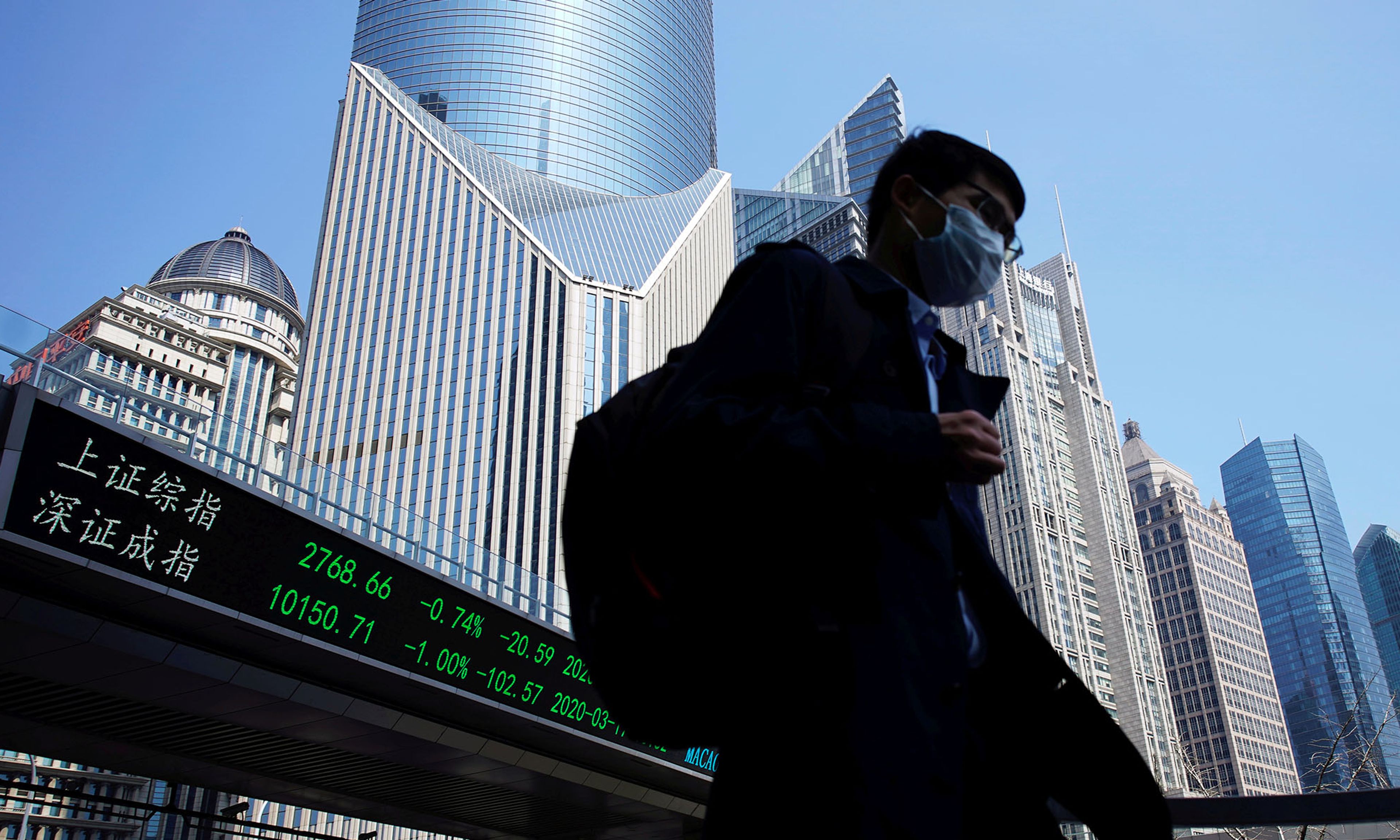
It hasn’t been the best of times for investors in Chinese tech stocks.
Chinese technology stocks listed in the US are set for their worst month since the global financial crisis after investors dumped shares following a regulatory crackdown by Beijing.
The Nasdaq Golden Dragon China index, which tracks Chinese tech stocks listed in New York, has fallen 22 per cent in July, putting it on course for its biggest monthly fall since 2008. Shares in Chinese internet groups Tencent and Alibaba have dropped about 16 per cent and 10 per cent respectively.
The sharp declines come as Beijing has launched a regulatory assault on companies that handle large amounts of data and education businesses, as well as an overhaul of how Chinese groups list on stock markets outside the country.
The Golden Dragon had already been looking a touch bedraggled:
Grant’s Almost Daily (July 29):
From its mid-February peak through Tuesday, The Nasdaq Golden Dragon China Index sank by 48%.
The authors of another report in the FT noted that the China Securities Regulatory Commission (the CSRC, China’s SEC) had tried to reassure the representatives of a number of global investors, Wall Street banks, and Chinese financial groups that Beijing’s most recent action (against online education companies) should not be read as an indication of a wider onslaught.
Not everyone was reassured. Somebody briefed on the call commented:
“These policies are not coming from the CSRC, they’re coming from much higher up. It’s clear there will be more to come, that’s obvious to everyone.”
Oh.
It is possible to have a long, long argument about the most accurate political label to apply to the Beijing regime. Nothing fits exactly. But it seems fair to say that today’s China is rather closer to being fascist than communist. This is a shift that can be seen more clearly in the area of economics than anywhere else. China’s increasingly virulent (and more or less explicitly ethnically based) nationalism is one marker, to be sure, but there are a good number of instances of such attitudes in the history of communist states, too. It is, however, impossible to find any equivalent to China’s economic arrangements under any communist regime (the licensed — and limited — capitalism permitted in the years of the early Soviet New Economic Policy was only ever going to be an interim measure), whether in terms of the wealth that has been generated — not something that is generally associated with communism — or in the willingness to permit a genuinely vibrant private sector.
But to understand what is meant by “the private sector” in China, at least when it comes to large-scale enterprises, a good place to start is a comment by one of fascist Italy’s leading lawyers, Silvio Longhi. Explaining how things worked under the variant of corporatism which was (in theory) the basis of how Mussolini’s state was run (the unnerving overlap — or potential overlap — between that and contemporary stakeholder capitalism is something that I have discussed on many occasions), he had this to say about private property:
The state recognizes and safeguards individual property rights so long as they are not being exercised in a way which contravenes the prevailing collective interest.
And the “collective interest” is, of course, decided by those at the top of the party.
China’s party leadership is, for purely pragmatic reasons, happy to harness entrepreneurial energy where it is helpful (Deng Xiaoping: “It doesn’t matter whether a cat is black or white, as long as it catches mice”), but only if it enhances rather than detracts from its power. Beijing learned a great deal from the collapse of the Soviet Union. Managing the economy on traditionally communist lines is a prescription for continuing economic failure, and if an economy fails for long enough, those in charge are going to be in trouble. The trick the Chinese leadership had to pull off was to liberalize the economy to a degree sufficient to start the long march toward prosperity, but without undermining the foundations of party control. There would be perestroika, so to speak, but as little glasnost as the party could get away with. The conventional wisdom in the West was that political freedom would follow on from economic freedom, but that has not proved to be the case. Economically and socially, China is far freer than half a century ago, and politically quite a bit so too (even if that now appears to be going into sharp reverse), but that there were limits to that political freedom had already been made very clear at Tiananmen Square in 1989.
Yet after that massacre, and the unambiguous reassertion of party control it represented, China continued to get richer, both at the state and the individual level. Western Marxists had already seen their teleological view of history reduced to ruin. Now their liberal counterparts had to suffer the same fate. And unfortunately, the faith of those Western liberals contained contributed to its own failure. To the extent that there was a danger (real enough) that the survival of China’s party-state might have held back innovation and economic dynamism, Western capital and (not infrequently) stolen Western technology filled the gap.
With that flow from the West now likely to slow, the question is whether China has already accumulated the resources for it not to matter overmuch. At a guess, the answer is yes, but even if it is not, the party would not be prepared to return to a less authoritarian path in exchange for renewed economic momentum. What matters to the party, above all, is the maintenance of its power. Clearly it felt that that power was threatened by the way that the economy was developing. And that was not a state of affairs it could tolerate.
That is not the whole story behind the current crackdown. It does seem clear that part of the reason for Beijing’s attack on Chinese Big Tech flows from antitrust concerns that would be recognizable in the West. It also appears that the party’s conviction that it knows what’s best for the economy (something that is a legacy of communism, but which would also fit neatly into the fascist–corporatist model) is playing a role. The Wall Street Journal’s Nathaniel Taplin argues that
perhaps the most compelling explanation, articulated on multiple occasions by the government itself, is simply that Beijing would strongly prefer more investment to flow into what it regards as real technology like microchips, batteries, robotics and advanced materials, rather than continuing to endure what it calls a “disorderly expansion of capital” in areas such as internet software platforms.
Nevertheless, it still seems reasonable (to me) to think that the single most important explanation for what’s going on lies in the party’s determination to preserve its monopoly of power in those areas that matter to it. Billionaires are free to be billionaires, but they must know their place, which is subordinate. In the case of Alibaba’s Jack Ma, he was beginning to trespass onto territory that party chiefs believed was theirs — questions of banking regulation — a move that either could have been read as a potential threat to their ultimate authority over the economy or as an early sign that Ma was straying into politics or, indeed, both. That he was the subject of an increasing cult of personality only made things worse. If anyone were to be a local deity it’s Xi Jinping.
Ma’s humiliation has parallels outside the tech factor: Check out the fates of Sun Dawu (animal husbandry — jailed for 18 years), Ren Zhiqiang (real estate — jailed for 18 years), and Wu Xiaohui (insurance — jailed for 18 years). Put all this together and it’s easy to understand how concerns have been triggered that even if other large tech companies or their leaderships had not transgressed any rules, their wealth, power, or position within the economy had grown to such a size that they would be reined in. There is no reason to think that those concerns are unjustified.
The party’s insistence on maintaining its control also helps explain China’s new approach to the overseas listing of some of its companies.
Joseph Sternberg in the Wall Street Journal explained:
Wall Street this week received a shock lesson in “capitalism with Chinese characteristics,” as Beijing’s preferred market setup is often described. The shares of many Chinese companies listed in New York and other foreign markets plummeted because it turns out that model never involved much actual capitalism.
Ostensibly the thing that set markets reeling was a raft of new regulations for China’s burgeoning . . . online tutoring market? It sounds ridiculous that a new restriction on for-profit extra instruction on Saturdays could have triggered a massive selloff that reduced the share prices of some of China’s largest tech companies by about 15% on average. These education regulations are bad for China’s middle class and its economy on the merits. But surely they don’t warrant such a pronounced market response.
Sure enough, the full explanation for the selloff turned out to have a lot do with the most obscure of the new rules: a demand that the listed tutoring companies “rectify” their shareholding structures.
Uh-oh. Beijing has in mind something called the variable-interest entity, or VIE. Many big-name Chinese companies that have sold shares in foreign markets (including Hong Kong) over the past two decades have done so only quasi-legally at best. Beijing prohibits foreign ownership of large sections of the Chinese economy, and especially the most profitable parts involving digital technology and data. The workaround was to create an offshore holding company or VIE. The Chinese operating company would bind itself contractually to remit its profits to the offshore entity, which could then sell shares to foreign investors.
Any investor with a stomach strong enough to read a Chinese listing prospectus will be familiar with the risks, which always boil down to four key points: The Western investor doesn’t own anything, since ownership of the VIE does not translate into a claim on the assets of the operating Chinese company. The Western investor can make no demands on the management of the Chinese company because absent an equity stake there is no mechanism by which to influence or change management. In the event of a dispute, no one can guarantee a Chinese court would enforce the contracts binding the operating Chinese company to the VIE that Western shareholders do own.
Oh, and Beijing could decide at a stroke that it no longer is willing to tolerate this obvious thumbing of noses at black-letter prohibitions on foreign ownership. Which is exactly what the Chinese government said last weekend when its new rules for online-tutoring companies prohibited the firms from listing abroad using the VIE method.
I can think of better paper to hold, yet — via Grant’s Almost Daily (July 29):
Some $1.6 trillion worth of Chinese VIE businesses listed on U.S. exchanges utilize this structure, Nikkei Asia calculated on July 14.
Oh.
Grant’s:
Of course, the VIE workaround is rife with potential pitfalls. A 2019 paper from GMT Research put it this way:
Companies that use the VIE structure tell two inconsistent stories. To Chinese regulators they say that the business is owned by Chinese and not by foreigners. Yet, to foreign investors they claim that foreigners own the business.
China expert Anne Stevenson-Yang underscored that point in a July 11 opinion piece in Swiss publication The Market, writing that the contracts that underpin foreign investors’ claims to Chinese profit streams “are legally iffy.”
For now, at least, the VIE structure serves the CCP’s geopolitical ends, Stevenson-Yang argues:
“China’s door is closing to inbound traffic – internet content and other forms of media, other channels of cultural influence, many kinds of inbound travelers, and many imports. . . For capital, the inbound door remains wide open, but the way out is increasingly shut.
Policies around IPO approvals, VIEs, internet control, anti-monopoly regulation, and investment policy have everything to do with capturing and holding on to hard currency.”
Past experience on that score is not reassuring. Indeed, foreign investors remain exposed to a reprise of a 1998 bait-and-switch in which the government allowed telecom firm China Unicom to list in Hong Kong using a structure similar to the VIE, and then deemed foreign ownership within that sector to be illegal, after it had gathered requisite foreign capital and technology. “This is likely to be ultimately the fate of Chinese VIEs,” Stevenson-Yang concludes.
Dan Harris, attorney at Harris Bricken, an international law firm that has warned clients on the legality of VIEs for more than a decade, said the Chinese Communist party had “lashed out at big companies and now all signs point to them going after VIEs”.
“If I had any money in any sort of VIE right now, I would be very unhappy,” he said, adding that investors seeking redress for losses have limited options. “It is very unlikely they [investors] get all of their money back. Legally they are on quicksand.”
I wonder if any of the Western financial institutions that spend so much time expounding on the need for “socially responsible investing” (SRI) have exposure to VIEs in any of their SRI funds. The fact that China is an authoritarian state that not only has a network of concentration camps, but is also actively involved in genocide and the crushing of Hong Kong ought, would I think be something of a disqualifier. More specifically, where an investment group has adopted that fashionable form of SRI known as ESG — under which the investment is scored against various and varying environmental (“E”), social (“S”) and governance benchmarks — it is hard to see how it could hold a single VIE in any fund purportedly run according to those principles, given the inability of the VIE holder to have any say in the running of the company in question and the absence of any accountability of management to these “shareholders.”
The fact that the non-reassuring reassurance meeting was reportedly attended (among others) by executives from BlackRock, Fidelity, Goldman Sachs, and JPMorgan means that it may not be necessary to ponder this question for too long.
Was that a black swan I saw flying by?
But back to Sternberg:
Beijing’s tolerance for share sales by large companies has often been interpreted as a sign of the Communist Party’s commitment to some measure of capitalist reform and opening. The persistence of these VIEs, year after year and listing after listing, actually showed the opposite. What makes a system capitalism rather than mere pursuit of capital is the ownership that brings with it both the motive to improve corporate performance (desire for profit) and the means to do so (control of the company’s management).
A perceptive point, and an important one — and it also returns the discussion to stakeholder capitalism, that form of capitalism which is not in any real sense capitalism, but is now endorsed by the Business Roundtable, “Davos,” and many of those inhabiting the leading C-suites in the U.S. and Europe. Stakeholder capitalism is all about the separation of ownership from control. Shareholders may still “own” the company (whatever that may mean anymore), but the company’s management is responsible to a series of ill-defined “stakeholders, ” a category that does (how generous!) include shareholders, but which also includes a motley crew ranging from its workers to “the community” to the environment (with the last generally represented by self-appointed activists). That stakeholder capitalism’s shoddy facsimile of the real thing has so many echoes in China — echoes that are not confined to VIEs — ought to concern our corporate elite. That it does not is food for, shall we say, thought.
Sternberg’s brutal conclusion:
The Chinese government never allowed its economy to move in such a direction. The obvious reason is the party’s intention to retain control of the commanding heights of Chinese business. The subtler reason is that the transparency that would come with foreign ownership and control would reveal an awful lot of awkward truths about the state of China’s domestic economy. Hence also the controversy surrounding Beijing’s refusal to allow Chinese audit firms to turn over their records to American regulators in line with Washington’s rule for companies listed in the U.S. Presumably the government is shielding interactions between Chinese companies and state-owned banks, or dealings between the private economy and a corrupt party-state apparatus.
Giving credit where it’s due, Beijing has played foreign investors like a fiddle. It induced them to finance the expansion of the riskiest parts of its economy while distracting them from asking why China couldn’t use its enormous financial resources to back unicorn tech companies itself. This funded national champions to compete with the Western giants, while insulating domestic middle-class investors—a politically sensitive cohort if ever there was one—from the risks. For whatever inscrutable reason, Beijing now appears to be deciding its interests lie elsewhere.
As for the Western investors, no one thought buying a Chinese “share” in a VIE was the same as buying a normal stock. But they may well be guilty of misjudging the risk against which they hoped to earn their big returns. Wall Street tended to view these investments as speculative bets on China’s future economic growth. Really, investors were placing a bet on the limits of Beijing’s perception of foreign investors’ own usefulness to its political goals.
While I wouldn’t necessarily agree that the reasons for the shift in Beijing’s actions are “inscrutable” (guessing is all one can do, but I do think it’s all about power), it’s hard to find fault with the idea that international investors have been played.
The SEC may well agree.
The Wall Street Journal:
The Securities and Exchange Commission will increase scrutiny of Chinese companies that aim to sell shares in the U.S. following new restrictions from China’s government on companies that raise capital offshore.
SEC Chairman Gary Gensler said Friday he has asked agency staff to seek specific disclosures from Chinese firms before signing off on regulatory filings that precede an initial public offering. He also called for additional reviews of filings for companies with significant China-based operations . . .
The Capital Record
We released the latest of a series of podcasts, the Capital Record. Follow the link to see how to subscribe (it’s free!). The Capital Record, which appears weekly, is designed to make use of another medium to deliver Capital Matters’ defense of free markets. Financier and NRI trustee David L. Bahnsen hosts discussions on economics and finance in this National Review Capital Matters podcast, sponsored by National Review Institute. Episodes feature interviews with the nation’s top business leaders, entrepreneurs, investment professionals, and financial commentators.
In the 28th episode David hosted Fox Business anchor, Charles Payne, to the Capital Record. Charles is a 35-year market analyst and highly regarded research provider who also hosts the hit show, Making Money, every day at 2 p.m. ET on Fox Business.
And the Capital Matters week that was . . .
Health care
A recent ruling by the D.C. Circuit Court of Appeals in a seemingly obscure case has important implications for limits on the Food and Drug Administration’s regulatory reach and for the freedom of physician–patient relationships . . .
Regulation
Americans on both the left and the right are tired of our nation’s hopelessly convoluted alcohol laws. COVID-19 has ushered in an era of unprecedented boozy deliveries dropped off at our doorsteps, but the revolution is far from complete. Although over 40 states allow wineries to mail their wine to consumers, only a small handful of states permit distilleries or breweries to do so. This nonsensical distinction does more than confuse consumers; it also creates arbitrary winners and losers in the marketplace.
While the pandemic has led to a wave of reforms that allow local restaurants, grocery stores, and alcohol producers to hand-deliver products to our homes, shipping beer or liquor in the mail remains nearly impossible. The United States Postal Service entirely forbids the shipment of alcohol through its channels, and barely a dozen states allow the mailing of liquor or beer.
Unsurprisingly, consumers are becoming increasingly vocal about their support for alcohol shipping. The Distilled Spirits Council just released a survey indicating that 80 percent of Americans think distillers should be permitted to ship liquor to consumers’ doorsteps . . .
Space
Bezos has explained that the whole point of trips such as the one he has just taken in Blue Origin’s New Shepard “is to get practice. . . . The fact of the matter is that the architecture and the technology we have chosen is complete overkill for suborbital tourism mission[s].” Devising New Shepard’s reusable rocket (the capsule can be reused too) is no mean feat, but the next stage of the company’s far larger project, the New Glenn, is a reusable rocket capable of putting a craft into orbit.
Then there’s Elon Musk. He hasn’t been to space yet (although he has booked a ticket with Branson’s Virgin Galactic), but his SpaceX Dragon 9 capsule delivered two NASA astronauts in a test mission to the International Space Station last year (the Falcon 9 rocket that shot them into space is also reusable) and on subsequent trips the recycled craft, delivered, on each occasion, four astronauts to the ISS. The days when American astronauts have to hitch a lift with the Russians should be over. And the private sector is doing what the private sector has a way of doing.
From a NASA research paper:
The development of commercial launch systems has substantially reduced the cost of space launch. NASA’s space shuttle had a cost of about $1.5 billion to launch 27,500 kg to Low Earth Orbit (LEO), $54,500/kg. SpaceX’s Falcon 9 now advertises a cost of $62 million to launch 22,800 kg to LEO, $2,720/kg. Commercial launch has reduced the cost to LEO by a factor of 20.
The easier and the cheaper it is to get into space, the greater the chances of taking advantage of the money-making opportunities that may be out there . . .
Spending and the Deficit
Here’s a funereal thought to darken your Monday: The United States is not going to address its spending crisis. The Democrats aren’t going to address it. The Republicans aren’t going to address it. The voters aren’t going to address it. It will just roll on like the Mississippi, undeterred, untiring, and unstoppable. It is now a part of our firmament — assumed as the political starting point by every man and his dog.
We are told from time to time that we will eventually hit a crisis that will serve to wake us up. But, if anything, the opposite is likely true, for instead of prompting sobriety and retrenchment, the crises of recent years have served only to make things worse. The 2008 crash prompted a mitigation effort that not only cost trillions of dollars on its own terms, but led in turn to the creation of a host of new spending programs that have now been absorbed into the baseline. The same is true of the federal government’s COVID-19 relief efforts, which cost $5 trillion in and of themselves and are now being used as justification for a “rebuilding” agenda that will add another $4 trillion on top of that. One might have expected that, assessing the scene in January of 2021, the Democratic Party would have said, “Well, I guess all the money is gone.” But it didn’t . . .
Inflation
The socialist congresswoman [AOC] said last week that if we had “an overall inflationary issue, we would see prices going up in relatively equal amounts across the board no matter what the good is.” She notes that we have instead seen “very sector specific” price increases, “which means that these are due to supply chain issues.”
This is wrong. Uneven price increases are consistent with overall inflation both theoretically and as a matter of historical fact (as in the 1970s). On the most charitable interpretation of Ocasio-Cortez’s remark that I have been able to make, she seems to have in mind the reasonable idea that an excessively loose monetary policy will eventually cause prices to rise in roughly equal proportions. But she also seems to be assuming, falsely, that we can’t have that kind of inflation at the same time that we have supply-chain weaknesses that cause some specific prices to rise especially fast . . .
Statements by a Fed chairman can be read in many different ways, and usually are.
But it would seem to me that, although Powell recognizes transitory inflation is taking a little longer to transit than hoped, that, so far as he is concerned, the risk–reward calculation has not changed. That’s made easier by the fact that the reward of lower unemployment clearly weighs higher for him than the risk of “transitory” inflation lasting long enough to feed upon itself. That’s just as well as that risk is evidently increasing. No taper yet, then, quite clearly, nor anytime soon.
As I mentioned the other day:
“The longer this “transitory” period of higher inflation endures, the greater the risk that inflationary expectations will become embedded in the “real” world (bond yields may show no serious signs of any impending concern, but that owes a lot to the Fed’s machinations, and, in all likelihood, some four- dimensional chess by bond investors). Inflation has a nasty habit of feeding on upon itself. And it can, as Bloomberg’s John Authers has put it, be “habit-forming.”
Just as generals go to battle with the army they have — rather than the one they might have hoped for — so, too, do policy-makers encounter the economy they happen to be given. Yet policy-makers typically walk onto White House grounds with ideas that they’ve formed over the course many years, if not decades. If the economy happens to be a less-than-ideal environment for shepherding your favorite policy from theory into practice, you then face a dilemma: Either abandon the agenda you’ve spent years hoping to implement, or attempt to do it anyway. The Biden administration has chosen the latter. The predictable effect has been a consumer price inflation that’s begun to erode the value of an hour’s work across the income distribution.
Our economy — marked by endemic supply-chain disruptions and shortages — is hardly the one the Biden administration would have hoped for. Nevertheless, administration officials are charging full steam ahead on the “transformative” policies that they’ve always wished for. These policies — such as the refundable child tax credit, which would be deposited directly into bank accounts — pump money into the demand side of the economy. Whatever merits these policies may have in theory, in an economy constrained in its ability to supply goods and services, the predictable result has been inflation. If more dollars chase relatively fewer things, the price of things tends to rise . . .
Trade Unions
A new report is out today summarizing the political activities of unions in the 2020 election cycle. It says unions spent $1.8 billion, and that is actually an underestimate.
The report is from the National Institute for Labor Relations Research (NILRR), the research arm of the National Right to Work Committee. It breaks union spending into three categories: spending by union political action committees (PACs), spending by public-sector unions on state and local politics, and spending from union general treasuries. The first of those, PAC expenditures, is often the number reported as total union spending in the media, according to the report. That totaled to only $57 million in 2020, leading one to conclude that unions’ influence is relatively small in elections.
But the other two categories in the NILRR report make up most of unions’ political activities. Public-sector unions spent $287 million in state and local races, and $1.4 billion left union general treasuries for political purposes in 2020 . . .
Cryptocurrencies
Bitcoin transactions can be slow and expensive, significantly limiting its adoption. But the underlying blockchain technology makes possible various innovations in Decentralized Finance (DeFi) that could help people in Lebanon and around the world access traditional finance and provide viable alternatives in the face of severe corruption and dire economic crisis.
Among the recent innovations in DeFi to watch out for are stablecoins and tokenization.
Stablecoins are cryptocurrencies with a value pegged (generally through reserves) to an asset or a basket of assets, fiat currency, or commodities such as gold. The result ought to be coins whose value is shielded from volatility. Theory has not necessarily been the same as practice, but various stablecoins exist; some are backed 1:1 by currencies such as the USD, Euros, commodities such as gold, a basket of currencies, or even other stablecoins.
As the technology evolves, stablecoins could provide a decentralized and relatively liquid solution to the problems such as those now faced by the Lebanese, without the volatility of bitcoin. As more users in Lebanon adopt crypto technology and the entrepreneurial ecosystem grows, stablecoins have the potential to emerge as a relatively liquid and fungible alternative to a broken financial system . . .
The Environmental, Social, Governance (ESG) movement is coming for Bitcoin and a host of other cryptocurrencies. This latest iteration of the corporate-responsibility movement has successfully captured public companies and forced a shift of priorities away from shareholder value toward a set of amorphous standards that too often serve as mere proxies for progressive policy goals. If crypto falls to ESG pressure, that will crush much of its global benefit to individuals worldwide.
The main ESG complaint about Bitcoin is its energy consumption. Wall Street and other ESGers see Bitcoin’s energy consumption as wasteful and dirty. Bitcoin currently consumes energy equivalent to the Netherlands, whose residents account for 0.22 percent of the global population, according to estimates.
So nonprofits and the trade press want to “solve” the crypto industry’s alleged “social” and “governance” issues by imposing top-down control via an ESG bureaucracy the way they have with public companies . . .
Stakeholder and Woke Capitalism
From improvements in product quality to innovations in services, the free market dominates due in part to unlocking the phenomenal pent-up creativity of innovators. Allowing creators to assemble in whatever voluntary arrangements they wish is a key to a healthy economy. Winston Churchill wisely observed, “Among our Socialist opponents there is great confusion. Some of them regard private enterprise as a predatory tiger to be shot. Others look on it as a cow they can milk. Only a handful see it for what it really is — the strong and willing horse that pulls the whole cart along.” Note that willing horses make for strong horses; hence, willing creators make amazing innovations that benefit many villages.
It is time for corporate leaders to abandon their efforts toward a global corporatocracy that stifles the very creativity that brought so much human flourishing over the past few centuries. Let us return to allowing the democratic political system to establish clean property rights and clear rule of law. Corporate leaders need to focus on rebuilding a culture of trust by primarily serving their shareholders through creative innovations that result in superior products at better prices. In this way, the voluntary village flourishes as well-managed corporations gain additional capital and repeat the innovation cycle. Let us therefore resist any effort to denigrate the First Amendment of the U. S. Constitution . . .
Last fall, Target thrust itself into a major political controversy when it suddenly removed a pair of books skeptical of prevailing LGBT orthodoxy from its online store. Around that time, we had several interactions with Target’s Investor Relations Department in which we pressed them on what this said about the company’s corporate culture. Their answers were less than satisfactory. Nevertheless, most of us moved on after the issue was apparently resolved. Then, months later, when no one was looking, Target appears to have re-banned the previously unbanned books.
Given the endless series of political controversies Woke Capital keeps throwing up, it is understandable if most people have forgotten about the entire pitiful episode. Here is a quick refresher: Back in November 2020, Target.com had among its catalog two books that upset Twitter activists: Irreversible Damage by Abigail Shrier, and The End of Gender by Dr. Debra Soh. A Twitter user complained that books they did not like were being sold, prompting a rapid response from Target. Both books were removed. Naturally, this produced a political backlash, so Target reversed the ban the next day.
That appeared to be the end of the story; yes, an embarrassment for a major corporation, and a bad omen for the direction of corporate America, but the books were again available on Target’s website. Until they weren’t. Prior to attending Target’s annual meeting on June 9, we dug into the controversy again and found that Abigail Shrier had tweeted about her book being unavailable on Target.com — months after the ban was supposedly reversed . . .
Antitrust
If one brand of any product or service has unique features that make it more popular than another, that does not make it a monopoly. Gillette is not a monopoly because it sells more razors than Harry’s. Campbell’s is not a monopoly because it sells more soup than Amy’s.
Facebook, likewise, is not a monopoly because it has more users than Snapchat or Twitter. Amazon is not a monopoly because its online sales — but not total sales — are larger than Walmart’s. Apple is not a monopoly because its cellphone operating system is more popular than Google’s in the U.S. (but not the world). And the Google Chrome browser is not a monopoly because it is currently more popular than Microsoft Edge (my personal favorite) or Apple Safari. You get the picture.
Wall Street Journal columnist Greg Ip concisely, if inadvertently, shows how the word “dominate” is commonly misused to imply Big Tech monopoly: “One or two companies now dominate social media, smartphone app stores, Internet search, web advertising and electronic commerce.” The trouble is that each of the so-called dominated markets is much too narrowly defined or is not a market at all. (Outsiders have no more right to place their app in the Google or Apple app stores than they do to place their movie on Netflix.) Here is why defining these “markets” is much more difficult than usually assumed . . .
Housing
As with petroleum, rising home prices are the result of a lack of supply. But herein lies a crucial difference. In the 1970s, the Fed and federal regulators couldn’t do much to speed up oil deliveries from the Middle East. They can, however, do quite a bit to speed up housing construction, by supporting strong economic growth and generous credit markets.
There is some fear that the return of rising urban rents will make the Fed’s job more difficult in the months ahead, but in fact, the opposite is true . . .
Eviction moratoriums do nothing to solve the problem of high housing costs; in fact, they make the problem worse by disincentivizing new construction. Further, government-built housing is unlikely to solve the problem at scale and without significant cost overruns. Luckily, there are better solutions to the housing shortage that are more politically feasible and can be implemented without significant government overreach.
The most important step is to address the regulatory burdens on construction that currently stunt it and drive up costs. A study by the University of California, Berkeley found that building costs in California have risen 25 percent in the last decade.
These trends are in large part tied to local regulations and approval processes. In a striking example of how ludicrous it’s become, one developer was denied a permit for a new San Francisco housing project because the building would cast a shadow over a local park. According to Curbed, the new building might obstruct 18 percent of the park at certain times, which was enough to get the project canceled . . .
China
Corporate America’s breathless courtship of the Chinese Communist Party was given five public faces during a hearing hosted yesterday by the Congressional-Executive Commission on China on corporate sponsorship of the Beijing 2022 Olympics.
“This is one of the most pathetic and disgraceful hearings in which I have participated in my eight years in the Congress,” said Senator Tom Cotton, in one of the most explosive moments of the two-hour affair, ripping into Coke’s global vice president for human rights, Paul Lalli.
Lalli and his counterparts from other prominent U.S. companies — Airbnb’s David Holyoke, Intel’s Steven Rodgers, Procter & Gamble’s Sean Mulvaney, and Visa’s Andrea Fairchild — became overnight the living embodiments of one of the most disturbing new trends in American capitalism. Each of their companies is sponsoring the Beijing Olympics in some capacity. And each of them went to great lengths to avoid criticizing the government in Beijing, which presides over perhaps the most lucrative market in the world for their companies . . .
Didi, China’s answer to Uber, is reportedly considering going private just one month after its New York Stock Exchange IPO. Didi denied the report on social media, but the stock opened 18 percent higher on the news, lending the Wall Street Journal report credibility.
It comes after Beijing halted all new downloads of the app pending a regulatory review of its privacy practices. Before the listing, Chinese regulators had told Didi to postpone its IPO. In tandem with new domestic restrictions on foreign listings, the government’s posture toward Didi indicates displeasure at the company’s choice to list in New York rather than Hong Kong or a Chinese Mainland exchange.
The news underscores Chinese president Xi Jinping’s commitment to developing domestic capital markets, which have long lagged those of advanced economies. A slew of financial reforms led to large capital inflows last year, particularly in China’s bond markets. Regulators appear to be leveraging the country’s tech behemoths to build an alternative to Western financing . . .
Infrastructure
At long last, we have some details of the bipartisan infrastructure deal, courtesy of Politico. Congress will be expected to vote on a massive bill without reading it, and we know what that leads to: unintentionally creating new programs they didn’t know were there.
On July 15, I wrote about how Congress used a fake emergency to create web welfare. It allocated $3.2 billion in the second COVID-relief bill passed right after Christmas in 2020 to the Emergency Broadband Benefit Program (EBBP). That program provides up to $50 per month to qualifying households for broadband service.
Well, now it looks like it’s just going to be a permanent welfare program . . .
Jobs
The situation of McDonald’s allows for a more direct comparison between states than anecdotes from small businesses. McDonald’s has thousands of locations all across the country with employees doing the same type of work. For them to say it’s easier to hire in states that ended the expanded unemployment benefits is a solid indicator that the unemployment benefits were hindering hiring.
Fox Business also reported that “McDonald’s franchisees have been luring workers back by offering a number of incentives, including free childcare, sign-on bonuses and other incentives.” It’s a good reminder that there are infinite margins on which to compete, and wages are only one part of compensation. If companies can’t compete on wages, they’ll find other ways to lure workers.
When President Biden whispers, “Pay them more,” in response to businesses having a hard time hiring, he’s ignoring that they have been paying employees more by offering extra incentives and often higher wages, too. It’s just really hard to compete with a government who is paying people to not work by offering compensation packages that require, you know, work . . .
The Contradictions of Capitalism’s Foes
The legal case is interesting in its own right. However, technicalities aside, it is evident that Johansson is suing Disney because she believes she didn’t make enough money on her film. The suit openly refers to Johansson’s “financial interests.” It should be clear that if Disney’s decision to stream Black Widow had generated more income for Johansson, she would not be suing for breach of contract
The fact that Johansson wants to make as much as she can is not the problem. Individuals should pursue their interests, financial or otherwise, within the bounds of ethics and laws. Furthermore, Disney is hardly “the little guy” here. No, the problem is the blatant double standard. Johansson has already made $20 million from Black Widow, yet she endorses a candidate who blames the American system for income inequality.
Johansson is not alone. In fact, she’s hardly the worst offender. Actors such as Mark Ruffalo are happy to make millions of dollars in a free-market economy but then call for socialism in politics. Americans notice those things . . .
To sign up for the Capital Note, follow this link.




Comments