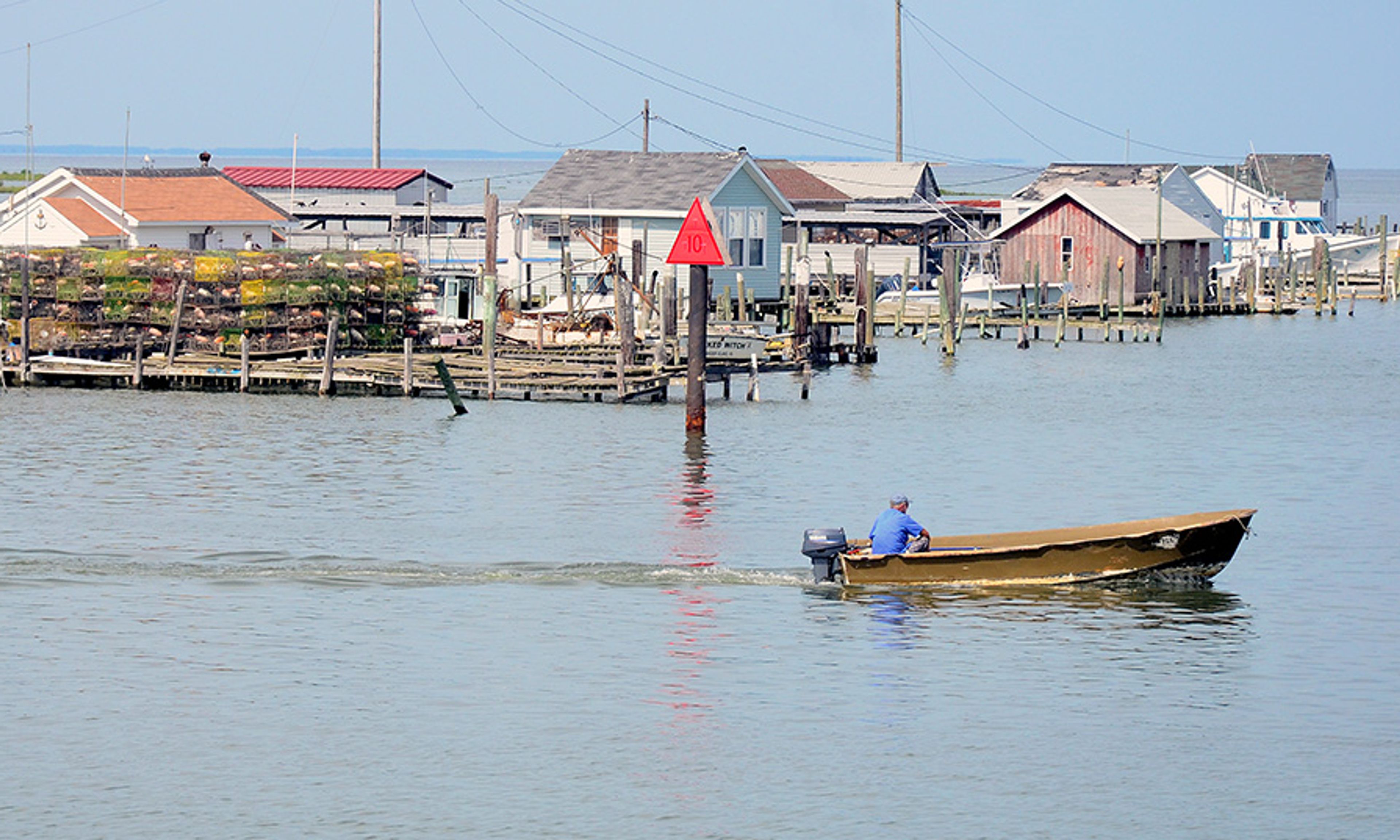
Prepare yourselves. There’s a new refugee crisis headed America’s way.
According to the authors of a study published last week in the journal Scientific Reports, rising sea levels threaten to submerge the Town of Tangier, population 727, which sits on one of Chesapeake Bay’s Tangier Islands — and “if no action is taken,” the authors warn, “the citizens of Tangier may become among the first climate-change refugees in the continental USA.” A midrange estimate of sea-level rise indicates that Tangier residents will need to flee by 2063.
The study’s conclusion — that Tangier Island may end up submerged in the relatively near future — is not unthinkable. But, as usual, sorting out cause and effect is a more complex process than the authors would have one believe.
The authors assume two all-important premises: 1) Sea levels are accelerating rapidly, and 2) mankind is responsible for the acceleration. To establish these premises, they simply quote the Intergovernmental Panel on Climate Change — because it’s not as if that esteemed institution has ever been wrong before! — and then move along.
RELATED: How to Put Climate Alarmism on Ice
But in fact, it’s hardly so simple. What the authors rely on is a “hockey stick”–style analysis of rising sea levels — the sort forwarded, for example, by the Australian National University in 2014, which claimed that sea-level changes were more or less steady for 6,000 years, until about 150 years ago, when the Industrial Revolution began pumping copious amounts of carbon into the atmosphere. Of course, it’s not so: A paper published in Nature in April 2014 suggests that sea levels were higher than they are at present during almost every prior interglacial period in the past 5.3 million years. Samuel Slater, the father of the American Industrial Revolution, can’t account for that.
#share#And it’s hard to believe that Slater and his fellow industrialists can account for the eventual disappearance of Tangier Island, either. After all, as the authors note in the Scientific Reports study, “Many [Chesapeake Bay] islands (>500) have been lost to SLR [sea level rise] and erosion since the 1600s and losses continue.” That raises a rather obvious question: If these islands have been drowning “since the 1600s,” why should we assume that mankind’s carbon use is responsible for this island’s loss? Could this not be a natural trend that has accelerated? And even if it has accelerated because of human activity, the authors would need to forge a much clearer link than they do. They do not address this quandary, yet they loudly ring the alarum-bell. “Climate refugees”! We need action!
Or do we?
RELATED: The Calcification of Climate Science
Climate science, which in theory takes as its subject the whole pulsing and heaving of Earth, is oddly hostile to considering the natural world’s own movements, those unprompted by aerosol sprays and Ford F-150s. The Town of Tangier was susceptible to those movements from the start. As the authors of the study note, the Tangier Islands were settled in the 1700s, but “few islands were ever inhabited (~39), as most lacked sufficient uplands for habitation.” In fact, the prospective “climate refugees” in this case are the 700 or so remaining ancestors of the folks who settled on the less than 8 percent of habitable land in this cluster of islands. It’s hardly unthinkable that Mother Nature might, in time and of her own accord, push them off.
#related#This would, of course, be some loss. Tangier Island exhibits a unique cultural and economic frozenness because of its isolation; the famous accent of Tangier Island natives is believed to be some approximation of Founding-era English.
But the exodus of people to suit a changing planet is nothing new. Earth has its rhythms — and its convulsions — and people move accordingly. There is good reason to think that Tangier Island will become Atlantis whether we act or not, and it’s myopic to think that the Town of Tangier is so precious that it must stay exactly as it is forever, and that we should spare no expense to preserve it.
— Ian Tuttle is a National Review Institute Buckley Fellow in Political Journalism.





Comments