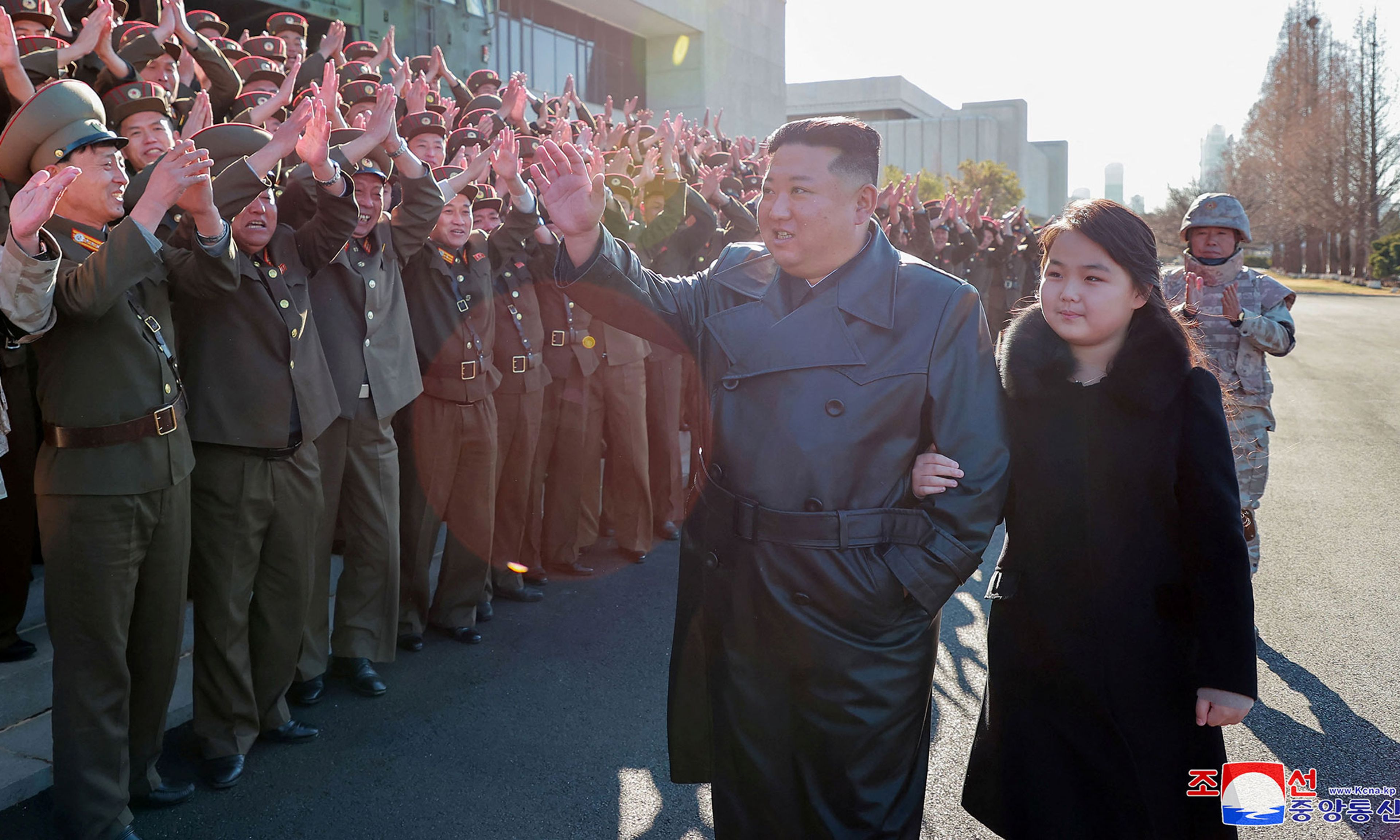
A headline last week read, “Kim’s daughter reveal hints at prolonged family rule.” “Daughter reveal” is a strange phrase. But it makes sense in North Korea, where things are very, very secretive.
The report — from the Associated Press — begins,
North Korean leader Kim Jong-un’s disclosure of his daughter in recent public events was likely an attempt to show his people that one of his children would one day inherit his power in what would be the country’s third hereditary power transfer, South Korea’s spy service told lawmakers.
Yes.
The report continues,
Kim publicly took his daughter to three events in the past few months: a missile-launch site, a photo session with weapons scientists, and a tour of a missile facility.
How do you like those, for “daddy-daughter dates”?
More from the report:
State news media called her Kim’s “most beloved child,” sparking outside debate over whether she’s being groomed as his heir apparent, though she’s believed to be around 9 or 10 years old.
The girl’s name is Ju-ae. Some years ago, I wrote a book called “Children of Monsters: An Inquiry into the Sons and Daughters of Dictators.” Terribly interesting subject. Let me paste for you the paragraph that concludes my chapter on the Kims. Before I do, however, a little “background.”
Kim Jong-un is a huge basketball fan — a fan of the NBA. So was his father, Kim Jong-il, before him. In 2000, when Secretary of State Madeleine Albright went to North Korea, she brought with her a basketball, signed for Kim Jong-il by Michael Jordan.
Okay, that last paragraph, from the Kim chapter:
The dictator, Kim Jong-un, has a wife, Ri Sol-ju. And they have a daughter, Kim Ju-ae. We know this girl’s name because Dennis Rodman, a former basketball star, reported it. Rodman has formed a bond with Jong-un, giving the young ruler a link to the basketball world. Whether Jong-un will be the last dictator from his family, no one can know. It seems unlikely the dynasty can continue. Then again, it seemed unlikely that it could endure, strangling North Korea, for as long as it has.
Before leaving this topic — the Kim family — one more word. Could Ju-ae succeed her father as dictator? Could a daughter ever succeed her father as dictator? It has never happened before.
In Haiti, “Papa Doc” Duvalier was very fond of his daughter Denise. She assisted him. She had a real appetite for politics and power. But she was a woman — so Duvalier tabbed his son, Jean-Claude, to succeed him. (He would be known as “Baby Doc.”) Jean-Claude wanted nothing to do with politics and power, really. He just wanted to play around. But the role was thrust on him.
In Syria, Hafez Assad had a daughter, Bushra. He brought her into the councils of government. He took her on foreign trips. But she was a woman. Bassel would be Assad’s successor. And when Bassel died in a car accident, it would be Bashar — the shy eye doctor, who liked to take black-and-white photos.
And in North Korea? Kim Jong-il had a daughter named “Sol-song,” which means “snow pine.” That name was given to her by her grandfather, Kim Il-sung, the first of the North Korean dictators. Evidently, Kim Jong-il was very, very fond of Sol-song. He had her work alongside him. But . . .
Kim Jong-un it was. How he won out over the other sons, is another story.
• An obit in the New York Times was headed “Nate Thayer, Bold Reporter Who Interviewed Pol Pot, Dies at 62.” Here is the subheading: “The ‘mad genius’ journalist scored an exclusive interview with the genocidal Cambodian leader and covered his show trial, another worldwide scoop.” I learned a lot — a great deal — about the Khmer Rouge from Nate Thayer.
I will excerpt, once more, Children of Monsters:
In the mid-1980s, Pol Pot was about 60, and Khmer Rouge officials decided that he needed a wife. As the journalist Nate Thayer writes, “they handpicked a small group of young women, chosen for their revolutionary commitment and the purity of their class background.” Pol Pot could choose from this lineup. He chose Mea Son, who had been an ammunition porter.
Those two had a daughter, Mea Sitha. Terribly interesting young woman, certainly given who her father was.
Another paragraph or two from my book:
In October 1997, Nate Thayer pulled off an extraordinary coup: an interview with Pol Pot. Among other subjects, they discussed Mea Sitha. Thayer writes, “When Pol Pot spoke of his 12-year-old daughter, he became animated and whimsical, exuding a gentle fatherly love that was clearly sincere and typical for the father of a young girl.” Pol Pot told him, “She is a good girl. She is kind and plays well with others. She studies hard and she helps her mother.”
Thayer asked him an excellent and pointed question: “When your daughter grows up and people know she is the daughter of Pol Pot, will she be proud of you?” Pol Pot was taken aback by the question, disturbed. Then he answered softly, “I don’t know about that. History will have to judge.”
By the way, the Times obit of Nate Thayer was written by another legendary reporter, Seth Mydans. I have learned a great deal from him, too. He is the son of another media legend: Carl Mydans, the Life magazine photographer.
• Where I live, Prince Harry is a bête noire, virtually a hate-object — like George Soros or Anthony Fauci. He has very interesting things to say, however. If you don’t have the time, or inclination, for a book, try this news article: “‘Spare’ but not stingy: takeaways from Prince Harry’s memoir.”
He was born into the British royal family. His parents divorced, which was highly unusual — for the heir to the throne and his wife to do. He himself was the brother of an heir. He was the “spare.” (What’s that like?) Their mother was a worldwide icon. She died in a car accident when Harry was twelve. He fought in Afghanistan. He married an American actress. He left his royal duties. And so on and so forth.
Yes, he has very interesting things to say. Now, you may not think he should say them. You may think he should suck it up and shut up. But people live their own lives, if they can. And no one is required to read Harry’s memoir or to listen to him.
I would like to meet the guy one day. Talk with him. Interview him. (Not sure he’d think my audience was big enough. Couldn’t blame him.)
• Cameron Hilditch, late of National Review, now with The Dispatch, has written a piece called “The Novel of the Twentieth Century.” What would that be? The Leopard, by Giuseppe Tomasi di Lampedusa. Some consider it more of a novella, but there’s no need to quibble. Anyone who has read The Leopard, will never forget it. Cameron has written a lyrical and discerning essay on it.
I myself wrote about The Leopard last year: as book, as movie, and, now, as opera. For that piece, go here. Encountering The Leopard in college meant a lot to me.
Mr. Hilditch calls The Leopard “the twentieth century’s greatest novel.” This reminded me of a conversation I had with Bret Stephens, many years ago. He referred to The Magic Mountain as “the second-greatest novel of the twentieth century.” I asked, naturally, “What’s first?” He answered, in an incredulous tone, as though I had asked him what the capital of France was, “Lord Jim!”
• Watching a Big Ten basketball game last week, I looked something up: Michigan State has had two head coaches since 1976 (Jud Heathcote and Tom Izzo). That is amazing. I thought of the Philadelphia Orchestra — which, from 1912 to 1980, had two music directors (Leopold Stokowski and Eugene Ormandy).
When I mentioned this on Twitter, some people said, “What about the Pittsburgh Steelers?” Ah, amazing: three head coaches since 1969 (Chuck Noll, Bill Cowher, and Mike Tomlin).
• A little music? For a review of The Elixir of Love at the Metropolitan Opera, go here. Elixir is a Donizetti comedy of 1832. As I say toward the top, “this is one of the most lovable operas in the repertory.” For sure.
• Charles Simic, the poet, has died at 84. For the obit in the New York Times, go here. He was born in Belgrade in May 1938. He was eventually able to get to America. “My travel agents were Hitler and Stalin,” he said.
Thank you for joining me today, dear readers, and I’ll see you later.
If you would like to receive Impromptus by e-mail — links to new columns — write to [email protected].




Comments