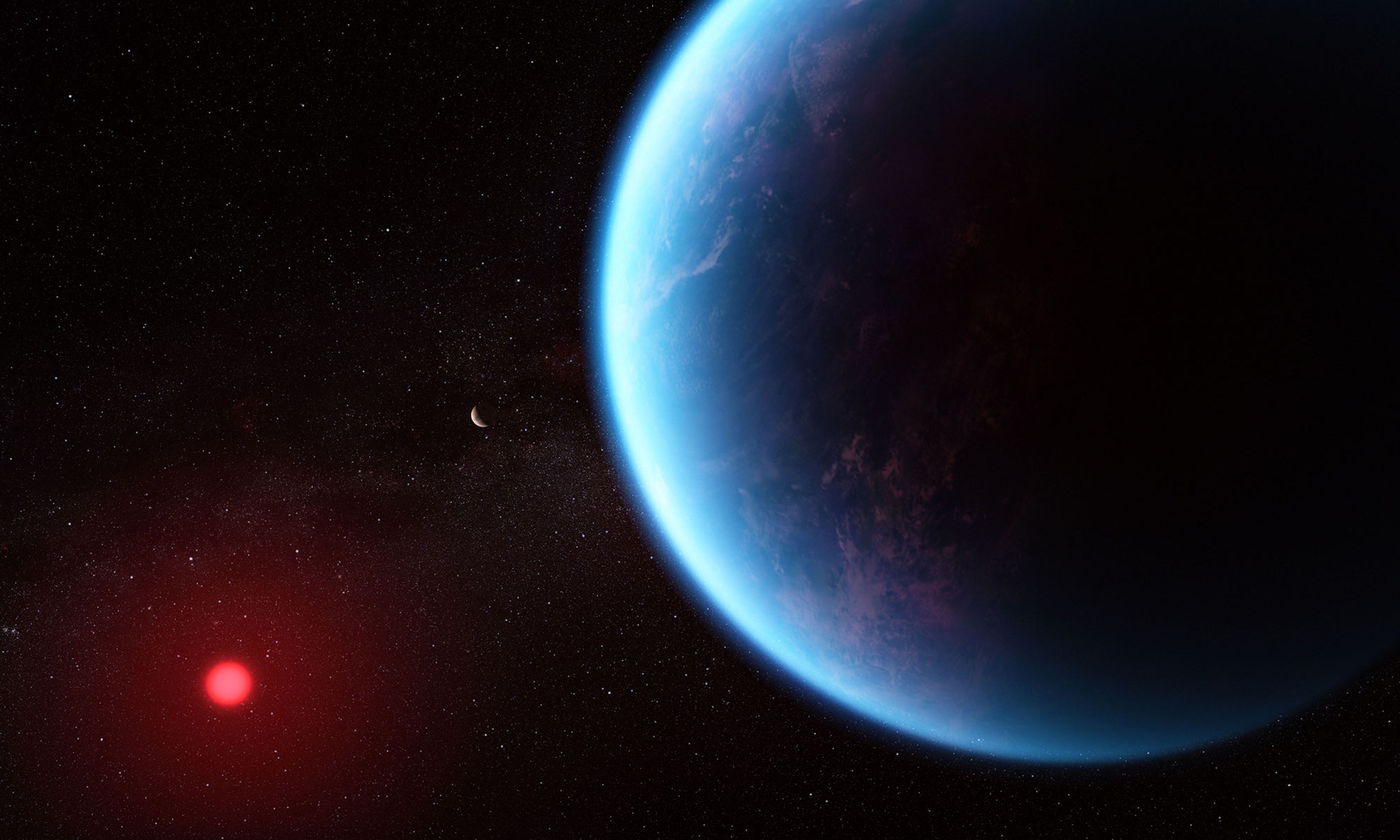
On September 11, an international team of astronomers led by Cambridge University professor Nikku Madhusudhan announced that, using NASA’s James Webb Space Telescope, they had found potential evidence of life in the atmosphere of another world.
The planet in question, known as K2-18b, orbits in the habitable zone — the “Goldilocks region,” where temperatures are neither too hot nor too cold for liquid water — of K2-18, a K-type red dwarf star located in the constellation Leo some 110 light-years from Earth. K2-18b is 8.6 times as massive as the Earth, intermediate in size between Earth and Neptune. Such “sub-Neptune” worlds are among the most common types of exoplanets detected around other stars, but K2-18b might also be a hycean (a portmanteau of “hydrogen” and “ocean,” coined by Madhusudhan and others in a 2021 paper), as its surface appears to consist largely or entirely of liquid water.





Comments