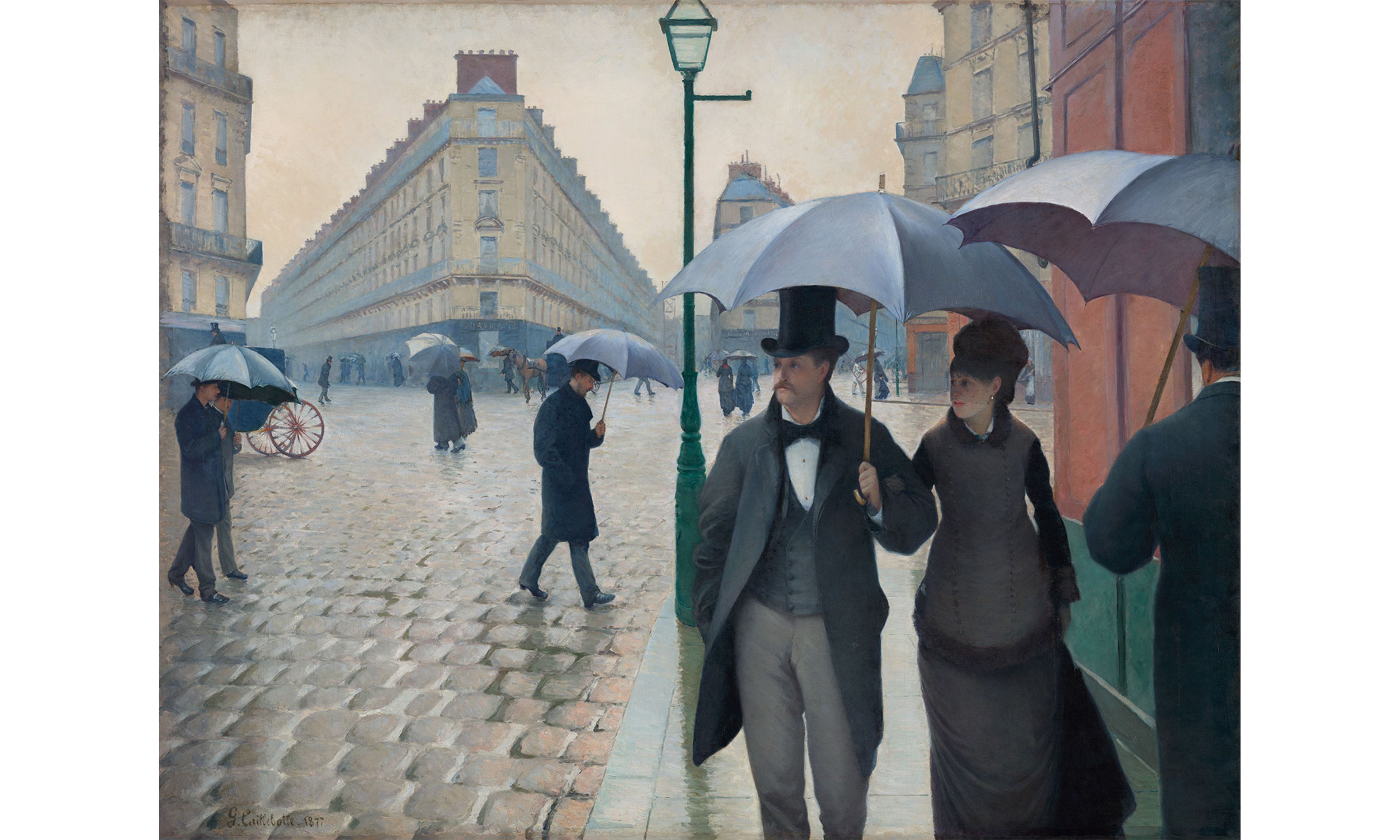
Greetings from Chicago and its splendid Art Institute, where Gustave Caillebotte: Painting His World is in its last month here after a run at the Musée d’Orsay and the Getty. Caillebotte (1848–1894) is the Impressionist paradox. His work is cerebral and cool, emotional but only on simmer, hot and sweaty but there’s never a dip too far away. Consciously modern like Monet, Renoir, Degas, and others among the renegade movement, he spiced his paintings with views of his subjects, mostly men, from behind, from startlingly high or low points of view or up close to the point of weird immersion: men at work, men at play, men fresh from the tub, and men as flâneurs. He’s brilliant at painting water and had a way with lush, cool, calm brushstrokes. He’s the new master of the Old Master tradition of dazzling reflections.
In a short time, only twenty years, he did close to 600 paintings and exhibited in five of the eight Impressionist salons. Still, until the 1990s, while not unknown — his mammoth Paris Street; Rainy Day anchors the Art Institute’s famous Impressionist galleries — Caillebotte wasn’t cherished, much less plumbed. Too cryptic, too peculiar, too many men and the wrong kind of men.




Comments