Kenneth Minogue was a political scientist who lived from 1930 to 2013. He spent his career at the London School of Economics, where he was a friend, colleague, and ally of Michael Oakeshott, the great classical liberal. Ken was such a person himself.
Once, I asked him about his name — which, though Irish, has a French air. He said this, among other things: “Once Kylie came along, everyone knew how to pronounce it.”
Was Ken a relation of Kylie Minogue, the Australian singer and actress? (Ken was born in New Zealand and went to school in Australia.) Not to my knowledge, no.
Encounter Books has just published a collection of Minogue essays, On Liberty and Its Enemies. This comes from a particular line of the publisher: Encounter Classics. Another book from this same line is Past and Present, a collection of essays by Gertrude Himmelfarb, the historian.
I will be commenting on both of these books in our next issue (the next issue of National Review). (You subscribe, don’t you? Yes? Whew.)
One of my favorite Minogue essays of all is not in the new collection — but you can read it, here. It is titled “Journalism: Power without Responsibility.” The title comes from the famous, bitter remark of Stanley Baldwin, who said that unfavorable newspaper owners were seeking “power without responsibility: the prerogative of the harlot throughout the ages.”
Baldwin was a cousin and close friend of Rudyard Kipling, and apparently he got the line from him.
Anyway, Kenneth Minogue wrote what amounts to a brief against journalism: the production of it and the consumption of it. I have spent much of my life both producing and consuming journalism. (Especially consuming.) I do love it.
I told Ken that his essay made me want to hang up my spikes, so to speak. He said, in essence, “Don’t take it too hard” — but he took none of his essay back! As why should he?
‐Before I continue with remarks on journalism, I want to say something about liberalism — classical liberalism, the kind that in America became known as “conservatism,” and in particular “Reagan conservatism.” Another political scientist, Robert Leiken, has just died. For its obit, the New York Times sought comments from Harvey Mansfield, the famed conservative at Harvard. He said that Leiken was “a liberal of the kind now rare: a man who stands up for liberty.”
I take up these themes in my little piece for the forthcoming NR.
‐Like other conservatives, I have spent much of my career bashing media bias, as represented in the “MSM,” the mainstream media. (Those initials have always bothered me, in that “mainstream” is one word. But I guess “MM” doesn’t sound as good.) I once said that my regular column, Impromptus, could be renamed “Gripes about the New York Times.”
And yet, I value the media, including the MSM, and I think that press freedoms are among our most precious.
President Trump gets a lot of mileage out of bashing the media. You can’t go wrong with media-bashing, especially on the Right. “Fake news,” he calls them — or, more often, in tweets, “FAKE NEWS.” By “them,” I mean news organizations he dislikes. He also calls them “enemies of the People.”
This is a phrase, an accusation, with a long, odorous history. Whether the president knows this history, I’m not sure.
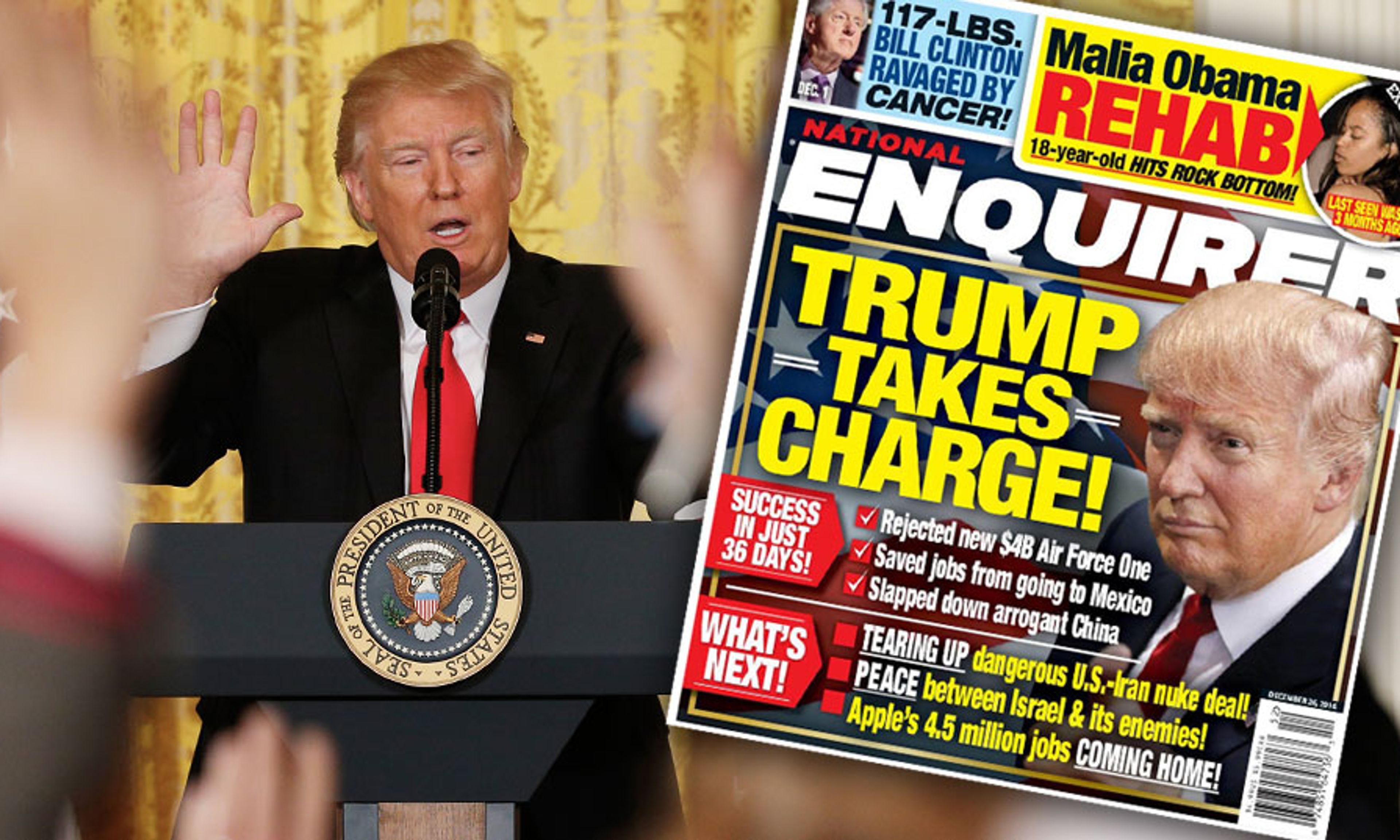
If the New York Times, the Washington Post, and all television networks except Fox are fake news, what do you call the National Enquirer? Trump is close to this publication, and close to its boss, David Pecker. During the campaign, Trump promoted a story that claimed that Senator Cruz’s dad was somehow involved in the Kennedy assassination. He also said that the Enquirer should win Pulitzers.
People have different ideas about what outlets are trustworthy and what are not.
The National Enquirer is involved in the current conflict between the president and Joe Scarborough. Does Trump have the power to place or kill a piece in the Enquirer? That is a helluva power for any official to have.
In Europe, President Trump said that he wanted a free press but a fair press. This reminds me of people who say they want free trade but fair trade. I wonder how committed to trade they really are.
And did you hear Mike Huckabee? I did, via a tweet from Kimberly Guilfoyle, who quoted a statement that Huckabee made on the Hannity show: “The freedom of the press only works when there is responsibility of the press to be objective.” Objectivity is a fine and important thing in journalism, as in other areas of life. But there are different kinds of journalism: opinion journalism, for example, and advocacy journalism, such as you find on Hannity.
Occasionally, I hear that “people hate journalists.” A reporter somewhere will do something objectionable and someone will say, “This is why people hate journalists.”
No, they don’t. They like the ones they like and dislike or hate the ones they don’t. Many, many media-bashers swear by Drudge, Fox, and radio talkers. Some swear by InfoWars and the National Enquirer, both of which the president has praised, lavishly. You pays yer money and you takes yer choice.
Actually, you increasingly don’t pay any money, which is another problem, a great problem, of the industry …
‐I will quote our president: “Word is that @Greta Van Susteren was let go by her out of control bosses at @NBC & @Comcast because she refused to go along w/ ‘Trump hate!’” I am pretty sure she was let go because her ratings were low, the TV business being what it is. But I wanted to comment on the president’s phrasing: “Word is …”
That reminded me a bit of Harry Reid, who said, “So the word’s out …” On the Senate floor, in 2012, he said, “So the word’s out that he hasn’t paid any taxes for ten years. Let him prove that he has paid taxes, because he hasn’t.”
He was talking about Mitt Romney, of course. There are many things about Washington today that I find obnoxious. But at least Senator Reid is gone …
‐IQ is in the air, it seems. Here at NR, we have had pieces and posts about IQ, and in particular race and IQ. I normally don’t enter these debates. Race and IQ aren’t my bag. There are other measures of man.
President Trump cares a lot about IQ, however (leaving race aside for a moment). He regards his as high and his critics’ as low. In 2013, he tweeted, “Sorry losers and haters, but my I.Q. is one of the highest -and you all know it! Please don’t feel so stupid or insecure,it’s not your fault.”
He also tweeted, “I know some of you may think I’m tough and harsh but actually I’m a very compassionate person (with a very high IQ) with strong common sense.”
On several occasions, he has said that he believes in what he calls the “racehorse theory.” He will point to his head when he says this. He means breeding, genes. “I had an uncle, went to MIT, who is a top professor. Dr. John Trump. A genius. It’s in my blood. I’m smart. Great marks. Like really smart.”
Again, Trump: “Good genes, very good genes. Okay, very smart.”
And so on.
The other day, he described Mika Brzezinski, Joe Scarborough’s partner on and off the air, as “low I.Q. Crazy Mika.” I wonder: Does Mika Brzezinski have a low IQ? Zbig’s daughter? What about the “racehorse theory”?
If Trump and Brzezinski were both tested — who would come out higher?
Is Brzezinski a dumb Pole? Are the Poles a stupid race? I grew up with “dumb Polack” jokes (in southeastern Michigan). Like a lot of ignorant fools, I’m sure I repeated some of them.
Anyway, I grew up. And I will move on to other topics …
‐Dmitri Trenin is the director of the Carnegie Moscow Center. He was quoted in this article, saying the following about Vladimir Putin: “He believes that personalities — not states, armies, or companies — determine the course of global events.”
You know, I do too. That’s one reason I’m not a Marxist: I acknowledge the great importance of individuals and their actions, for good or ill.
‐The foreign minister, Sergei Lavrov, has acknowledged what everyone has long known: that Russia is fighting in Ukraine. (For a news article, go here.) Well, at least it’s on the record …
‐We are getting a new Russian ambassador, General Anatoly Antonov — who since 2015 has been under EU sanction for his role in Ukraine. Great, great.
‐Okay, some news from the American military. My eye was arrested by this headline: “Rare Butterfly Thrives on, and Because of, U.S. Military Bases.” You may get a kick out of the article, which begins,
In the shadow of giant war machines, a tiny rare butterfly is flourishing. Oddly, experts say, the U.S. military gets the credit.
The frosted elfin, which flutters along on a 1-inch (2.5 centimeters) wingspan, has found a home at several defense installations because of the way the military manages open spaces, said Robyn Niver, an endangered species biologist with the U.S. Fish and Wildlife Service.
“Military training requires vast open areas, so these bases are some of our last great wild places,” Niver said.
I’ll be. Heh. G.I. Joe and “Mad Dog” Mattis, friends of the butterfly.
‐Even more than on the street — way more than on the street — I dislike begging in subway cars. It’s on the increase — and has been for the last few years. (I blame the mayor, Bill de Blasio, but then I would.)
On a recent evening, a young man begged. He looked about 16. And he did not merely beg. He had something to offer. Like the Juggler of Notre Dame, he had a certain gift to offer.
He recited a poem, not quite a rap, about his life — a hard life, which includes fatherlessness and its companion, poverty. There was some uplift in this poem too: some striving, some hopefulness, some righteous admonition. It went on for about two minutes.
The poem rhymed, by the way — a traditional rhyming poem.
Now, I don’t like unasked-for interruptions. Even entertainment. But I must say this young man earned his coins and bills, and he was even, I swear, an inspiration.
A word from the National Review Store: To get Digging In: Further Collected Writings of Jay Nordlinger, go here.






Comments