‘I’m sad this is so hard for Mommy. I think it is even harder for Mrs. O’Beirne.”
That’s my memory of a young girl’s wise observation as she watched the sadness of her parents and other adults in a Washington, D.C., hospital hallway, going in and out of a room where our beloved friend was dying. The sweet remarks were as pure as it gets, and I’ve thought of them many times since as I remember the love Kate O’Beirne shared with us even as she breathed her last breaths, just a few weeks ago.
Those were such tender hours, the last time I saw her, deep into the night before she would let go. A former Washington editor at National Review and president of the National Review Institute, a vice president of the Heritage Foundation, and a regular on CNN — among other credits — she was a powerful woman, by worldly standards, for quite a time. But her real power was around her deathbed: her family and the friends her family generously welcomed to say good-bye. There was a peace there, even a joy, even amid all the sorrow. Life is a race to eternity, and she ran it. We are not made to be here forever, as one wise man reminded me as I cried. And while we are here, we are made for more than we often realize or settle for. Kate helped people see this. And even as we still look around for her, look to e-mail or call her, can’t believe she’s gone, she shows us this.
In those last hours as we told her how much we loved her, it must have been hard for her, as my young friend noted. But, goodness, did she seem at peace. Even more so when her sons and husband — and sisters — were nearest. She seemed to be radiating: I’m not afraid. Don’t be afraid. I’m not going far. The veil between heaven and earth seemed thin.
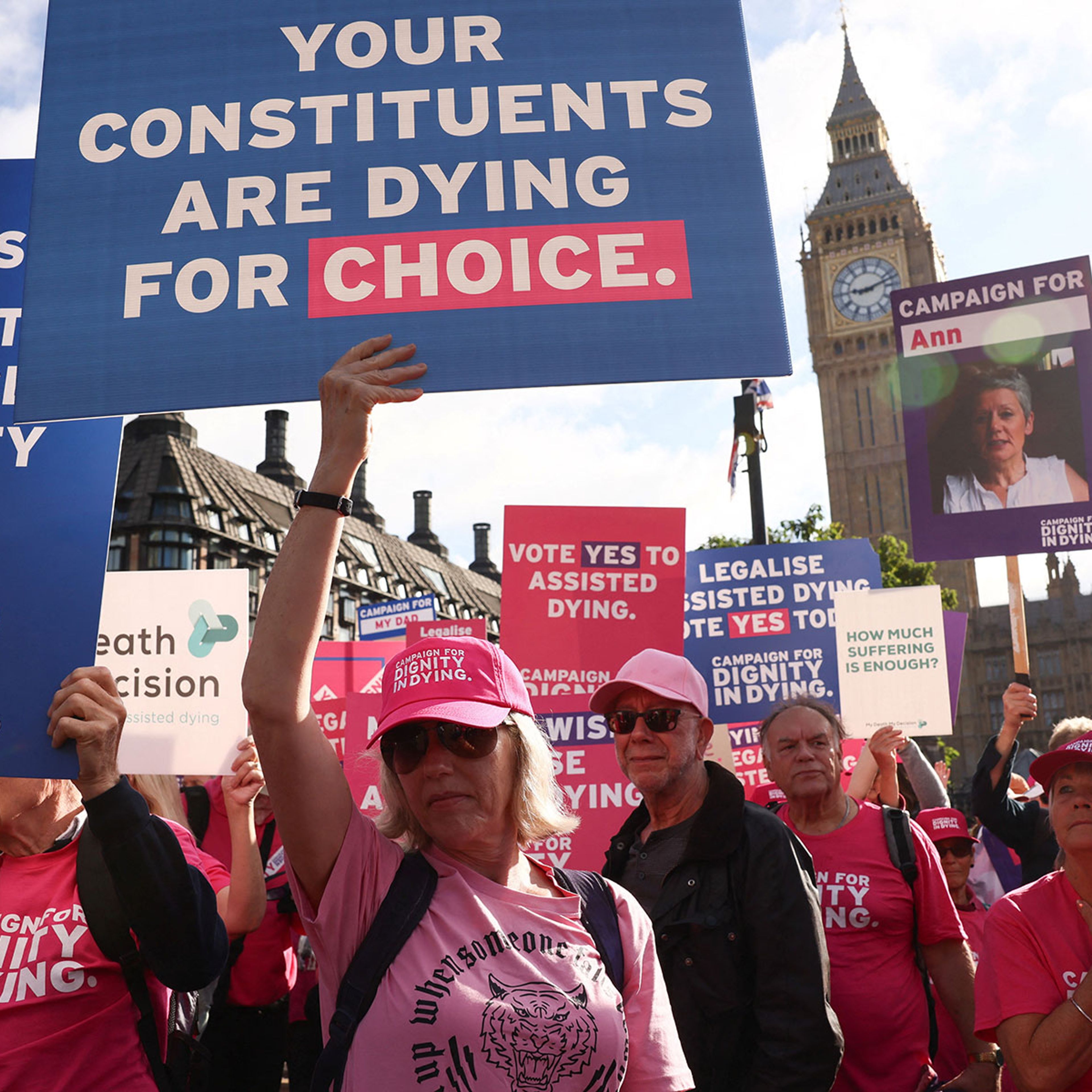
I think of this, because it’s still new. And because death and dignity and mercy are in the headlines constantly, as campaigns to legalize assisted and doctor-assisted suicide are in progress and successful, leaving us a less tender people.
Recently Cardinal Gerhard Muller, the prefect of the Congregation for the Doctrine of Faith at the Vatican, spoke in Toronto about legal euthanasia and doctor-assisted suicide, lawful realities in Canada. The “primary rationales” for these, he said — “respect for autonomy and compassion for the suffering” — are “internally incoherent and fatally flawed.” He continued:
First, supporters of legal euthanasia argue that respect for autonomy and self-determination entitles individuals to choose the time and manner of their death, especially when faced suffering and profound dependence. Euthanasia advocates attempt to bolster this claim by asserting that this is a decision that only affects the patient and doesn’t cause harm or even involve anyone else.
The first thing to notice about this argument is its detachment from the reality of our shared life. Human beings do not exist as atomized units whose actions are entirely limited to their own sphere of consequences. People exist in embedded relationships to others — families, communities, and nations.
Isn’t this the painful paradox of our problem today? We pretend we are so radically independent and yet are so hyper-connected. This illusion of autonomy can isolate us even in the presence of people and leave us stunned and perplexed in our grief.
As Cardinal Mueller put it:
Anyone who has ever experienced the suicide of a loved one or even a casual acquaintance knows the profound effects this can have on entire communities. Euthanasia in particular is not a self-contained act. It affects families and communities. It affects the medical community and alters its relationship to patients and the public. In fact, social-science evidence has demonstrated that suicide can be “contagious” — causing an increase in the incidence of suicidal impulses and actions in the immediate peer group and community. . . .
The vast majority of persons with suicidal ideation suffer from treatable mental illness, including especially clinical depression. Suicidal impulses are also associated with badly managed but manageable pain. Suicidal wishes likewise emerge from intrinsic or extrinsic burdens, including social, familial or financial. It has been demonstrated that the desire for suicide often departs once mental illness and pain are effectively treated. This is true even among the terminally ill.
I think of so many young men in a particular way — men who end their lives in a dramatic fashion, thinking it’s the only way to make any kind of mark on the world. It’s a lie, and yet we double down on the lies in grave laws that present suicide as a norm.
The entire speech is worth reading and reflecting on. He made a point that, though it should be obvious, will change the way we use fundamental words such as “freedom”:
The population of people whose suffering or hopelessness leads them to desire suicide are, as a general matter, not operating at the fullness of their freedom. Thus, the very premise of autonomy as justification for legalized euthanasia is fundamentally unstable.
Citing compassion as the justification for assisted suicide fails to persuade when we learn that effective pain management is on the decrease for all patients in Oregon, where euthanasia is legal. “This is because once euthanasia is an option, it quickly becomes the path of least resistance for medical decision makers, leading to an overall decrease in developing and pursuing creative pain-management techniques, which in turn causes a greater measure of suffering overall.”
We are so overwhelmed by so much today. By looking away from our concerns and preoccupations — many of them quite serious, others not so much — and seeing those we love right now, we might be able to face the hardest days together in more courageous love. We might be able to speak the truth in love, even when the most intimate realities are being debated as matters of law and are threatening the soul of a civilization.
By the time I said good-bye to Kate, there was nothing extraordinary being done for her. She had fought a battle against cancer, but it had now taken too much from her. She chose to live until she couldn’t live any more, and by doing so, she showed us what’s most important.
READ MORE:




Comments