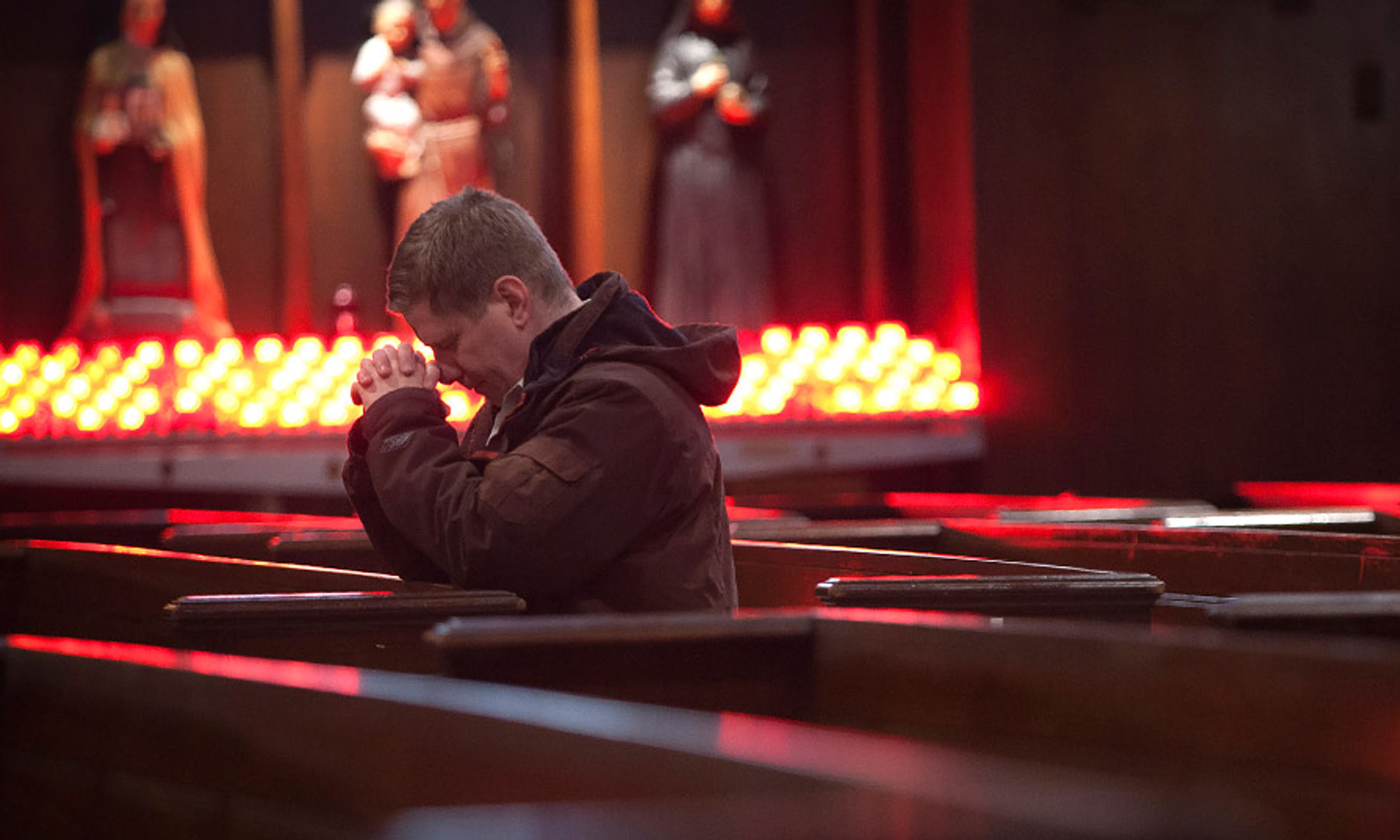
‘I must admit, that in contemporary seasons, Lent has a way of coming and going,” National Review founder William F. Buckley Jr. once confessed. Still, he wrote, “Lent is here to put us in our place, humble and sublime.” He continued:
It was remarkable, I thought, that at a certain point in Lent one no longer was able to look into the face of the cross, because it was shrouded in purple. Grief time. The conjoining of the petty griefs of minor abstinences, on over to a consideration of the overwhelming grief brought on by the suffering of the son of God had, in its quiet way, an electrifying sense of participation in the mysteries of divine providence.
Lent is one of the seasons of the liturgical calendar in the Catholic Church, and Chene Heady — associate professor of 20th-century British literature at Longwood University and longtime reader of National Review — has much to say about Lent in his book, Numbering My Days: How the Liturgical Calendar Rearranged My Life. We discuss the book, those “days,” and WFB.
Kathryn Jean Lopez: You write: “It’s no coincidence that we see ourselves as producers and consumers rather than as divine creations.” Is that the fundamental problem of our time, that we don’t see ourselves as created? We don’t see creation in front of us and as us? Is that what Pope Francis’s& encyclical Laudato Si’ was all about?
Chene Heady: Laudato Si’ is a perceptive analysis of our age. Pope Francis realizes that we now live in a utilitarian, mechanistic universe. We have abandoned the attempt to uncover and accept the nature of the world and ourselves in favor of discovering how both might be revamped and remade. We imagine our minds as computers to be reprogrammed and our bodies as blank tablets capable of infinite reshaping. We judge people, like we judge machines, to be either “functional” or “dysfunctional,” and assume that nothing, including human life, possesses inherent value.
Early on in Numbering My Days, I admit that I am disturbed by how mechanical I am. I can be quite literally Pavlovian, conditioned to be more responsive to the bells and beeps of my Outlook calendar and e-mail notifications than to the chatter of my toddling daughter. I spent a year observing the liturgical calendar to see whether this practice might teach me how to live as if my life — and time itself — were a divine creation.
Lopez: Paying attention to the liturgical calendar sounds so “churchy.” Is it really something within reach for someone who simply wants a richer faith, a more ordered life?
If you belong to a church with a liturgical tradition — most of the world’s Christians do — following the liturgical calendar simply means noticing what’s already in front of you.
Heady: Of course, the liturgical calendar is, by definition, “churchy.” That’s also precisely why it is readily in reach of anyone who wants a richer faith. By their very nature, calendars of all types are easily accessible and communally shared. Show up at any Catholic parish in December and you will find a folding table full of free calendars that list every liturgical celebration for the year (typically alongside advertisements for funeral homes). This isn’t obscure stuff; the liturgical calendar gave us Christmas (Christ’s mass) and Easter, after all. The bestseller lists are always full of titles popularizing forgotten spiritual practices from the Andes, Nepal, or medieval Ireland. We assume that spiritual depth and obscurity are synonymous. But if you belong to a church with a liturgical tradition — and, to speak numerically, most of the world’s Christians do — following the liturgical calendar simply means noticing what’s already in front of you.
Lopez: What’s so special about John Keble, whom you write about in your book?
Heady: John Keble was a 19th-century High Church Anglican clergyman; he was a close friend of Blessed John Henry Newman. He also wrote the single bestselling book of poetry of the whole 19th century in England: The Christian Year. At one point, almost every literate home in England owned a copy (no exaggeration). And the book is as churchy and liturgical as the title suggests. The Christian Year contains a poem for every Sunday, feast day, and special service in the Anglican calendar; over the course of the volume, the reader experiences the Church year alongside the speaker and learns with him to view the world through a liturgical lens.
The Victorian period in England was a time of rapid cultural and technological change and increasing secularization. Charles Darwin was a Victorian, and Karl Marx did his best work in the reading room of the British Library. Keble’s work — and its mass popularity — showed me that living liturgically need not be a practice restricted to vowed religious or relegated to a simpler time; it could resonate with ordinary people living amid the complexities of modernity. My book tests this thesis on the experimental subject closest at hand: me.
Lopez: Can this calendar awareness make Lent richer?
Heady: It can make Lent richer, certainly. But I think that for most Catholics (and Christians from liturgical traditions generally), Lent is the one season where we are already aware of the calendar on a daily basis. Most people practice some daily act of self-denial in Lent, and many perform some sort of devotional reading. In Lent, we are in the habit of making a concrete connection between faith and daily life, between the Church calendar and our secular routine. My book tries to show that the average person really can live the whole year as most of us live Lent and that Lent’s sense of heightened meaning is attainable in each liturgical season.
Lopez: Did this philosophy make your past Advent and Christmas more prayerful?
Unfortunately, Advent’s penitential nature has vanished from common knowledge, buried under an avalanche of cookies and chocolate samplers.
Heady: Yes. In Advent we wait for Christ’s coming in our own lives now and in our world at the end of time. But Jesus’s first coming went, for the most part, unobserved or unrecognized. We can encounter God and not know it, which is a most disconcerting thought. The very penitential Saint John the Baptist — camel hair, bugs, and all — is the gospel model of a person capable of recognizing Jesus for who he is. Self-honesty and self-examination lead to spiritual perception. The Church designates Advent as a penitential season like Lent, and Christmas is more meaningful if you’ve properly prepared for it. Unfortunately, Advent’s penitential nature has vanished from common knowledge, buried under an avalanche of cookies and chocolate samplers. But if you’re orienting your life by the lectionary, the self-reflective nature of Advent is inescapable; John the Baptist and the Old Testament prophets constantly keep popping up.
Lopez: Does paying attention to the liturgical calendar make one more grateful?
Heady: Perhaps at one point most people intuited that life was a gift, which (like all gifts) must be accepted on its own terms and should cause the recipient to be grateful to the giver. But now we take nothing to be a gift and accept nothing as a given.
Each day, the liturgical calendar reminds us that we live in a world that is charged with meaning and that we did not create it. The world and our lives are gifts. Learning gratitude for the concrete particulars of my life — to appreciate what is rather than what is not or what might be — was a large part of my journey with the liturgy. I titled a chapter “Out of Fantasy, into Actuality,” and that phrase sums up an important element of my experience.
Lopez: Why do you want the world to stop for a bit on Good Friday?
Heady: Christians believe that there was a particular day, Good Friday, on which the normal order of life and time was interrupted. The sun was darkened, the temple liturgy was disrupted, and in a sense God himself was dead. The world was as devoid of meaning as the darkest nihilist could imagine.
We can appreciate the joys of the Resurrection only if we are willing first to enter for a while into this disruption and live in this darkness. And that must mean interrupting the normal habits of our lives; we must, at the very least, briefly stop and be still. Otherwise, we’ve missed the point.
Lopez: What do you teach your students about Bill Buckley and a well-constructed essay?
Heady: Buckley’s essays are both concise and precise, clear and entertaining, well-reasoned and witty. Typically, college freshmen imagine these literary virtues as engaged in a zero-sum game; they assume that one must choose between being dull and detailed or fun and vacuous. Buckley’s syndicated columns illustrate that within space limits as narrow as those of the typical freshman composition paper, it’s possible to be both exact and engaging.
[More from our interview here.]





Comments