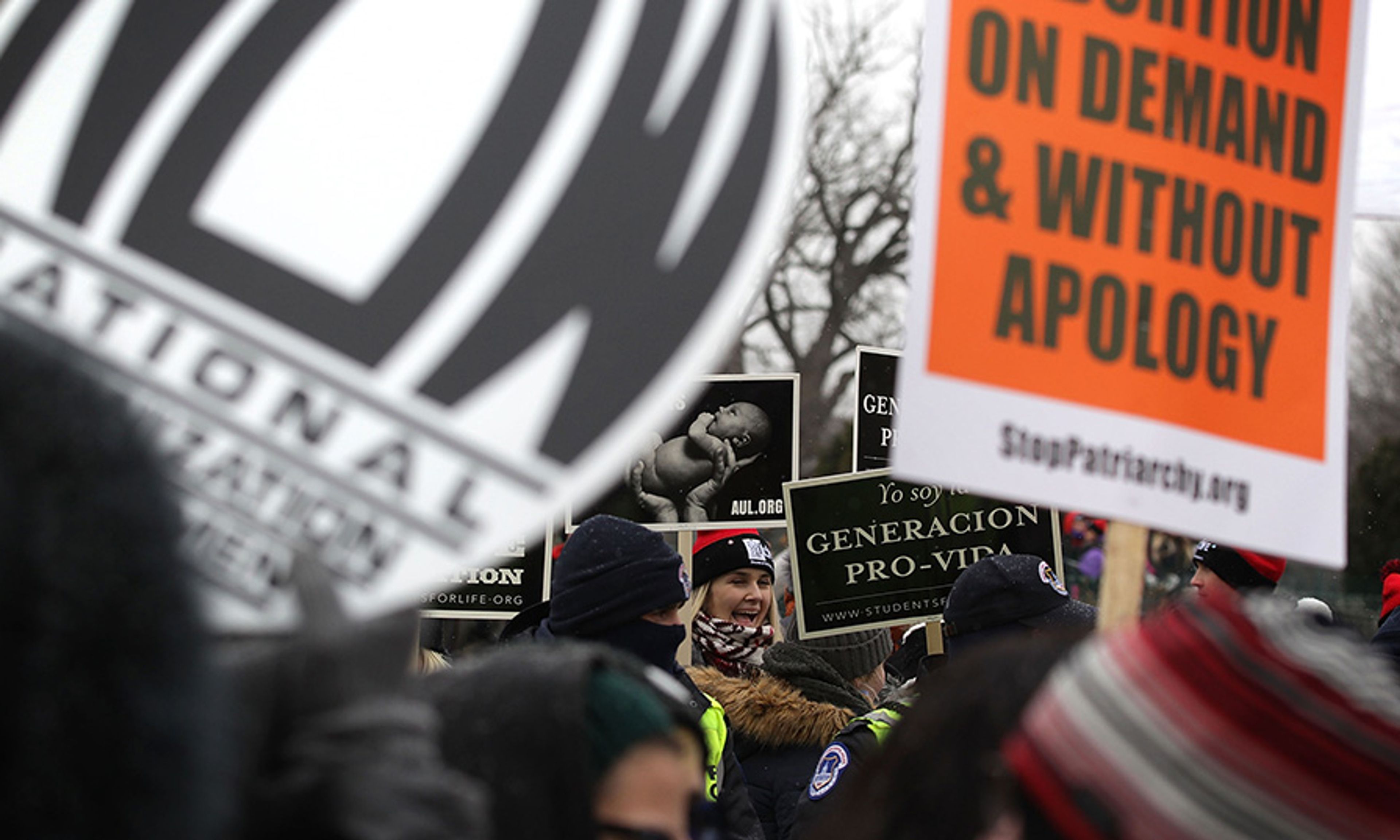
Washington, D.C. — Every year, for as long as I can remember, the annual March for Life story is about the same: Joyful high-school and college students flood Washington, D.C., in buses. And a few, angry counterprotesters show up around the Supreme Court.
I’m pretty used to the routine. But I wasn’t prepared for this year.
“If we are pro-choice and just sitting on the sidelines, we are no better than THEM.”
“We need to be taking to the streets and taking a defiant stand, standing up for the women of the world. FOR THE WOMEN OF THE WORLD, STAND UP.”
“WE NEED FOR OUR VOICES TO BE HEARD. WE NEED TO BE FIGHTING FOR THIS BASIC RIGHT.”
That was calm compared to a few minutes before.
“Women are not incubators! Women are not punching bags!”
“Blood curdling” comes closest to describing the scene. The anger was so intense I imagined the terrors of hell. These shrieks seemed to be coming out of such deep wounds and anger.
It was a small counterprotest to the 42nd annual March for Life, 43 years after the Roe v. Wade decision, which made abortion legal in the United States throughout pregnancy. But it was a loud one.
RELATED: Radical Mercy on the March
As the March was making its way up Capitol Hill, a group in white and black descended on the Supreme Court, seemingly with the express intention of drowning out all other voices. At that particular moment, members of the Charismatic Episcopal Church were praying: For an end to abortion; for those hurt by abortion. They expressed their love and prayers for those who were screaming at them. Children whose parents thought they were doing a good thing by exposing them to the importance of civic responsibility early on were crying, perplexed by what they had done to incur such wrath.
THEM — the pro-life marchers — were described as “F—ing skinhead Nazis.” (The F word was a bit longer in reality.) As one teenaged boy with a pro-life church group from Maryland, running ahead of the March to get home before the snow, put it in response: Except we are engaged in the democratic process, exercising our free speech.
The largely ragtag counterprotesters were screaming about how women aren’t sluts. They seem to have missed the fact that the March for Life’s theme this year was precisely about women, about loving both a pregnant woman and her child. They didn’t seem to be interested in the older woman with the “I Regret My Abortion” placard.
SLIDESHOW: March for Life 2016
And with their “Abortion on Demand & without Apology” signs, they seemed to have missed, too, where our culture is and has been for decades. Abortion is, in fact, legal by judicial edict, and the choicers’ responses to efforts to make it as safe as you can make such intimate violence take on a hysterical tone, as if any small step was going to roll back all of Roe v. Wade.
The demonstration outside the Court — in all its crude, rude anger — was something of a voice crying for help, and not in the way the protesters intended.
#share#During the same week, Marist polling commissioned by the Knights of Columbus showed that two-thirds of those who describe themselves as pro-choice want some restrictions on abortion — they do not want “Abortion on Demand & without Apology.” One-third of them, in fact, say that abortion is morally wrong. The “pro-choice” label, in other words, doesn’t tell the whole story. People want to know that women in tough situations have the help they need — have true choices. Choice should not be pressure to abort. Choice should be what former Cosmo writer Sue Ellen Browder described during a March for Life panel as interconnecting bonds of loving support.
Every year before the March for Life, high-school and college students move into the Basilica of the National Shrine of the Immaculate Conception, adjacent to the campus of the Catholic University of America, my alma mater. I laughed at one of the headlines reporting on this year’s Vigil for Life: “Make Your Life a Nativity Set, Cardinal Dolan Tells Pro-Life Marchers.” Well, it’s not quite as neat a package as that, available on Amazon for overnight shipping.
The ‘pro-choice’ label doesn’t tell the whole story. People want to know that women in tough situations have the help they need — have true choices.
But what he described is exactly what Browder had in mind: He told the story of a frightened mother who left her newborn in the waiting, empty Advent crib in a Catholic church in Queens, N.Y. She told a reporter: “I’m very religious, so right away I thought of my church, Holy Child Jesus. I go there a lot, and the priests and people are so good. I just knew if I left him in God’s hands, my baby would be OK. So, I ran into my church and put him in the empty crib. Then he started crying. I just hoped he was warm enough. I hid in the back of church, knowing Father would find my baby and the people would help him. They did.”
Dolan, who is head of the office of the bishops’ conference devoted to pro-life ministry and education, said: “God bless that baby — who I hear is doing well and is named José, after the foster father of Jesus; God bless that frightened, young mom who refused to believe in what Pope Francis has termed our ‘throwaway culture’; God bless Holy Child Jesus Parish in Queens, for radiating such a spirit of welcome, joy, warmth, and outreach that our Mexican mother spontaneously knew her baby would be safe there; God bless this culture of life!”
It’s that kind of welcome that will end abortion in America — people knowing there is support for the choice for life.
#related#About a week later, again at the basilica in D.C., Father Peter John Cameron, O.P., a Dominican priest and the editor of the monthly Magnificat, preached at a Mass for the Feast of St. Thomas Aquinas with Catholic University students. “I see that with us at Mass today there are many young people,” he said. “I have such a heart for young people of today. Because they suffer a lot — from loneliness — from a lack of meaning or purpose in their life. They suffer because they really want to belong, they really want to be loved, and they are not loved enough, especially at times — very sadly — by their own fathers. And this creates a terrible wound and can lead to self-destructive behavior.”
There is nothing more self-destructive than turning in on ourselves, lashing out, doubling down on a politics that pits a mother against her child. The shrill sounds of counterprotest seemed to betray that — especially in such stark contrast with the joy and hope that overflowed from those who want to help, and who in many cases live that help with the work of their everyday lives.





Comments