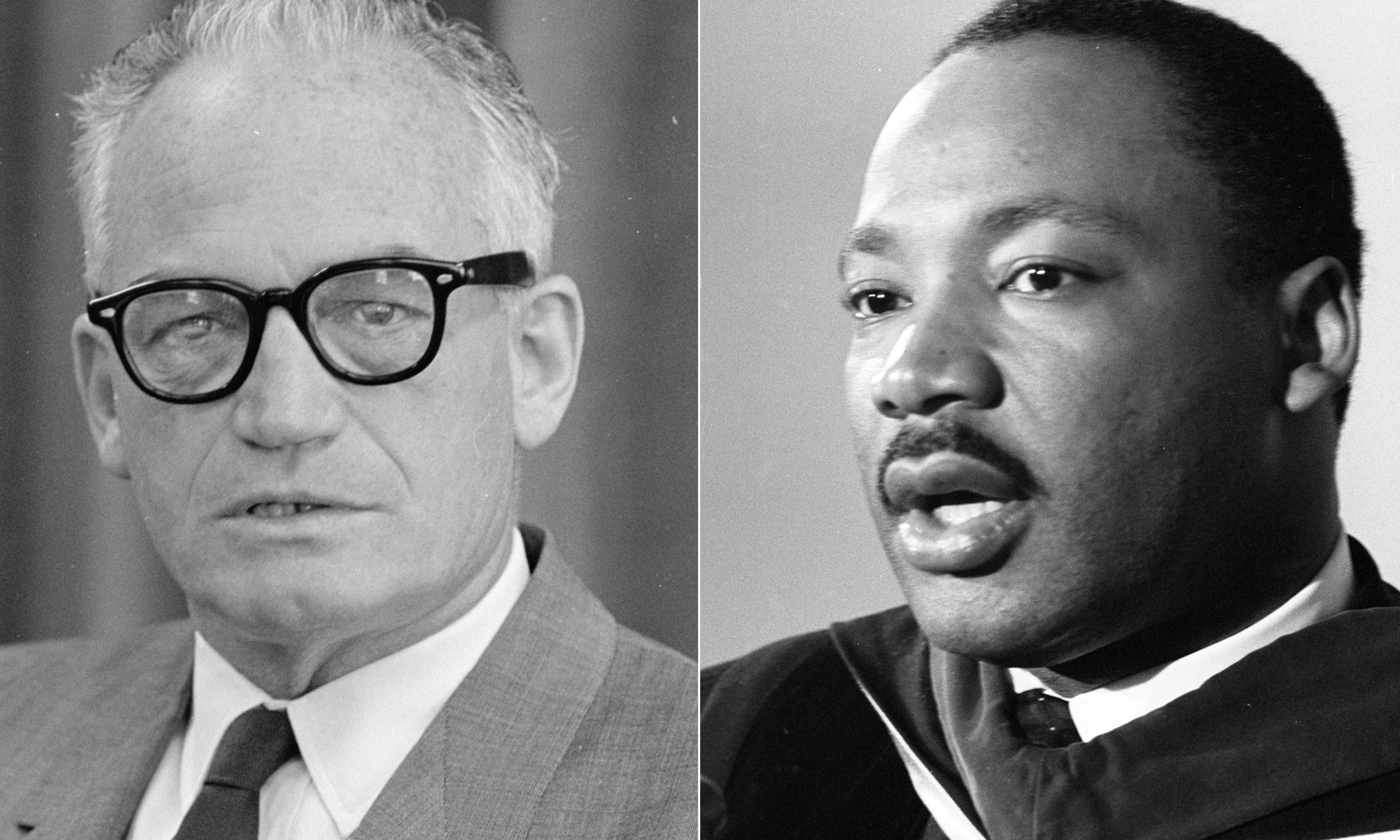
The political stage of the 1960s was set by Martin Luther King Jr.’s “Letter from Birmingham Jail” and Barry Goldwater’s acceptance of the Republican nomination for president. Both embraced the title of extremist for themselves. In Goldwater’s case, the label had been applied by Harry V. Jaffa, a professor of government at Claremont McKenna College. Sixty years later, Nicholas Buccola, also a government professor at Claremont, has delivered One Man’s Freedom: Goldwater, King, and the Struggle over an American Ideal, covering the lives of King and Goldwater in the crucial years between 1955 and 1965. The book is a sequel to Buccola’s 2019 The Fire Is Upon Us, a similar tale of parallel lives chronicling legendary National Review founder William F. Buckley Jr. and the activist and author James Baldwin.
One Man’s Freedom ostensibly poses a larger challenge. Unlike Baldwin and Buckley, King and Goldwater never met. Yet this pairing works just as well. Buccola presents speeches of King’s and Goldwater’s in tandem with analyses of the deeper political philosophy he finds in each. His vivid writing brings the era to life. Moreover, Buccola’s willingness to use the black press as a source yields interesting observations not seen in the many mainstream media tellings of these men’s lives and separates the book from the pack.




Comments