“Our enemies are little worms. I saw them at Munich.”
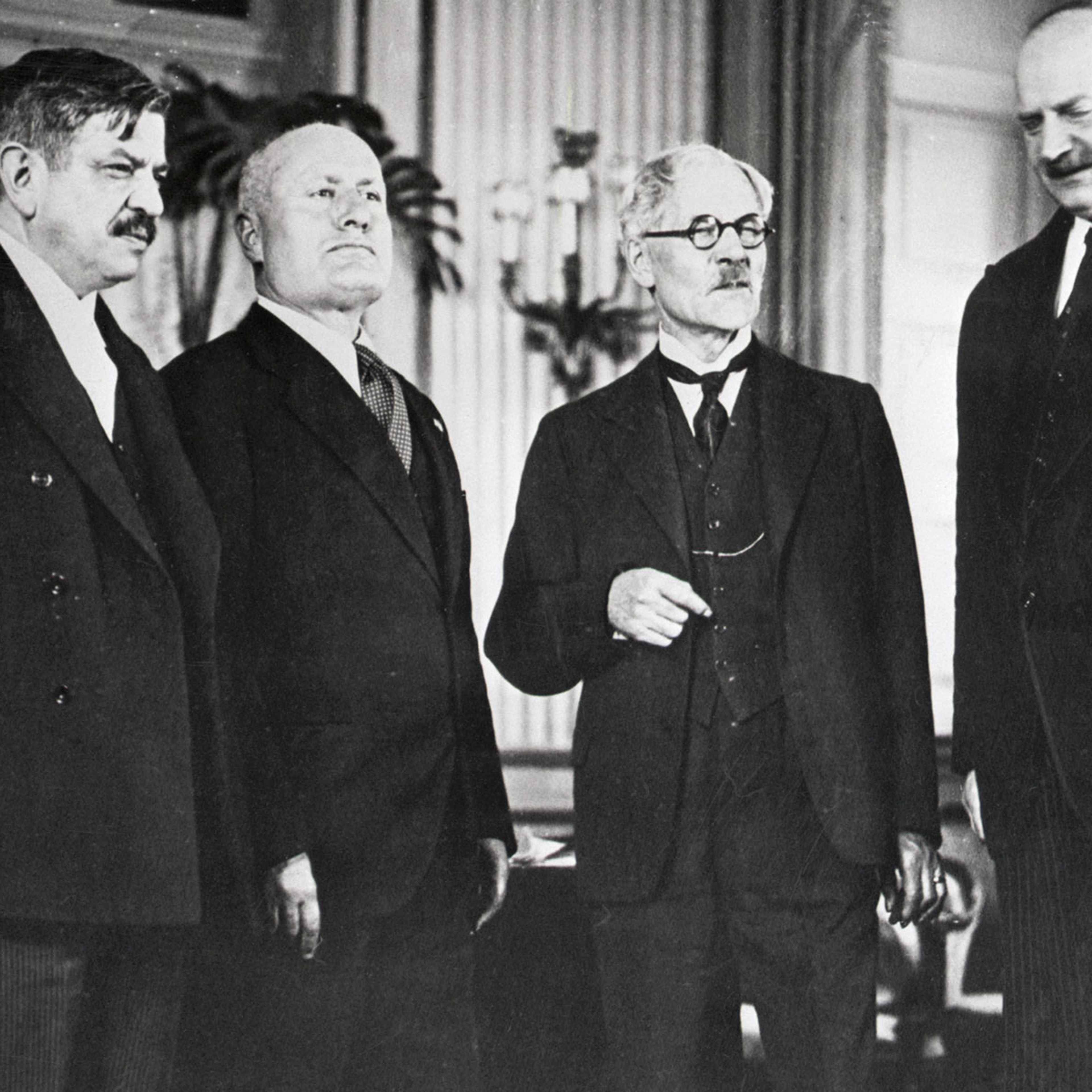
That was Hitler’s appraisal of the leaders of Britain and France he hosted in the Bavarian capital in 1938. British Prime Minister Neville Chamberlain had requested the meeting “to find a peaceful solution” to growing tension over Nazi Germany’s grievances and demands.
The outcome: an attempt to appease Hitler through the betrayal of Czechoslovakia. “Britain and France had to choose between war and dishonor,” Winston Churchill remarked at the time. “They chose dishonor. They will have war.”
In 1972, Munich again was linked to appeasement: Palestinian terrorists massacred 11 Israeli Olympic athletes. The group responsible was guided by Palestine Liberation Organization Chairman Yasser Arafat. Nevertheless, Arafat received more encouragement than condemnation: He was invited to address the U.N. where “the question of Palestine” rose to the top of the agenda; it has remained there ever since with no resolution in sight.
Against this backdrop, last weekend I attended the 43rd annual Munich Conference on Security Policy, a gathering of the international political elite: presidents and prime ministers, defense and foreign secretaries, ambassadors, scholars, and journalists from more than 40 countries.
The conference was opened by German Chancellor Angela Merkel. She surveyed a minefield of world crises but proposed little in the way of strategies to resolve them, other than “Peace through Dialogue” — the conference’s slogan prominently displayed in German and English behind her on the stage.
Senator Joseph Lieberman asked Merkel if there was not a “global moral responsibility to stop the genocide” of black Muslims in Sudan. She agreed there was, but added that before action could be contemplated “the African Union has to make clear what it thinks.”
Russia’s Vladimir Putin was the next world leader to take the microphone. He launched into a venomous attack on America, charging that because of Washington “nobody feels secure anymore because nobody can hide behind international law,”
The possibility that international law is not meant to conceal despots was not raised with him. However, Rep. Jane Harman did ask Putin to explain why he was selling nuclear technology and sophisticated surface-to-air missile systems to the regime in Tehran. “We don’t want Iran to feel cornered in a hostile region,” the Russian president said dismissively.
Only seven weeks into his new job, Secretary of Defense Robert Gates decided not to respond to Putin in kind. Instead, he remarked that the former KGB officer’s words “almost filled me with nostalgia for a less complex time. Almost. … One Cold War was quite enough.”
Finally, there was Ali Larijani, the secretary of Iran’s Supreme National Security Council, playing the role of the indignant revolutionary deigning to address the benighted emissaries of a dying order. “What is important,” he sternly instructed, “is that the world undergoes fundamental changes.”
Cunningly, he appealed for multicultural tolerance: “In the West you have adopted secularism as the basis of democracy. Our democracy is based on Islamic thoughts.” Assuming the mantle of victim, he complained that “in the West, the defamation of the Prophet of Islam is being supported.”
As for Iran’s nuclear program, he insisted it is intended only to generate electricity. “We have no intention of aggression against any country,’’ he said, sounding offended by the very thought. He added that, on the contrary, “We are a victim of terrorism.” At whose hands, he did not specify.
Larijani sternly set down the rules for those wishing to question him: He was not to be asked about “suspension of uranium enrichment, the Holocaust or Israel.”
Perhaps the sharpest rejoinder came from Sen. Lindsey Graham. “It must have been difficult for you to say what you said,” he told the Iranian official. “Because it was difficult for me to listen.”
Graham observed: “No one who denies the Holocaust can be trusted with nuclear materials.” And he advised Larijani to “Go visit Dachau,” the Nazi concentration camp preserved as a memorial in Munich’s bucolic suburbs; an unintended consequence of the policy of appeasement.
In contrast with Graham and other members of the American delegation — which included also Senators John McCain and Jon Kyl — few European leaders seemed distressed by Larijani. If anything, they congratulated themselves for having invited him to Munich to begin a process of “peace though dialogue.”
As for what Larijani and his fellow Islamist revolutionaries think of their European hosts, one can only surmise. But I suspect it is not too far from the Führer’s appraisal of those he humiliated in Munich nearly 70 years ago.
– Clifford D. May, a former New York Times foreign correspondent, is the president of the Foundation for Defense of Democracies, a policy institute focusing on terrorism.





Comments