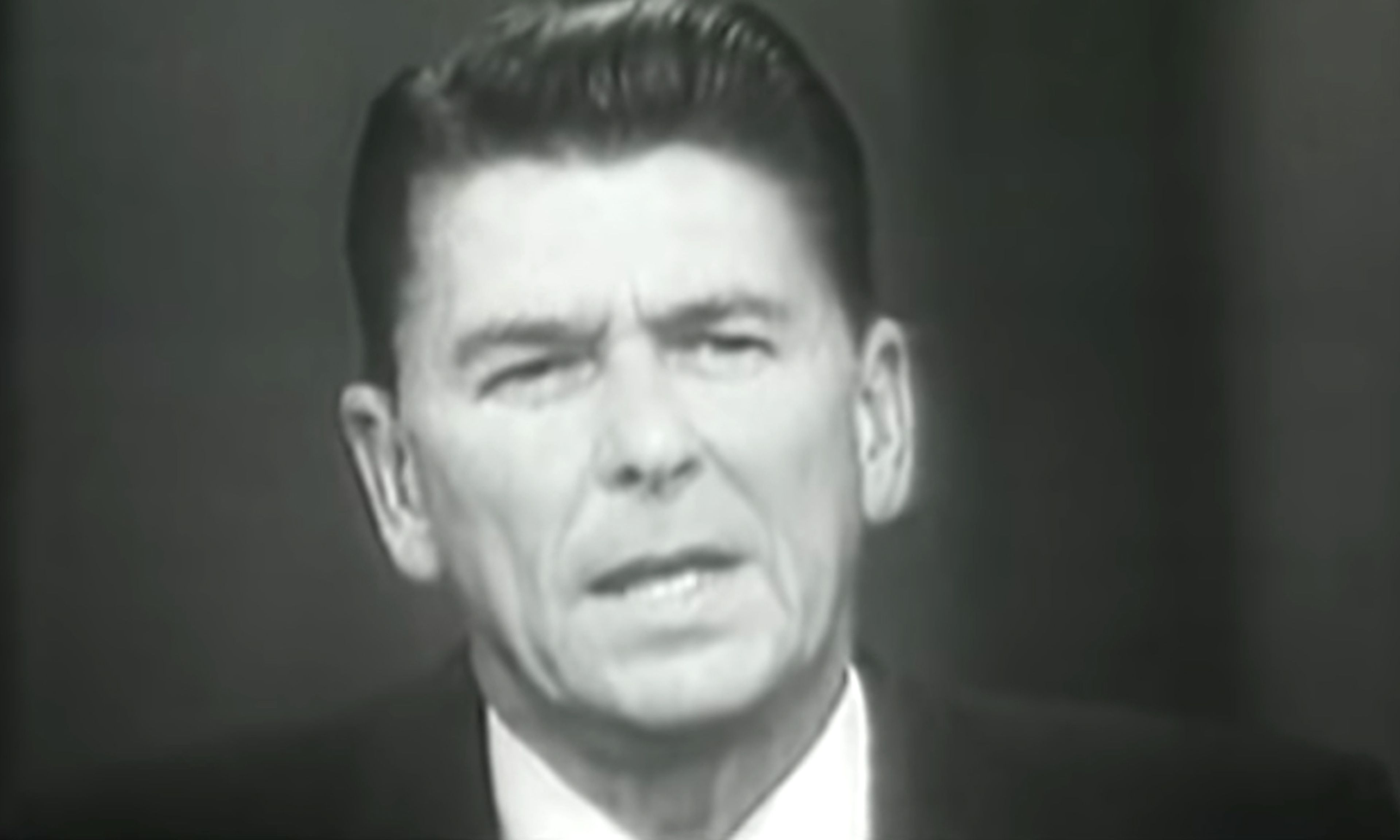
A week before Jimmy Carter was inaugurated in 1977, I picked my way gingerly across an ice-glazed central Washington to the Mayflower Hotel to attend an ISI dinner at which former candidate Ronald Reagan was to address about 300 conservative scholars. Reagan had narrowly lost the GOP nomination five months before. The smart money, I was told, believed that the former California governor in his mid-60s would now retire honorably and leave the field to a younger generation of conservatives.
Two hours later, 300 people were giving Reagan a standing ovation after a speech in which he had called for a “New Republican Party” that would bring together economic conservatives and working-class Democrats who were conservative on the social issues (chiefly crime, abortion, busing, and quotas). At a string of late-night parties in the Mayflower’s corridors the scholars, getting less scholarly by the minute, were shouting that the “Old Man” was running again. And Reagan’s second, successful bid for the presidency had been launched.
As a visiting British journalist I was thrilled to be present at this historic moment. But when I reviewed the papers and Sunday talk shows for their assessment of Reagan’s return, I could find almost no mention of it. With the exception of a short but characteristically shrewd article from Lou Cannon in the Washington Post, it had been a non-event. Except for the gallant 300, everyone was discussing the incoming Carter administration, who was In, who Out, and what would be the “theme” of Jimmy’s inaugural.
This near-obsession was not confined to the Beltway. For the following three weeks I crisscrossed America as a guest of the United States Industrial Council lecturing on the “British Disease.” Almost everywhere I went, there was enthusiasm even among conservatives for Governor Carter. He was seen as likely to bring a provincial American’s virtue to the corrupt capital. It was whispered that he insisted on democratically carrying his own luggage. And after the inauguration, when he disdained the usual limousine and walked down Washington’s streets to the White House waving to the crowd, the media went into ecstasies over his egalitarian simplicity.
All that seems funny in retrospect because the Carter administration turned into the biggest shipwreck since the Titanic. Carter himself proved no more virtuous than Ford or most other presidents (and considerably more small-minded than some of them). And the failures of the Carter years provided Reagan with the opportunity to win over the working-class Democrats who were conservative on social issues.
To be sure, Reagan had in readiness a well-crafted strategy to appeal to these new conservatives. But would that strategy have won the election and changed history if Carter had been a roaring success? Probably not. Much of the breathless flattery that is today directed towards the incoming Obama administration will seem equally absurd once the new president has left office. Even though the election of the first black president is genuinely more “historic” than Carter’s new southern Democracy, the zeitgeist in the media and the Beltway has been so adulatory towards Obama that he is bound to fall short of its audacious hopes. He seems well aware of this himself and will probably move soon to dampen these expectations. But because we cannot know the precise failures of an Obama administration in advance, we can only dimly envisage his future vulnerabilities and how the GOP might exploit them. Any future Reagan must plan in the dark.
The first step for the GOP is to be impressed but not over-impressed by Obama’s election. All parties claim their every victory as the “most important election of our lifetime,” a historic realignment, an irreversible shift of power, etc., etc. Some in the media are even more goggle-eyed with less professional excuse. The New York Times regularly hails Democratic victories as harbingers of Utopia and Republican ones as, at best, necessary pauses for breath on the march there. It memorably dismissed Reagan’s 1984 landslide as an expression of affection for the president entirely lacking in political significance. That kind of thing gives post-partisanship a bad name. Skeptics would do well instead to imitate the cool distance of Hilaire Belloc, who commented on his party’s landslide victory in the 1906 British general election:
The accursed power which stands on Privilege
(And goes with Women, and Champagne, and Bridge)
Broke — and Democracy resumed her reign
(Which goes with Bridge, and Women, and Champagne).
In reality Obama’s victory fell short of historic. Its margin was small; it did not suggest wholesale defections from the GOP; and there was no single great issue that determined victory and that might therefore have presaged a realignment.
Consider, first, the margin. Obama won 53 percent of the popular vote to McCain’s 46 percent. This was a substantial victory but well short of a landslide for the Democrat. McCain’s percentage is a marked improvement on the 41 percent achieved by Senator Dole twelve years ago. And this relatively modest defeat for the Republicans came after a series of political failures, in the middle of a financial crisis, in the face of unprecedented media bias, against an unusually attractive and polished Democrat, when all measures of public opinion showed a growing disquiet about the nation’s direction, following an erratic campaign by a Republican who was heartily disliked by his party’s conservative base. It might have been much worse.
Look, second, at the components of the defeat. There were some interesting trends, such as a large swing of the very rich to the Democrats. In the main, however, this was an across-the-board shift to the left in almost every group, whether defined by income, ethnicity, class, education, ideology, whatever.
Odd though it may sound, there is comfort in this. It suggests that the GOP’s defeat was not the result of driving away particular electoral groups on specific issues. The party was suffering a general unpopularity arising from policy errors as different as monetary policy and immigration.
True, black Americans voted for Obama almost unanimously, but that was a personal achievement. It is unlikely to be readily transferable to a later candidate. Obama’s election over time may even loosen the Democrats’ grip on (typically) 85 percent of the black vote by assuring black Americans they are fully integrated into U.S. society and can thus afford to follow their divergent interests rather than seeking power through solidarity as a quasi-independent bloc. It is a paradox of politics that an excluded group, once accepted into the national “majority,” often rewards its political patron by defecting to the party of the majority. That may finally happen to black Americans 150 years after the Civil War.
But Hispanics neither swung to the GOP because John McCain pandered desperately to them on immigration, as some Republican strategists had hoped, nor deserted the party because its congressional representatives had sunk the two amnesty bills in 2006 and 2007, as the media constantly predicted. Instead, by giving the GOP 31 percent of their national vote — not out of the ordinary, in a losing year for Republicans — Hispanics confirmed their status as a 2–1 split vote for the Democrats. In future they will shift leftwards if more poor Mexicans enter the U.S., thus increasing the pool of welfare-minded voters, or rightwards if fewer do so, thus strengthening the incentives for assimilation.
The lesson for the GOP, however, is encouraging. Though all voters will take time to forget their recent disappointing record, Republicans can reasonably hope to win back most of those they have lost this year as memories fade and fresher Democratic failures replace them.
This relative stability is linked with the third issue — namely, the fact that there was no great issue dividing the parties and determining the election. Instead, the parties differed on what seem quite small and technical details in tax, health care, spending programs, and (by Election Day) Iraq and Afghanistan. Oddities there certainly were: Obama won more voters in favor of tax cuts largely because McCain gave the impression of not really believing in his own tax policy. Both candidates endorsed an “amnesty bill” policy towards immigration in opposition to the voters; so they quarreled over trivialities and kept immigration out of the campaign. The financial crisis was probably the key issue pushing the election towards Obama, but that was because he seemed the calmer of the two in handling it. Both of them supported the policy of bailing out Wall Street. And so on. Realignments and major historical shifts are almost always linked to massive single issues such as slavery that divide parties, destroy some, and force whole regions or blocs of voters to switch parties and even to create new ones altogether. Nothing like that happened in 2008.
If Obama’s victory was not necessarily “historic,” it should not be written off. Victories give politicians the levers of power and so the possibility of moving societies in new directions. But societies have minds of their own and often resist or even move in the opposite direction. Such clashes are rarely predictable in advance. A look at three 20th-century elections will demonstrate:
In 1932, FDR won a landslide because the Depression made voters desperate for change. As Amity Shlaes has shown in her history of the period, Roosevelt initially continued Hoover’s policy more than he changed it. But because he was a first-class personality, he initially invested some of the same policies with a sense of adventure, possibility, and success. Obama certainly has the capacity to do that. But though Roosevelt was later able to exploit the divisions of a society in which most blue-collar workers had little savings to introduce Social Security, Obama would find the same kind of trick far harder in an America with 401(k)s and a large investor class. Universal health insurance would be his best bet here, because that is the main locus of middle-class insecurity. But it would be a high-stakes game with no assured outcome. Even FDR was losing popularity until the threat of war rescued him. But he had established a new Democratic supremacy in politics.
In 1964, LBJ won a landslide of Reaganite proportions and seemed to have killed off the nascent conservative rebellion in the form of the Goldwater campaign. In retrospect that victory was the last triumph of the Roosevelt coalition. Goldwaterism was one sign — a misleadingly negative one — of the rising discontents that undermined and divided the FDR coalition and that soon became the Sixties revolution. In his superb book on the consequences of the Kennedy assassination, James Piereson has outlined how liberals embraced a pessimistic and punitive form of cultural politics, formerly held mainly by radical leftists, in response to the assassination. With liberals becoming radicals, the field was open for conservatives and the GOP to win over culturally conservative Democratic blue-collar workers. Two years later the Democrats lost heavily in the off-year elections. Two years after that, LBJ withdrew from the Democratic primaries rather than face defeat. Later that year Nixon won narrowly in a close three-way race (that included the Dixiecrat George Wallace). But no side seemed able to win outright. And the Sixties revolution and counterrevolution continued their winding struggle until Carter’s 1976 victory.
That election was a narrow victory for Carter. But it was hailed as the restoration of Democratic supremacy. And, more significantly, it was seen by many in the Carter administration as the first opportunity for the new, radical, post-FDR Democratic party to implement its radical vision. It was against that background that Reagan delivered his speech to the ISI dinner and, a few weeks later, a more substantial version of the same argument to the annual CPAC conference.
In that second speech the Gipper cited the following opinion-poll results as evidence for his belief in a New Republican Party: “A Harris poll released September 7, 1975, showed 18 percent identifying themselves as liberal and 31 percent as conservative, with 41 percent as middle of the road; a few months later, on January 5, 1976, by a 43–19 plurality, those polled by Harris said they would ‘prefer to see the country move in a more conservative direction than a liberal one.’”
As it happens, the exit polls taken at the 2008 election show a surprisingly similar breakdown of the electorate. Voters who described themselves as liberals came to 22 percent of the electorate, moderates to 44 percent, and conservatives to 34 percent. The social composition of those voters is naturally somewhat different than in 1975; blue-collar workers are more likely to be conservative and the rich are more likely to be liberal. In 2008, there was a 17-point shift of voters earning more than $200,000 annually into the Democratic column. Reagan’s success in creating a New Republican Party produced new social tensions that, over time, were bound to create new political loyalties. Such shifts are now changing both the social and the ideological character of both parties.
Yet it does not seem that the Reagan coalition is gradually breaking down, as the FDR coalition finally had by 1980. The exit-poll figures above suggest that Reaganism is resilient. Reagan’s 1977 analysis of the political character of the struggle still rings true: “A majority [is] trying to assert its rights against the tyranny of powerful academics, fashionable left-revolutionaries, some economic illiterates who happen to hold elective office, and the social engineers who dominate the dialogue and set the format in political and social affairs. If there is any ideological fanaticism in American political life, it is to be found among the enemies of freedom on the left or right.”
And the broad political success that Obama needs to kill off the Reagan coalition and substitute his own may yet elude him as it eluded Carter but favored Reagan.
One day the Reagan coalition will be replaced by something else from either left or right. As Margaret Thatcher reminded us in her final Tory conference speech, “There are no final victories in politics.” But there are no certain defeats either — until they happen. At present the GOP still has more than a fighting chance to remain America’s natural governing party.
Of course, that means it will have to fight.





Comments