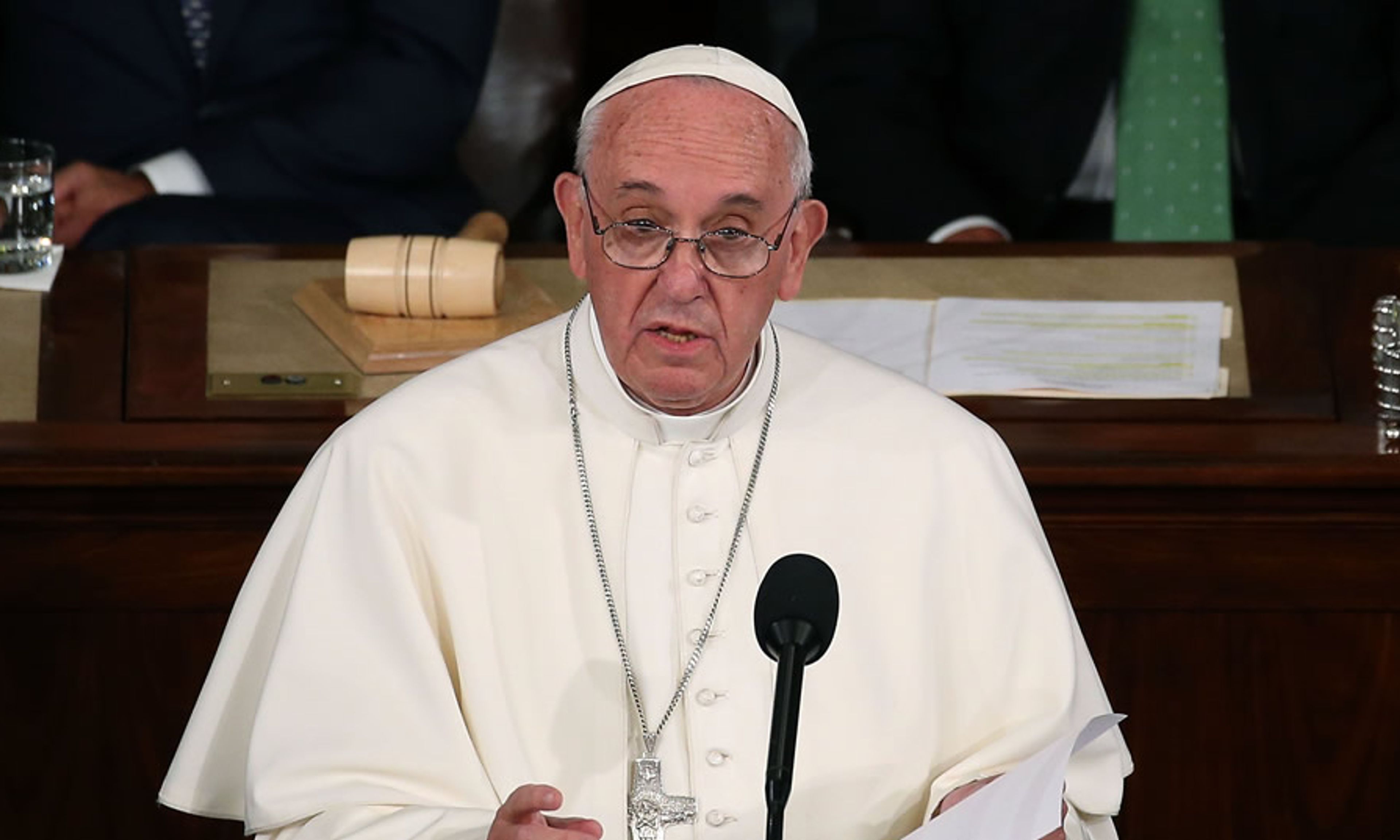
We agreed with the “God bless America” part.
Pope Francis has his politics, and they are, broadly speaking, not our politics. This isn’t to say that we disagree with his principles or his goals, which are, in the main, shared by all people of good will: less poverty and better care for the poor, more opportunity, good stewardship of the environment, peace that is more than the mere absence of war. But that isn’t really politics; politics is the fight over how we get from here to there.
The pope’s remarks as delivered today to Congress were marginally less hostile to capitalism than one might have expected: There was praise for the power of enterprise, and a line about making politics “a slave to the economy and finance” was omitted. That the pope chooses to be strident on some issues (the environment and, of all things, the arms trade) and more oblique about others (marriage) is of some interest: He pronounced himself enthusiastically in favor of abolishing the death penalty but talked around abortion, even though the Church takes an absolute position on the latter but not the former, and even though many of those professing Catholic Democrats in his audience had just expended some considerable effort to prevent the passage of modest abortion regulations less restrictive than those of France or Sweden. The pope is on his way to Philadelphia to attend the World Meeting of Families, so perhaps these issues will find their way to a higher place on his agenda at that time.
#share#Some of the pope’s critics say, in effect, “What do you expect from a left-wing Jesuit from Argentina?” That reduction strikes us as overly simplistic. The pope certainly stumbles over his own biases and intellectual shortcomings, but he is not making the case for a Marxist utopia. Rather, he is attempting to incorporate some of the difficult facts of 21st-century life into a humane, Catholic model of community. As the pope noted, the past few decades have seen radical reductions in the proportion of the world’s people living in extreme poverty as (he did not quite put it this way) the benefits of capitalism have been permitted to spread to China, India, and other parts of the developing world by the implementation of limited but significant economic reforms. But even the most dedicated of free-marketeers can appreciate that there are those who have been partly or entirely bypassed by spreading prosperity, that economies are touched by political corruption, and that there are many millions still who are sentenced at birth to privation and misery through no fault of their own.
#related#Where Pope Francis and many of those who share his tendencies go wrong is on a question of priority: They simply assume prosperity sufficient to support their redistributionist programs. “Business,” the pope says, “is a noble vocation, directed to producing wealth and improving the world. It can be a fruitful source of prosperity, . . . especially if it sees the creation of jobs as an essential part of its service to the common good.” There is some bad economics in that (jobs are a means, not an end) and some vast understatement: It is not the case that business “can be a fruitful source of prosperity” — it is, in human material experience, practically the only source of prosperity.
‘No one would remember the Good Samaritan if he’d only had good intentions,’ Margaret Thatcher wryly observed. ‘He had money as well.’
And it doesn’t just happen. Rather, there are necessary preconditions without which prosperity cannot emerge: the rule of law, physical security, property rights, the freedom to engage in commerce and trade. The pope is not the first man of his political stripe to implicitly argue that we can put to good use the fruits of capitalism while holding capitalism itself at arm’s length. The pope’s antipathy here is difficult to miss: In an act of sweeping equivocation, he spoke of the need to “combat violence perpetrated in the name of a religion, an ideology, or an economic system,” as though Google executives were posting Internet videos of Bing users being beheaded.
“No one would remember the Good Samaritan if he’d only had good intentions,” Margaret Thatcher wryly observed. “He had money as well.” The United States, the English-speaking countries, Western Europe, and Japan grew wealthy for particular reasons, just as Argentina stagnated for particular reasons. Our great complaint with the Holy Father is that he does not seem to be much interested in what those reasons are.
The pope praised, among others, Catholic Worker activist Dorothy Day, who once was described by a Jesuit writer as “an apostle of pious oversimplification.” There is more than a little of that in Pope Francis, too, on questions of political economy. One expects simplicity from a man who chose the name “Francis” for his papal ministry, but we have in mind the cautionary epigram attributed to Albert Einstein: “Everything should be made as simple as possible, but not simpler.”






Comments