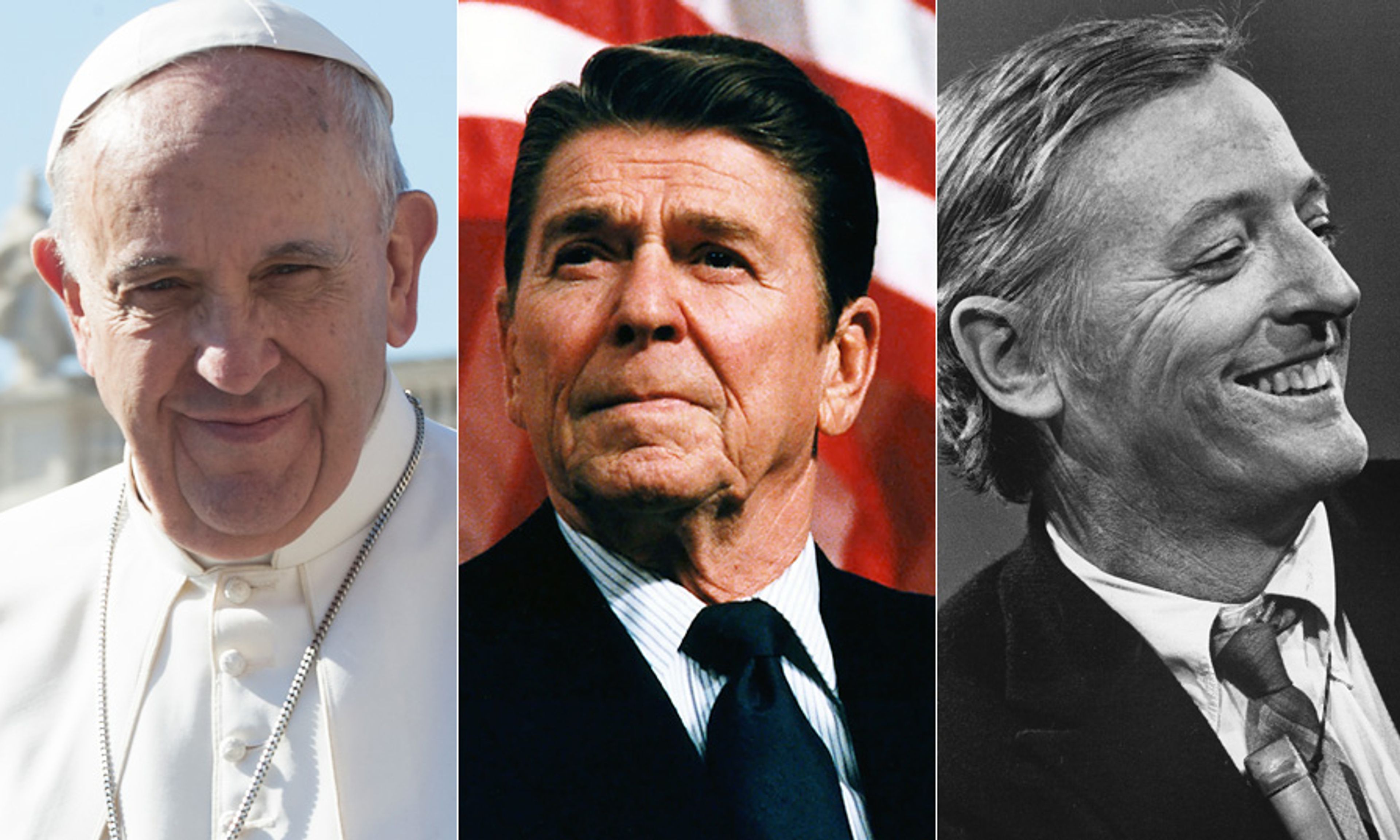
Editor’s note: This is adapted from a speech delivered on April 27 at Arizona Christian University, “A Time for Choosing: How to Be Leaders of America’s Renewal: Fatherly Wisdom from a Potentially Unlikely Trio: Pope Francis, Ronald Reagan, and William F. Buckley Jr.”
A good father — whether in the home or as a voice of moral or temporal authority — tends to tell the truth and do important things to free souls and lives. At a time when we are urgently in need of tender fathers, consider the examples of men who’ve given witness to these things, consider Ronald Reagan, Pope Francis, and William F. Buckley Jr., founder of National Review — three men who probably have never been considered together.
First, President Reagan. His 1964 “Time for Choosing” speech used to be a common staple of any conservative diet — which may seem strange, given that the speech didn’t win the election for Goldwater. But it did however unintentionally, build a national following for Reagan.
He talked in that speech about the dangers of accommodation and appeasement — which have a lot to do with being afraid to call evil by its name. He warned against the spiritual, moral, and economic decay caused by these sins.
He warned against saying to those enslaved behind the Iron Curtain at the time, “Give up your dreams of freedom because to save our own skins, we’re willing to make a deal with your slave masters.” He quoted Alexander Hamilton, who said, “A nation which can prefer disgrace to danger is prepared for a master, and deserves one.”
Unfortunately, these days, while we may want to love freedom, we don’t always know what it is anymore. What you mean by freedom may be different from what I do. Planned Parenthood and other ideological lobbies co-opt such unobjectionable words for rallying to their cause.
Reagan understood the cost of freedom. In his “Time for Choosing” speech, he said,
You and I know and do not believe that life is so dear and peace so sweet as to be purchased at the price of chains and slavery. If nothing in life is worth dying for, when did this begin — just in the face of this enemy? Or should Moses have told the children of Israel to live in slavery under the pharaohs? Should Christ have refused the cross? Should the patriots at Concord Bridge have thrown down their guns and refused to fire the shot heard ‘round the world? The martyrs of history were not fools, and our honored dead who gave their lives to stop the advance of the Nazis didn’t die in vain.
I bring this up not because I’m advocating any war other than the one for good and against evil. We live in a world today where men and women have been asked the question Jesus asked Peter: Do you love me? And they have not denied Him. Some have given their lives for Jesus Christ. Pope Francis has said — and Pew numbers back him up — that there are more martyrs in the world today than in the first days of Christianity. And yet so many of us don’t think we have time to pay attention. We look away and follow more entertaining news stories. My brothers and sisters, these people — the Christian martyrs in our world today — remind us who we are. Pray for them. Advocate their cause. Talk about them.
And, please, whatever you do, do not waste your freedom. Do not fail to stand up for it. Do not become enslaved to any of the idols of our day that can distract our souls to death.
In that speech, Reagan, in a plea for moral responsibility in citizenship, said:
You and I have the courage to say to our enemies, “There is a price we will not pay.” “There is a point beyond which they must not advance.” And this — this is the meaning in the phrase of Barry Goldwater’s “peace through strength.” Winston Churchill said, “The destiny of man is not measured by material computations. When great forces are on the move in the world, we learn we’re spirits — not animals.”
And he said, “There’s something going on in time and space, and beyond time and space, which, whether we like it or not, spells duty.”
Does that resonate with you today, on a lot of fronts?
Reagan went on to say, “You and I have a rendezvous with destiny.”
He drove it home with this: “We’ll preserve for our children this, the last best hope of man on earth, or we’ll sentence them to take the last step into a thousand years of darkness.”
There are many challenges today to life, family, the most vulnerable. We must rise to meet them.
Pope Francis has said — and Pew numbers back him up — that there are more martyrs in the world today than in the first days of Christianity.
Reagan also said in that “Time of Choosing” speech something that explains why the Little Sisters of the Poor, an order of Catholic women who serve the elderly poor, now find themselves at the Supreme Court looking for religious-liberty relief from our current White House. He said that “our natural, unalienable rights are now considered to be a dispensation of government and freedom has never been so fragile, so close to slipping from our grasp as it is at this moment.”
Historian Steven Hayward, who has written for National Review frequently over the years said about the “Time for Choosing” speech, “It also provided a template — an understanding of government as ruinously ambitious and out of control, projecting weakness and uncertainty to our enemies abroad — that still defines conservatism today.”
He added that Reagan “would not have been so successful for so long with appeals to emotion alone. ‘A Time for Choosing’ reveals a coherent political philosophy that differed in subtle ways from the main current of conservatism, blended with great skill and art in Reagan’s rhetoric.”
When you look at politics today, do bear in mind that Donald Trump or Bernie Sanders or anyone else on the political scene didn’t start the fire, to borrow a line from Billy Joel. And I think we’d be wise to study but, again, not make idols of some of our founding fathers — of America and of a conservative movement that formed and inspired some great and even successful leaders.
#share#
You may remember I mentioned the urgent need we have today for tender fathers. And I firmly believe that we have a great one in Pope Francis. You do not have to be Catholic to see a wisdom and humility in his model of leading with mercy. So many of his words and gestures are invitational. He wants to re-propose the Gospel to people who often have no idea what Christianity has to offer them about what is true and good and beautiful.
He gives so many examples — examples that frequently do not make the New York Times.
This spring, for example, he spoke to teenagers who were on pilgrimage to Rome. There are these beautiful pictures of him hearing confessions in St. Peter’s Square. There’s such joy on his face and such peace on the face of many of the teenagers.
Actually, as a journalist, I always hesitate to use a picture of people praying and receiving sacraments. These are such intimate things. But sometimes our world needs to see these things, which can often be so countercultural and yet speak to some of our deepest needs.
On that Saturday, with the teens in front of him, Pope Francis said:
Dear young friends, what an enormous responsibility the Lord gives us today! He tells us that the world will recognize the disciples of Jesus by the way they love one another. Love, in other words, is the Christian’s identity card, the only valid “document” identifying us as Christians. It is the only valid document. If this card expires and is not constantly renewed, we stop being witnesses of the Master. So I ask you: Do you wish to say yes to Jesus’ invitation to be his disciples? Do you wish to be his faithful friends? The true friends of Jesus stand out essentially by the genuine love; not some “pie in the sky” love; no, it is a genuine love that shines forth in their way of life. Love is always shown in real actions. Those who are not real and genuine and who speak of love are like characters is a soap opera, some fake love story. Do you want to experience his love? Do you want this love: yes or no? Let us learn from him, for his words are a school of life, a school where we learn to love. This is a task which we must engage in every day: to learn how to love.
Not to divert things, but there’s this song that I keep hearing in airports and hotel restaurants and taxis. The refrain goes: I love you like a love song, baby. I love you like a love song, baby. That seems to unintentionally speak to exactly what Pope Francis is talking about. You’ve heard a few songs that pass for love songs in American culture. That’s not love. It reminds me of a synthesizer-laced 80s pop song from Howard Jones. He sang: What is love anyway? Does anybody love anybody anyway?
That’s the kind of question Pope Francis asks near daily. He gives morning homilies that are published on news.va, a Vatican website, available in English translation before most Americans are awake. And they are constantly challenging Christians to be Christian. He talks about the dangers of lukewarm Christianity. We cannot be museum pieces, he says. We cannot pretend the Bible is an artifact.
We cannot, as my friend Harvard Law professor and former ambassador to the Vatican Mary Ann Glendon, puts it, be chameleon and turtle Christians. These descriptions all too often fit American Christians. We either blend in with the culture or hide, hoping our differences won’t become an issue. But we need to be all-in as Christians, so chameleon or turtle Christianity is not authentic. And the world needs us. Our country needs us. Your community needs you. Your family needs you. Everyone you encounter needs you to abide by your principles — to know who you are and be true to your professed identity as a Christian.
The last father I want to talk about is William F. Buckley Jr., a founding father of conservatism, who started National Review magazine in 1955. During an anniversary speech in 1985 he talked about an early conversation with his friend, former Communist Whittaker Chambers. He said:
A year before National Review was founded, I spent an evening with Whittaker Chambers, and he asked me, half provocatively, half seriously, what exactly it was that my prospective journal would seek to save. I trotted out a few platitudes, of the sort one might expect from a 27-year-old fogy, about the virtues of a free society. He wrestled with me by obtruding the dark historicism for which he became renowned. Don’t you see, he said, the West is doomed, so that any effort to save it is correspondingly doomed to failure? I drop this ink stain on the bridal whiteness of this fleeted evening only to acknowledge soberly that we are still a long way from establishing, for sure, that Whittaker Chambers was wrong. But that night, challenged by his pessimism, I said to him that if it were so that Providence had rung up our license on liberty, stamping it as expired, the Republic deserved a journal that would argue the historical and moral case that we ought to have survived: that, weighing the alternative, the culture of liberty deserves to survive.
Surely you would agree with this today. I don’t know what is to come for America and Western Civilization and all the rest but I do know that we are a people of hope with great gifts that we’re called to be good stewards of. That’s what Bill Buckley did. He saw the great gifts God had given him. He saw the tremendous wealth God had given America. And he sought to educate and protect. He did it because he was inspired. He did it because it was his love and his duty. He did it with all those who suffer, who do not have it as good as we do — for whom speaking or writing one’s mind is a courageous act.
Everyone you encounter needs you to abide by your principles — to know who you are and be true to your professed identity as a Christian.
I want to share with you some words from him about America. In a 1979 speech on “What Americanism Seeks to Be,” Buckley credited the Constitution — and in particular the Bill of Rights — with “majesty” for prohibiting government from infringing on human dignity and flourishing. But it wasn’t merely some grand idea, some clever strategy, some brilliant ideology. “It grew out of a long, empirical journey,” he reflected, “the eternal spark of which, of course, traces to Bethlehem, to that star that magnified man beyond any power of the emperors and gold seekers and legions of soldiers and slaves: a star that implanted in each one of us that essence that separates us from the beasts, and tells us that we were made in the image of God and were meant to be free.”
So there you have it: A founding father of conservatism traces everything we value back to Bethlehem, back to our Creator, to Whom we owe all thanks. If our work — whatever it is — doesn’t start with gratitude, we’re going to be disappointed with the results. This is important to remember in politics and in everything else.
And relatedly, I think if we begin with gratitude we’re going to see our politics and culture and very lives change. There’s a light that radiates from a grateful person that is a great gift to the people you encounter. A grateful person tends to make situations better, tends to inspire, tends to — pun intended — lighten the mood and burdens, even as at important work.
I think right now about a priest from Iraq who was recently in the U.S. His name is Father Douglas Bazi. I met him a few weeks ago and despite having been tortured by Islamic territories and seen his people forced into exile, he overflows with gratitude, including for Americans. And you couldn’t blame him if he held a little bitterness toward us! But no, he is a holy man and tender father who says thank you instead — for what you can do now to help his people, for the truth you can speak, for the prayers you can offer.
What all these fathers have in common are an appreciation that the world is bigger than them and to fail to be good stewards of the gifts we have been given is what gets us — and the world — into all kinds of trouble. Celebrating Fathers’ Day should be about more than ties and Hallmark cards. Along with the applause, download the wisdom of age and experience and witness. We need it.
— Kathryn Jean Lopez is a senior fellow at the National Review Institute and an editor-at-large of National Review Online. She is co-author of the updated How to Defend the Faith without Raising Your Voice.





Comments