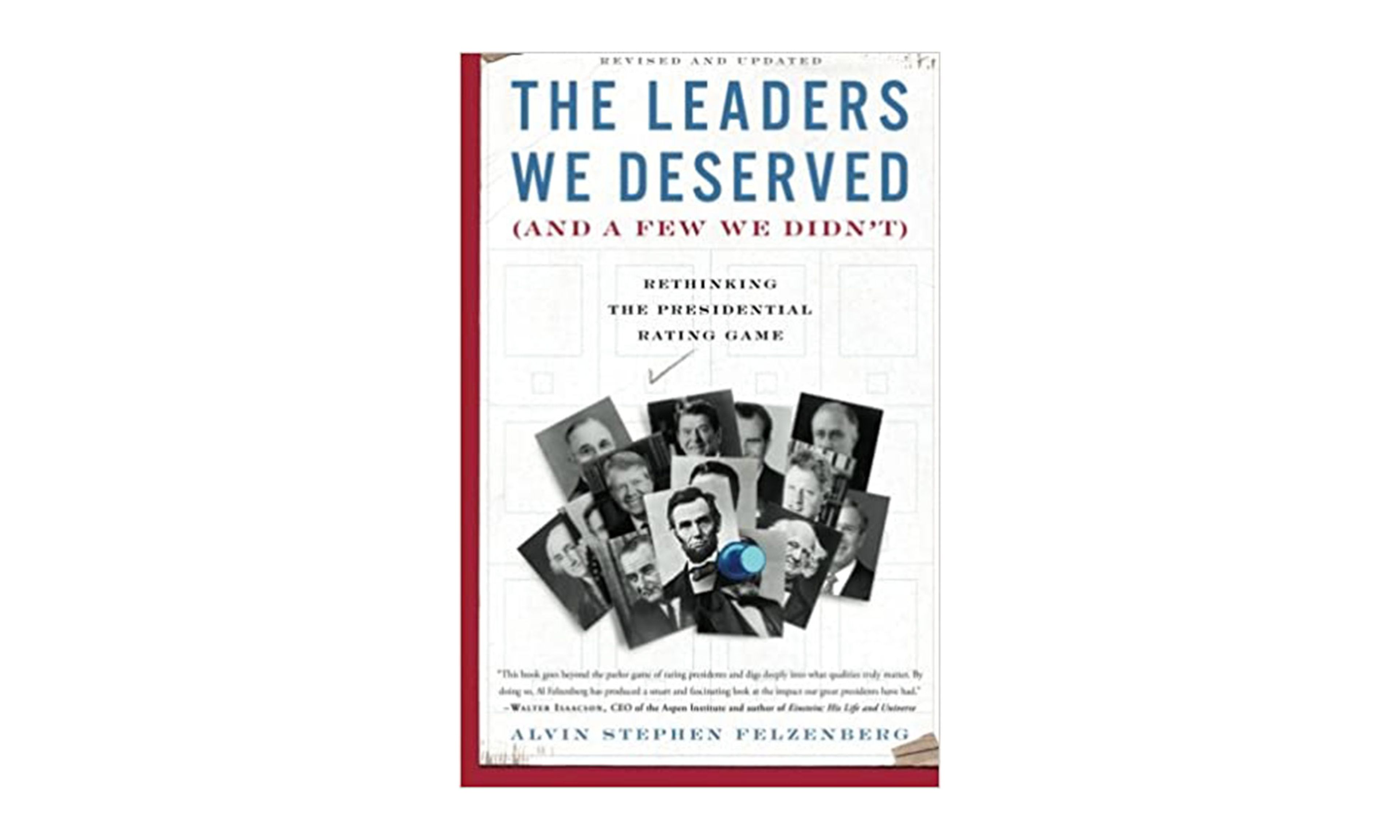
A veteran of two Republican presidential administrations, Alvin Felzenberg offers a novel rating system for the U.S. presidents. It differs from those produced by such scholars as Arthur Schlesinger Jr. in both its methodology and its results.
Methodologically, the ratings are based not on a survey of academics, but rather on the application of six criteria. Each president receives a grade (one to five) for three personal qualities (character, vision, and competence) and three areas of policy output (economic policy, “preserving and extending liberty,” and foreign policy). These grades are averaged to produce a president’s score.
Felzenberg’s results are frequently surprising: Eisenhower, Reagan, and even Ulysses S. Grant find themselves in the top ten. FDR has fallen out of the top five, Thomas Jefferson has dropped to the middle of the pack, and Andrew Jackson now sits in the bottom third. These twists — combined with Felzenberg’s lively prose and his incisive narrative of many administrations — make the book an interesting read. His contrarian interpretation of Grant’s presidency is particularly welcome, as is his defense of Reagan.
Nevertheless, the work suffers from several deficiencies. Felzenberg is to be credited with wanting to apply rigorous criteria as an alternative to polling (typically liberal) scholars; unfortunately, his methodology is not up to the task.
There are three salient problems.
First, the criteria themselves are problematic. Felzenberg posits these six standards and assumes that we will agree that they are self-evident. Upon first glance, they appear to be, but on closer inspection maybe they aren’t.
As I mentioned above, three of the criteria hinge on personal qualities and three on policy outputs. Higher scores for the personal qualities should make a president more successful; thus, higher personal scores should yield higher policy scores. This appears to be the case with vision and competence: An analysis of each president’s scores indicates that these personal scores are closely related to output scores. So, for instance, a president with a high vision score is more likely to receive a high score on preserving and extending liberty.
However, the scores on “character” have only a weak relationship with the output scores. The correlation between character and economics is only 25 percent, between character and preserving and extending liberty 48 percent, and between character and foreign policy a measly 10 percent. In other words, character seems not to matter much when it comes to performance. Felzenberg says that character “can be a precursor” to presidential greatness, but the results leave one wondering if this is really the case.
While the other personal qualities show a stronger relationship with policy outputs, even here there are some peculiar exceptions. For instance, only three presidents receive a perfect score for preserving and extending liberty: Lincoln, Grant, and Lyndon Johnson. Lincoln and Grant both receive a perfect vision score — but Johnson receives a three out of five. This is strange, as Felzenberg defines preserving and extending liberty in terms similar to those of his definition of vision: Preserving and extending liberty is the “principal mission of the country,” and vision has to do with the “purpose of America.” This definitional closeness makes one wonder how LBJ can do so well on one and so poorly on the other.
There are other oddities of this sort. Thomas Jefferson, author of the Declaration of Independence, receives a four out of five on vision (the same score as Zachary Taylor). This points to the second major problem with the methodology: It requires judgment calls that stretch far beyond the reach of the data. Granted, we can detect differences between Herbert Hoover and Abraham Lincoln; but Felzenberg claims to find much smaller differences. For instance, he gives James Monroe a vision score of four, while George H. W. Bush rates merely a two. It is difficult to believe that the data allow for this kind of fine-grained distinction. Yet it is these seemingly minute differentiations that produce much of the final results.
The third problem with the system is that no criterion captures the effect a president can have on the institution itself. Presidents make and remake the office, and in this way can influence the country beyond their policy achievements. But Felzenberg has no category to account for this — and this, too, occasionally produces strange results. For instance, Thomas Jefferson, a paradigm-shifting president who helped transform the office, receives the same final score as James Monroe, who was working within the Jeffersonian framework.
This problem is most pronounced with Jackson. We can, of course, criticize Jackson when it comes to the wisdom of his bank policy, or the morality of his Indian policy, but there is no doubt that Old Hickory helped make the presidency what it is today. Indeed, Lincoln drew upon Jackson’s stand against Nullification to defend the Union. Felzenberg faults previous historians for overestimating Jackson. He may be correct — but, by excluding a category to account for the institutional changes that leaders like Jackson helped create, Felzenberg has ended up underestimating him.
More broadly, Felzenberg’s omission of any institutional variable means that his ratings retain the strange “apples to oranges” quality that prior ratings have had. How, for instance, can Bill Clinton be judged in relation to Chester Arthur? The presidency in 1881 was a very different institution than it was in 1993. How can we profitably compare its occupants across time? Felzenberg, like previous raters before him, does not give a satisfactory answer to this important question.
Given that one of Felzenberg’s professed purposes is to cleanse the presidential-ratings game of past liberal biases, the following must be mentioned. Being a Republican is positively associated with a higher score along all six criteria. Being a Democrat is negatively associated along all six criteria. That is, in the aggregate, Felzenberg’s analysis slightly but consistently tilts toward the GOP. This analysis jibes with several noteworthy results: There is no Democratic president in the top five. FDR, the highest-rated Democrat, sits in the seventh position, sandwiched between Eisenhower and Taylor. The Jacksonian Democrats — for whom Felzenberg has barely a kind word — never break the bottom half; all but one (Polk) are in the bottom third. If conservatives have been rightly unhappy with the results of surveys like Schlesinger’s, liberals might have reason to be unhappy with Felzenberg’s conclusions.
Nevertheless, Felzenberg is to be credited with bringing to the presidential-ratings game a quality that had been sorely lacking: an opportunity to debate. Though I disagree with Felzenberg’s methodology and many of his conclusions, it must be noted that he — unlike others — has offered a thorough explanation of his reasoning. Previous ratings typically relied upon a poll of “the experts.” This made them seem less like the initiation of a public discussion and more like the final word from the Ivory Tower. Felzenberg has offered a correction to that condescending attitude by giving us clear reasons for his ratings. He offers us an opportunity to deliberate, discuss, and ultimately sharpen our views of the presidents. In this regard, he has done us a service. The book can be recommended to those with an interest in this subject — not as the final word, but as the opening argument in a long-overdue debate.






Comments