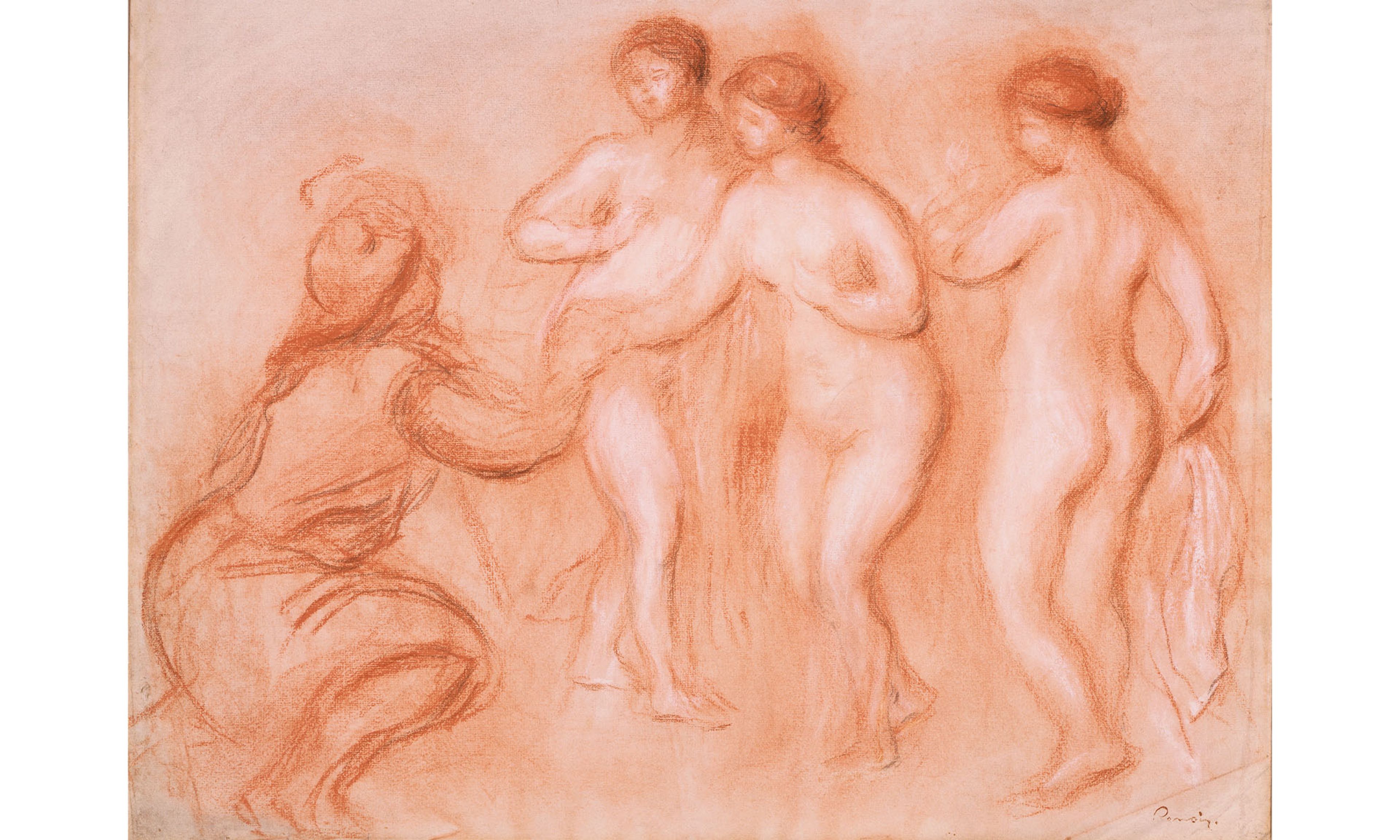
Enough of America’s 250th, for a while at least. I’m writing today about my visit to the Morgan Library, much loved and always worth visiting, since its Renoir Drawings exhibition closes on February 8. The weeks have gotten away from me, as time tends to do, and this exhibition, though a so-so show, has some stellar things to see.
I can’t call Renoir Drawings a dud. On the one hand, it’s the first exhibition dedicated to Renoir’s drawings since 1921. Pierre-Auguste Renoir (1841–1919) is a giant among the renegades, soon called the Impressionists, who convulsed the Paris art world in the 1870s with new ideas on color, subject, brushstroke, and selling art. At the Clark Art Institute, where I was a curator for years, all four of us curators had to know a lot about Renoir, though my field was American art. Renoir is central, specifically Renoir from the late 1870s to, say, 1884. I love his work. The introductory essay of the Morgan catalogue tells us that Renoir was said to have paid so little attention to his drawings that he used them to stoke the fire in his home. Whether his friends and servants attested to this or not, we’re assured it isn’t true. But looking at some of the drawings in the show, I wonder. Renoir Drawings is an overview rather than a deep dive. I left the exhibition and the book thinking that an opportunity might have been missed. There might be not much of a there, there.





Comments