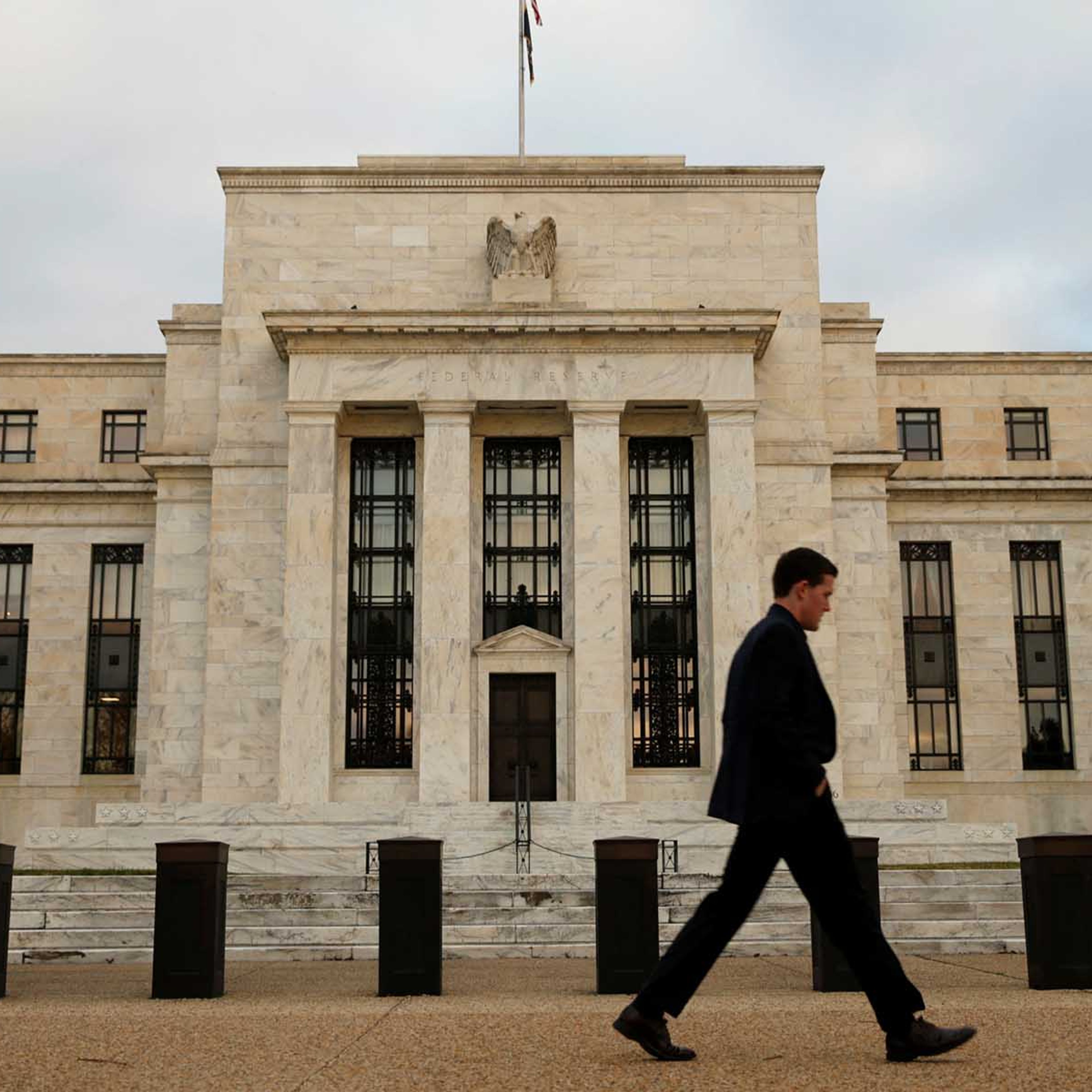
The Federal Reserve is increasingly becoming a costly source of uncertainty for an economy that already has more than enough to worry about. Things get worse every time the Fed opens its collective mouth. That might be why there’s a new seasonal influence in stock prices: Now when the FOMC meets, stocks go into a big correction. (See chart.)
Chairman Ben Bernanke correctly admits that economic prospects are “unusually uncertain.” It has been a year since the U.S. economy bottomed. By this point in every other post-war recovery, real GDP has rebounded to a new all-time high, with the strongest rebounds following the deepest recessions. But not this time: We’ve now experienced both the deepest recession and the weakest recovery in the post-war period.
Meanwhile, the Fed has ventured into terra incognita. The Fed now operates a near $2.4 trillion balance sheet, holding the toxic assets of AIG and Bear Stearns and about 20 percent of the agency mortgage pass-through market — essentially all of this funded with borrowed money. It’s the biggest leveraged hedge fund in history, and it’s being run by a committee of economics professors.
Of the five Fed governors and twelve regional Fed presidents, eleven have PhDs in economics, and nine have taught economics at the college level. If economics is a science, you’d hope all these scientists could agree on the facts, agree on how to proceed, and explain their conclusions clearly to the rest of us. But this is hardly the case. Instead, their bickering and inability to speak with shared conviction is eroding confidence.
Consider the Fed’s core strategy since it lowered the fed funds rate to near-zero in December 2008. Back then, the FOMC announced that the rock-bottom rate would be maintained “for some time,” and it repeated this promise at its next meeting. After that, the language was adjusted to “for an extended period,” where it has held through this month’s meeting.
And why was this language employed? To reduce uncertainty. Bernanke, who got his doctorate at MIT and once chaired the economics department at Princeton, explained it in a November 2002 speech: By assuring the bond market that the funds rate will not unexpectedly be hiked, yields farther out on the Treasury yield curve will come down since long-term yields are, in large part, the sum of expected short-term yields. So certainty and predictability are at the core of this scheme, enabling the Fed to fight deflation by lowering long-term rates even when the short-term rate is stuck at zero.
So now, with the economy weakening, Bernanke wants to strengthen the “extended period” language — and up the ante in the battle against uncertainty — by guaranteeing the “extended period” will last for, say, one year at least. In Senate testimony several weeks ago, this was first among equals on Bernanke’s list of remedies for a faltering economy.
But here’s the problem: Bernanke’s strategy for creating certainty is itself being subjected to uncertainty.
Enter St. Louis Fed president James Bullard, who received a doctorate from Indiana University and taught at Washington University. In a paper released days before the August FOMC meeting, Bullard called the ongoing zero-interest-rate policy a “peril.” In doing so, he argued that a similar Bank of Japan policy was responsible for that country’s lost decade of deflation.
So now we have one economics professor saying an “extended period” of low interest rates is the cure for deflation, while another says the same policy causes deflation.
Who’s right? Well, Bullard’s case is intriguing as an abstraction, but in the real world where the Fed must operate it’s a distraction. When the funds rate was first lowered to zero in December 2008, annual CPI inflation had fallen to exactly zero. It would then go negative — that is, into deflation — for several months. Yet now, after 18 months of a zero funds rate, inflation has risen to 1.3 percent. So if a zero funds rate causes deflation, it’s not in the data.
Nevertheless, Bullard’s theorizing adds critical mass to the views of Thomas Hoenig, president of the Kansas City Fed. Hoenig, who got his PhD at Iowa State and taught at the University of Missouri, has dissented at every FOMC meeting this year, objecting to the “extended period” language. He argues that the promise of a near-zero funds rate will lead to credit distortions such as those that caused the housing bubble.
So here we go again: One PhD claims that assuring the markets of a continued low funds rate will reduce uncertainty and lower long-term rates; another says this policy will cause a credit bubble.
And who’s right? Between 2002 and 2005, the funds rate was demonstrably too low versus the simple “Taylor Rules” that benchmark the funds rate to inflation and growth. So serious market distortions followed, a connection that Hoenig gets right. But today, such rules unambiguously say interest rates should be below zero. So while Hoenig is brave to question the Fed’s past errors and warn against excessive intervention, it is higher rates, not low ones, that would presumably cause the distortions he fears.
Debate about monetary policy is healthy, but this is no time for the Fed to act like a coffee klatch in the faculty lounge. The arguments need to be resolved — correctly, one hopes — since resolution would be an end in itself. It’s the lack of resolution — indeed, the apparent impossibility of reconciling the opposing absolutes offered by seeming experts — that explains why the stock market swoons after every FOMC meeting.
All this suggests a radically simple solution: a policy time-out for one year. In other words, the Fed should commit to leaving the near-zero funds rate and its large balance sheet just as they are. If there’s some kind of dire economic emergency, the Fed can respond. And if the PhDs want to debate, they can hold “office hours,” just like in college.
Businesses, investors, and households already face crippling uncertainty about future tax rates and regulations. Wouldn’t it help if, for just one blessed year, they could at least be certain about the Fed?
– Donald Luskin is chief investment officer of Trend Macrolytics LLC, an independent economics and investment-research firm. He invites you to visit his blog and welcomes your comments at [email protected].


Comments